ISC Class 12 Economics Exam Pattern 2026-27: Marking Scheme, Question Paper Structure & Weightage
ISC Class 12 Economics Exam Pattern 2026-27: The ISC Class 12 Economics Exam Pattern 2026–27 divides 100 marks into an 80-mark external theory paper and a 20-mark internal project evaluation. Conducted over three hours, the paper splits equally between Microeconomics and Macroeconomics across objective, short-answer, and long-answer sections, incorporating diagrams, numericals, and competency-based case studies.
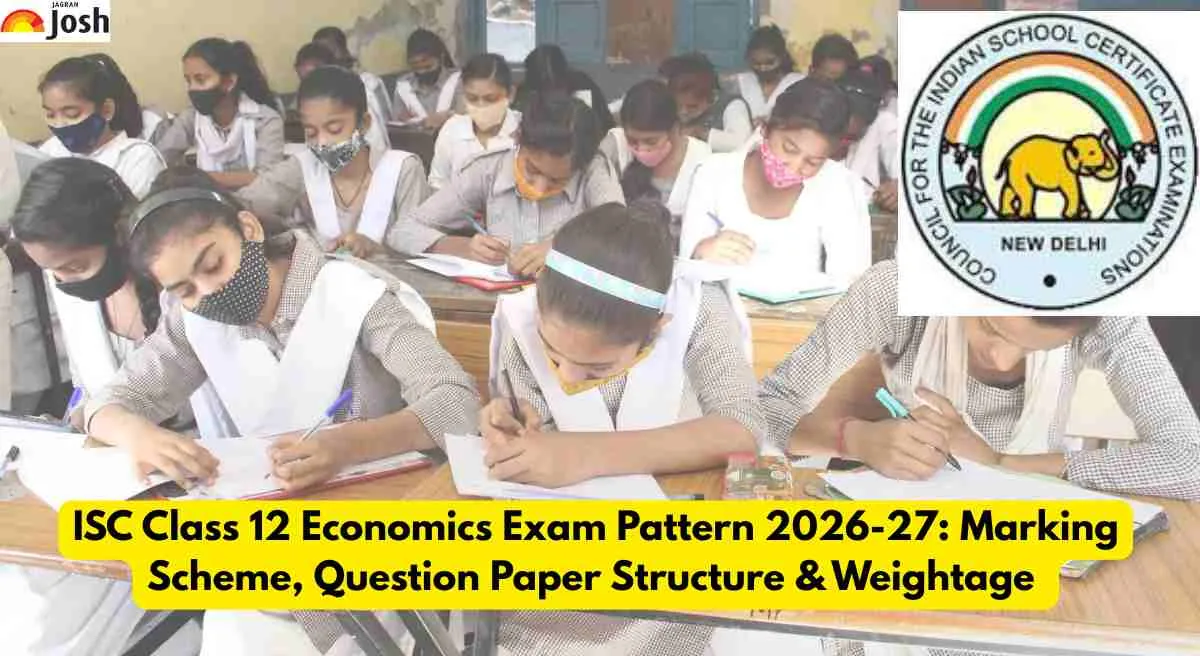
ISC Class 12 Economics Paper Pattern and Marking Scheme 2026-27: The ISC Class 12 Economics Paper Pattern and Marking Scheme 2026-27 is an ideal guideline for candidates to prepare themselves efficiently for the upcoming board examinations conducted by the CISCE in 2027. This pattern consists of an equitable distribution of questions in different types, viz., very short answer questions and objective questions, short answer questions, long answer questions, and competency-based case studies related to practical situations from the Indian economy.
The Economics examination is thoroughly planned for 100 marks following the typical pattern, which is of 80 Marks (Theory) + 20 Marks (Project Work). This examination is held for a period of 3 hours (plus 15 minutes reading time) and is of 80 marks which evaluates the candidate's knowledge in Microeconomic Theory (40 marks) and Macroeconomics (40 marks) through varied types of questions from 1-mark objective questions to 8-mark questions involving graphical diagram drawing, numerical calculations, and analytical description. Hence, candidates need to understand the marking scheme and weightage of each section and unit, especially high-weightage units like Demand, Elasticity & Supply (16 marks) and National Income (12 marks).
Also Read: ICSE Class 10 Commercial Studies Exam Pattern 2026-27
ISC Class 12 Economics Exam Pattern 2026-27: Key Highlights
Below are the key highlights related to the ISC Class 12 Economics Exam Pattern 2026-27:
| Particulars | Details |
| Conducting Body | Council for the Indian School Certificate Examinations (CISCE) |
| Exam Name | ISC Class 12 Economics Exam 2026–27 |
| Class | 12 |
| Academic Year | 2025-26 |
| Subject | Economics |
| Total Marks | 100 Marks |
| External Exam Weightage | 80 Marks |
| Internal Assessment Weightage | 20 Marks |
| Types of Questions | MCQs, Short Answers, and Long Answers (Choice Based) |
| Mode of Exam | Offline (Pen and Paper) |
| Medium of Exam | Hindi, English |
ISC Class 12 Economics Exam Pattern 2026-27
The ISC Class 12 Economics Examination Scheme 2026-27 will give an idea to the students about the weightage of marks between internal and external examinations. This scheme will help the students in preparing well for the examination.
| Subject Name | Percentage Marks - External Exams (%) | Percentage Marks - Internal Exams (%) |
| Economics | 80% | 20% |
ISC Class 12 Unit-wise Weightage of Economics 2026-27
The weightage of different topics in the ISC Class 12 Economics exam, presented in a table format:
| Chapter | Marks |
Microeconomic Theory: | |
| Demand Elasticity of Demand Supply | 16 marks |
| Market Mechanism Concepts of Production Cost and Revenue | 12 marks |
| Main Market Forms and Equilibrium of a firm | 12 marks |
Macroeconomics | |
| Theory of Income and Employment | 8 marks |
| Money and Banking | 8 marks |
| Balance of payments and exchange rate | 6 marks |
| Public Finance | 6 marks |
| National Income | 12 marks |
| Total | 80 |
ISC Class 12 Economics Question Format 2025-26
Following is the tabular presentation of the questions type for the ISC class 12 Economics exam 2026 and their weightage in percentage:
| Sections | Type of Questions | No of Questions | Marks |
| Section-A | Objective/Very Short Answer Questions | 16 of 1 marks each | 16 |
| Section-B | Short Answer Questions | 8 of 4 marks each | 32 |
| Section-C | Long Answer Questions | 4 of 8 marks each | 32 |
Key Preparation Takeaways for 2026–27
Construct Clear and Correctly Labeled Diagrams: In Microeconomics (Elasticity, Cost Curves, Market Equilibrium, Price Ceiling) and Macroeconomics (AD-AS Equilibrium, Foreign Exchange), correctly labeled X and Y-axes and curves contain special step marks.
Learn Step-by-Step Calculations: Learn how to calculate National Income using Value Added, Income, and Expenditure approaches, Price Elasticity of Demand and Supply, and Investment Multiplier calculations, with all formulas being written down for partial step marks.
Time Management Tips: Allocate around 25 minutes for Section A (16 marks), 65 minutes for Section B (eight 4-mark questions with diagrams), and 75 minutes for Section C (four 8-mark questions that include calculations and case studies), reserving 15 minutes for final checking.
ICSE Class 10 Mathematics Syllabus for Board Exam 2026-27, Download PDF Here

Siddhi Sharma is an education journalist at Jagran Josh. A Journalism and Mass Communication graduate from IP University, she brings sharp newsroom instincts developed during her previous stint at Zee News. At Jagran Josh, Siddhi specializes in decoding the educational updates. Her coverage is highly exam-centric, ranging from curated news blogs for competitive exams to crucial school board and university news. Combining her strong media foundations with a research-driven approach, she creates reliable, high-utility content that helps students and aspirants stay ahead of the curve. Her writing is factual, engaging, and tailored to meet the fast-paced needs of modern learners and exam aspirants.