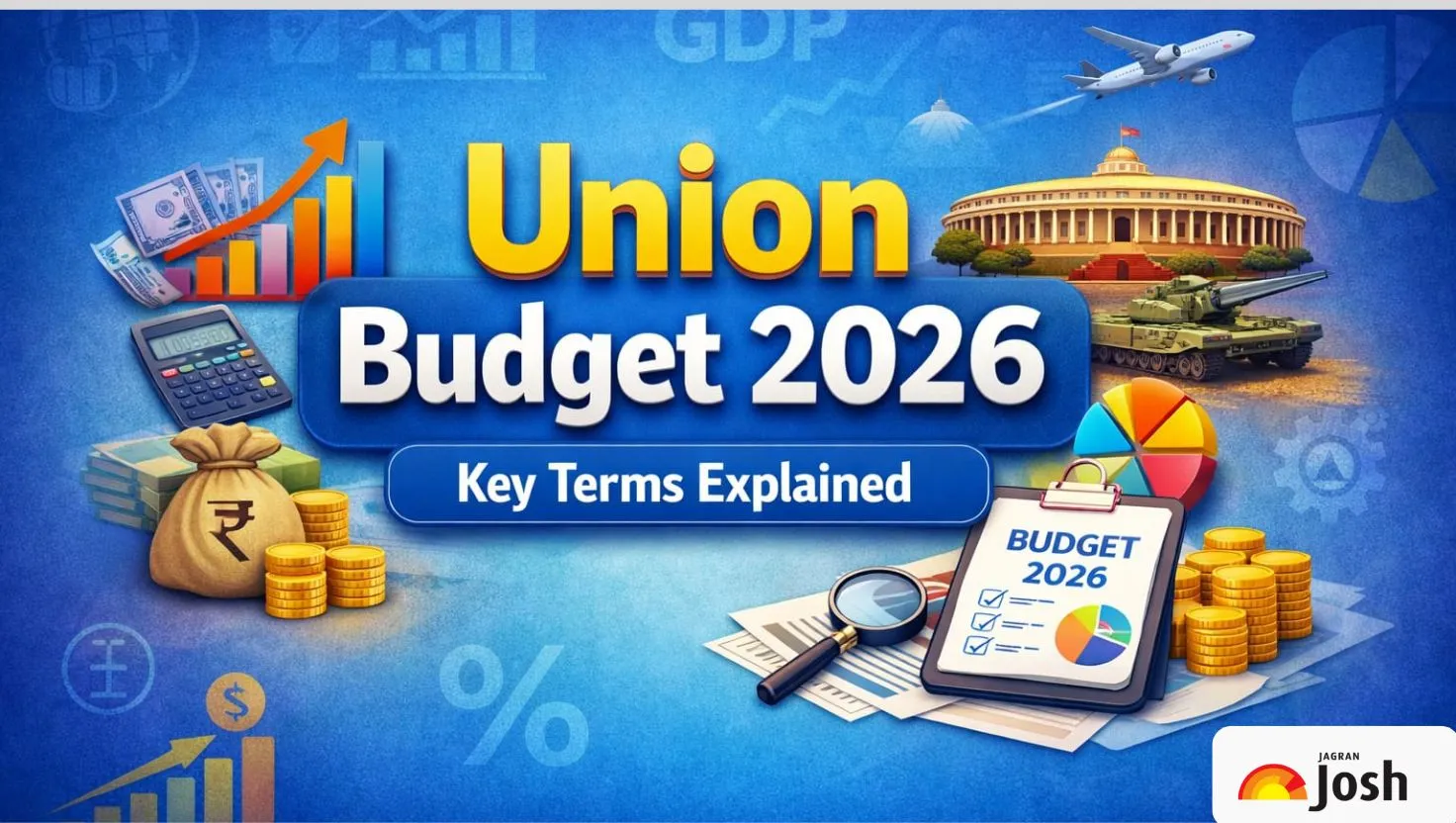
Union Budget 2026 Key Terms Explained: Important Budget Terms & Meanings
Union Budget 2026: The Union Budget of India is one of the most important documents that represents the expenditures and income of the Government of India. To understand the Budget clearly, it is essential to be familiar with the key terms and concepts associated with it. These terms are frequently asked in competitive examinations like UPSC, SSC, Banking, and State PCS.
Key Points
- Union Budget 2026 presented on Feb 1, 2026, outlines income & expenditure.
- Budget includes Revenue & Capital Budgets, detailing receipts & expenditures.
- Fiscal deficit shows government borrowing needs; Revenue deficit impacts debt.
Union Budget 2026: Article 112 of the Indian Constitution talks about the Annual Financial Statement, which is commonly referred to as Budget. The Union Finance Minister presents the budget in the Parliament which provides an account of the government’s income and expenditure. The Budget is presented for the upcoming financial year which starts from 01 April of the current fiscal year and ends on 31 March of the following year. The Union budget 2026 was presented on 01 Februaray 2026 by the Union Finance Minster, Nirmala Sitharaman in the Parliament.
The budget consists of two components: Revenue Budget and Capital Budget.
1. Union Budget
The Union Budget is the commonly used term for the annual financial statement which is mentioned in the Article 112 of the Indian Constitution. The Union Budget outlines estimated revenues and expenditures for a financial year (1 April to 31 March).
2. Revenue Receipts
Revenue receipts are a part of the Revenue Budget which tell about the expenses of the government. The revenue receipts do not account for creation of liabilities and they do not reduce assets as well. Revenue receipts include:
-
Tax Revenue (Income Tax, GST, Customs Duty)
-
Non-Tax Revenue (Dividends, Fees, Interest receipts)
3. Capital Receipts
Capital receipts are a part of the Capital Budget which results in either creating liabilities or reducing government assets. For examples:
-
Borrowings by the government from financial institutions, banks, IMF, World Bank, RBI,etc.
-
Disinvestment proceeds by the government
-
Recovery of loans
4. Revenue Expenditure
Revenue expenditure is another component of revenue budget which refers to day-to-day government expenses and it does not result in asset creation. Examples:
-
Salaries to the Union Government employees
-
Subsidies
-
Interest payments on loans and borrowings
5. Capital Expenditure
Another component of the Capital Budget is the Capital expenditure which helps in long-term growth. The capital expenditure helps in the creation of assets which accelerates the economic growth Examples:
-
Infrastructure projects such as Sagarmala project, Bharatmala project
-
Railway expansion
-
Defense equipment purchase
6. Fiscal Deficit
Fiscal deficit is the difference between total expenditure and total receipts (excluding borrowings). It clearly shows how much the government requires to borrow to fulfil its targets.
Watch this Video to Understand the Union Budget
FD = Total Expenditure - Total Receipts (excluding borrowings)
7. Revenue Deficit
Revenue deficit occurs when revenue expenditure exceeds revenue receipts. This means that the government is borrowing to fund its day-to-day administration. The impacts of revenue deficit are:
-
Increased borrowing by the government leads to increased debt
-
Increased borrowings means more money in circulation which leads to inflation
8. Primary Deficit
Primary deficit is defined as the fiscal deficit minus interest payments on previous borrowings.
9. Gross Domestic Product (GDP)
GDP is the total sum monetary value of goods and services produced in the country during a year.
Fiscal indicators like deficit are often expressed as a percentage of GDP.
10. Budget Estimates (BE)
Budget Estimates are projected figures for the upcoming financial year presented in the Budget.
11. Revised Estimates (RE)
Revised Estimates are updated figures of the current year based on actual performance and revised assumptions.
12. Actuals
Actuals refer to the real figures of receipts and expenditure for a completed financial year.

Upasna is an education journalist and subject matter expert with an extensive background in the competitive exam landscape. Currently contributing to the Exam Prep Section of Jagran Josh, Upasna specializes in creating well-researched, aspirant-centric content and simplifying complex topics for competitive examinations. Her academic expertise, coupled with her own firsthand experience preparing for the UPSC Civil Services Examination, helps her provide strategic preparation insights and a comprehensive perspective to aspirants. She holds a Master's degree in Forensic Chemical Sciences. Apart from delivering valuable exam resources, Upasna is a passionate communications professional who also enjoys reading and writing.