What is a Group of Bats Called?
What is a group of bats called? While scientists recently identified the Himalayan long-tailed Myotis in 2025, curious readers are turning to linguistics to describe these social mammals as a group. Whether they are swirling in caves or migrating across continents, their collective names are as mysterious as their nocturnal habits.

Key Points
- In early 2026, increased bat sightings prompted interest in group names.
- Terms like 'colony,' 'cloud,' and 'cauldron' describe bat groups.
- 2025 studies highlight bats' vital role in forest regeneration.
The night sky has always had secrets, but few are as interesting as seeing thousands of leathery wings against a rising moon. In the first few months of 2026, both city dwellers and wildlife lovers have seen a lot more groups of bats.
This has led many people to ask, "What do you call a group of bats?" This question isn't just for trivia enthusiasts; it's a way to learn about one of the most complex social structures in the animal kingdom.
Bats live very social lives, from the clouds that block out the sun in Texas to the camps that are found in Australian suburbs. The terminology used for the group of bats as mammals reveals the high-energy nature of their existence.
What is a Group of Bats Called?
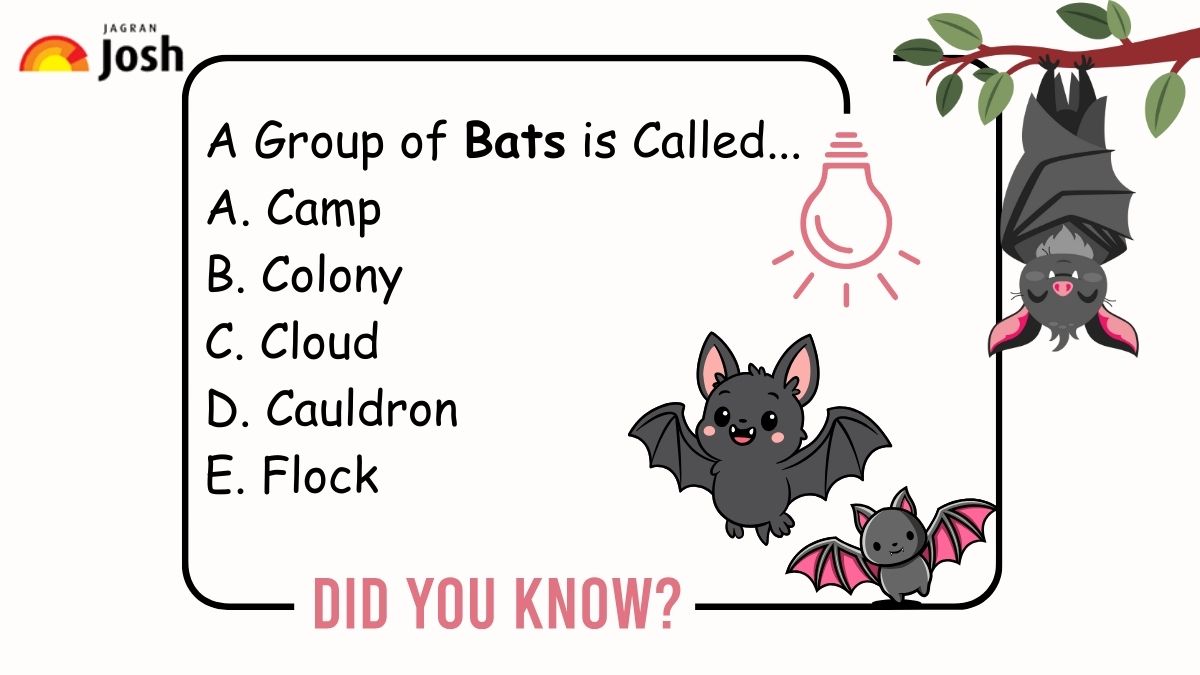
The most common and scientifically accepted term for a flock of bats is a colony. This word means bats that live together in a certain place, like a cave, a hollow tree, or even the rafters of an old building. Because bats are highly social, these colonies can range from a few dozen individuals to millions, as seen in the world-famous Bracken Cave.
However, the name changes based on the setting. If the bats are hanging together in a cluster to stay warm, they are sometimes called a cloud. In the case of fruit bats, which often hang in the open on tree branches, researchers at the Smithsonian Tropical Research Institute frequently use the term camp.
Check Out - What is a Group of Rabbits Called?
Why a Group of Bats is Called a Cauldron
The term cauldron is specifically reserved for a group of bats seen flying together in a swirling, circular motion. This behavior usually occurs at the mouth of a cave as thousands of bats spiral upward to gain altitude before heading out to hunt.
Historical linguistic sources, such as the Oxford English Dictionary, suggest that this term probably comes from how it looks like a bubbling, dark liquid in a boiling pot. It shows the chaotic but coordinated energy of a group of bats.
In 2025, high-speed drone footage of these cauldrons in Texas showed that this spiral flight is actually a complex traffic control system that keeps planes from crashing into each other in the air.
Do You Know - What is a Group of Crows Called?
Interesting Facts about Bats You Should Know
Beyond their unique names, bats are currently at the center of major environmental breakthroughs in 2026. Here are five facts that show why these animals are important to our ecosystem:
1. New Species Discovery
In mid-2025, a team of researchers in the Western Ghats identified a new subspecies of leaf-nosed bat, proving that we are still discovering members of the bat family.
2. Natural Pest Control
A single colony of bats can eat millions of bugs in one night. This saves the world's farmers about $3.7 billion a year on pesticides.
3. Record-Breaking Mammals
Some bats can live for more than 40 years, even though they are small. Scientists are looking at their DNA right now to figure out how they stay so healthy and don't get sick from viruses.
4. Incredible Speed
The Mexican Free-tailed bat is one of the fastest animals on Earth. It can fly straight at speeds of up to 100 miles per hour.
5. Vital Pollinators
Over 500 plant species, including those used for chocolate and bananas, rely on bats for pollination. Without them, our grocery stores would look very different.
Also Read - What is a Group of Ravens Called?
Bats are one of the most important parts of our global ecosystem, no matter what you call them: a colony, a cloud, or a cauldron. Recent studies from 2025 have shown how important these nocturnal mammals are for forest regeneration. Now more than ever, we need to learn about them for the future of our planet.

Harshita Singh is an education and general knowledge journalist with over 5 years of experience in educational writing. Specializing in US affairs and GK, Harshita has a track record of breaking down intricate geopolitical and historical subjects into clear, digestible insights for learners. Her strong background in text analysis, coupled with a Bachelor of Arts (Hons) in English from the University of Delhi, helps her produce authoritative, thoroughly researched content that empowers readers to engage confidently with global current affairs. For inquiries or academic insights, you can reach out to her directly at harshita.singh@jagrannewmedia.com.