Fact Of the Day: Interesting Facts about the Western Ghat
Discover fascinating facts about the Western Ghats—one of the world’s oldest mountain ranges and a UNESCO World Heritage Site. Known for unique biodiversity, rare species, monsoon influence, and ancient ecosystems, this ecological treasure is vital to India’s climate and cultural heritage.
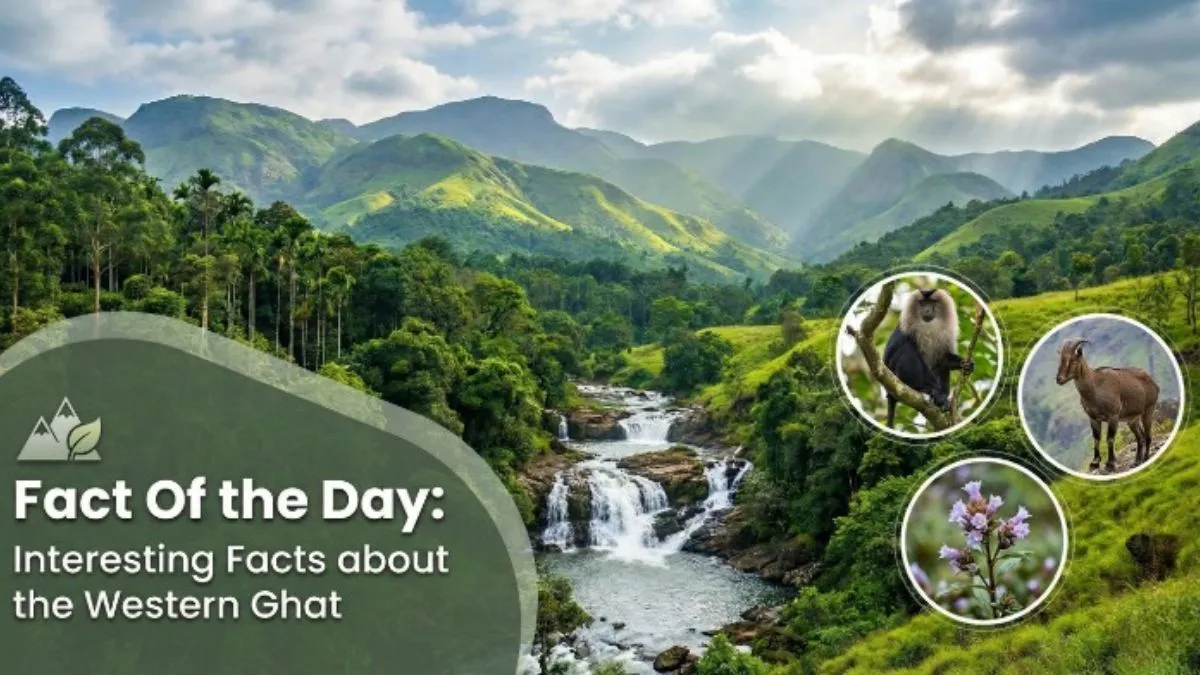
The Western Ghats are much more than just mountains, being the length of the green spine which winds down the western coast of India. They define the climate, contain ancient forests, house endangered wildlife and hold the oldest stories of the earth. This is a natural wonder which is revered all over the world and is considered a treasure house of biodiversity on the planet.

Source: wwf.org.uk
About the Western Ghats
Western Ghats is a 1600km long mountain range that runs parallel to the coast of the Arabian Sea, and is located in Gujarat, Maharashtra, Goa, Karnataka, Kerala and Tamil Nadu. These mountains are over the Himalayas, and occupy almost 140,000 sq km, with unique ecosystems, evergreen forests, shola meadows, river systems, and special habitats which can not be found anywhere on the planet.
Western Ghat is Recognised as a UNESCO World Heritage Site on 2 July 2012. The Western Ghats hold immense geological, cultural, climatic, and ecological value. Their montane forests directly influence the Indian monsoon, making them one of the best examples of tropical weather systems in the world.
Source: UNESCO
10 Interesting Facts About the Western Ghats
1. Older Than the Himalayas
The Western Ghats were formed many millions of years ago, before the birth of the Himalayas. Their primaeval age causes them to be a living museum of geological history, holding the evolutionary records of the time when India broke off Gondwanaland.
2. A Global Biodiversity Hotspot
The Ghats are one of the world’s eight “hottest biodiversity hotspots.” They also harbour major plant and animal species, of which thousands have never been identified anywhere on the planet, which underscores their ecological significance as irreplaceable.
3. Master Controller of the Indian Monsoon
These mountains are critical towards determining the monsoon patterns in India. They play the role of being a huge wall that captures the moisture-filled winds of the Arabian Sea and causes voluminous rains on the western slopes, supporting forests, rivers, farms, and millions of people.
4. Home to Over 325 Globally Threatened Species
The Ghats are home to at least 325 species of critically endangered amphibians, rare trees and mammals covered by the IUCN Red List. This comprises endangered species such as lion-tailed macaque, Nilgiri tahr, and numerous delicate plant species.
5. 54% of Tree Species Are Endemic
Out of approximately 650 species of trees known to be present in the Western Ghats, over 500 are endemic, i.e. occur only in this place. This high degree of endemism demonstrates the irreplaceable nature of such forests.
6. Land of Rare Animals and Iconic Mammals
The Western Ghats are known to harbour high herds of elephants, gaurs, tigers and endangered primates. The mountains have unique species like the Nilgiri langur, lion-tailed Macaque and Nilgiri tahr, and this increases their level of conservation.
7. Extraordinary Amphibian and Reptile Diversity
The Western Ghats are the haven of the herpetologists with approximately 179 species of amphibians (65 endemics) and 157 species of reptiles (62 endemics). Here, new species of frogs are still found nearly every year.
8. Hosts Unique Habitats Found Nowhere Else
The area has been identified as having shola forests, Myristica swamps and mass flowering meadows, which are rare habitats that result from millions of years of climatic and evolutionary impacts. Many of the endemic species depend on these habitats.
9. A Chain of 39 Protected Natural Wonders
UNESCO site has 39 preservation areas in seven clusters. These are the tiger reserves, wildlife sanctuaries and national parks- the ecological fable of the Ghats all in a variant manner.
10. A Living Heritage Sustained by Communities
The eco-development programs and sustainable forest rights at the local level are also important to conservation. Their cultural affiliation and ancient understanding of the area also conserve the weak ecosystems of the Western Ghats.

Conclusion
Western Ghats is a work of natural technologies, ancient, diverse and crucial in terms of climate and biodiversity of India. Their forests, species, and landscapes are sources of an exceptionally rich ecological heritage of the products of millennia-long evolution. They not only need protection to preserve the wildlife but also to maintain the climate, culture and the life of the people in the southern part of India.

Prabhat Mishra is a Subject Matter Expert and digital journalist with an extensive background in the competitive exam landscape and over 4 years of experience in education, national and international news, and current affairs. Over his tenure with top knowledge platforms like Mentorship India, IAS BABA, IAS SARTHI, and now Jagran Josh, he has a deep understanding of government exams like UPSC and State PCS, including UP and Bihar, as he has already qualified for the UPPCS 2022 Mains and Bihar 68th Mains. With his core expertise in history, polity, geography & current affairs, he specialises in creating well-researched, aspirant-centric content and simplifying complex topics for competitive examinations.

-1790774580285_t.webp)
-1790773109683_t.webp)