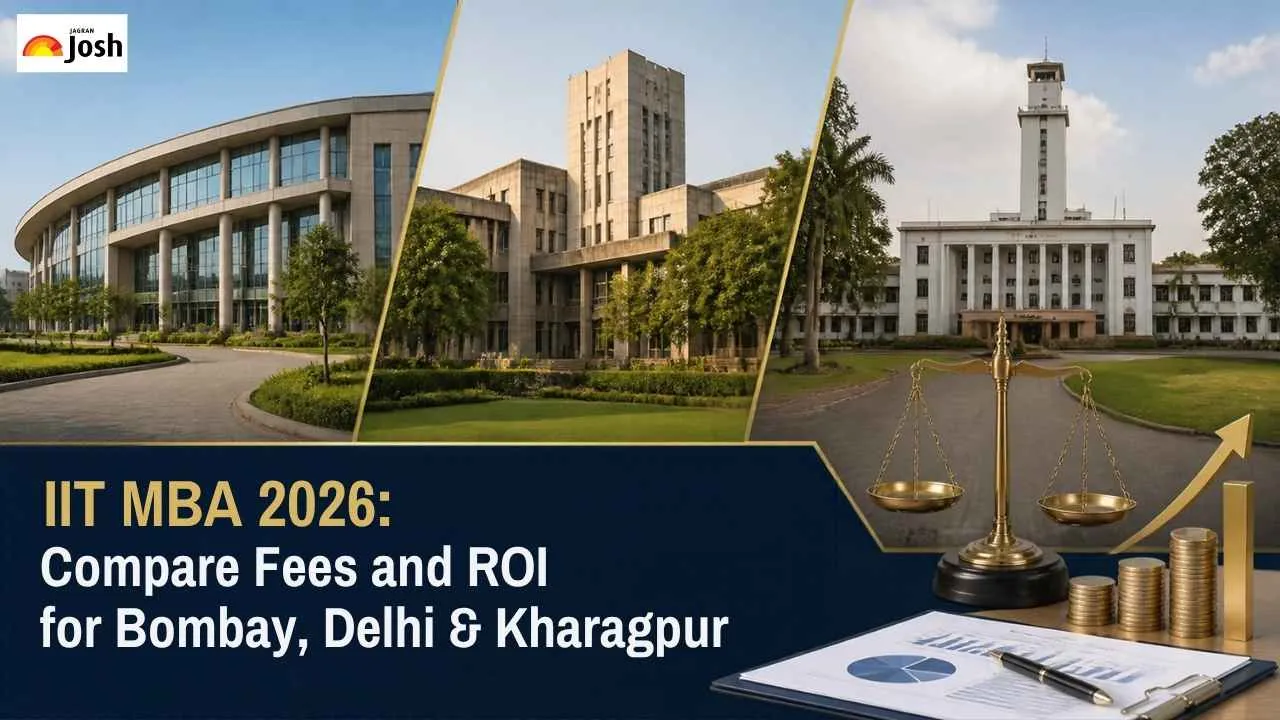
IIT MBA 2026: Compare Fees and ROI for Bombay, Delhi & Kharagpur
This article compares IIT Bombay, IIT Delhi and IIT Kharagpur for MBA programmes, highlighting their fees, NIRF Management Ranking, placements and course details. These IITs have exceptional B-Schools which makes it difficult for students to choose among them. This article brings an overall analysis on these institutes which will help students at the decision making.
IIT MBA 2026: Indian Institutes of Technology (IIT) are recognized as the institutes of national importance (INI). Alongside Engineering IIT Bombay, IIT Delhi & IIT Kharagpur also have one the best B-Schools in India with excellent networking and infrastructure. Common Admission Test (CAT) is the primary entrance exam to be cleared with required cutoff for these institutes. IIT Bombay has an MBA department called Shailesh J. Mehta School of Management (SJMSOM) which is ranked 14th in NIRF Management Ranking whereas IIT Delhi MBA department is called Department of Management Studies (DMS) with NIRF Management Ranking 4 and IIT Kharagpur MBA department is Vinod Gupta School of Management (VGSoM) with NIRF Management Ranking of 12.
The Median CTC for IIT Bombay is INR 25.25 LPA followed by IIT Delhi with median CTC of INR 22.50 LPA and IIT Kharagpur with median CTC of 22.15 LPA. The Return on Investment (ROI) generated by these institutes is exceptional due to moderate fees and better placement as IIT Bombay has ROI of 1.63x and IIT Delhi has ROI of 1.77x and IIT Kharagpur with ROI of 1.74x. Candidates can find comparison between these institutes on the basis of fees, ROI and minimum cutoff percentiles.
To know about your college with the help of your percentile and complete profile you can check out MBA Profilizer.
Check | IIT Bombay MBA 2026: Check Average Package and ROI Details Here
IIT MBA 2026: Overview
IIT Bombay with management ranking 14 requires minimum of 90 percentile whereas IIT Delhi with management ranking requires minimum of 98 percentile in CAT. Candidates can check the detailed list below.
| Parameter | SJMSOM, IIT Bombay | DMS, IIT Delhi | VGSoM, IIT Kharagpur |
| Established Year | 1995 | 1993 | 1993 |
| Flagship Degree | MBA | MBA / MBA (Telecom) | MBA |
| NIRF Management Rank | 14 (2025) | 4 (2025) | 12 (2025) |
| Min. CAT Cutoff (Official) | 90 percentile (75%ile sectionals) | 98 percentile | 90 percentile |
IIT MBA 2026: Placements Comparison
IIT Bombay has recorded the highest CTC of 53.80 LPA with 100% placement consistency whereas IIT Delhi has highest CTC of 40.50 LPA. Candidates can check the detailed list below.
| Metric | SJMSOM, IIT Bombay | DMS, IIT Delhi | VGSoM, IIT Kharagpur |
| Highest CTC | 53.80 LPA | 40.50 LPA | 37.63 LPA |
| Average CTC | 25.82 LPA | 23.40 LPA | 22.75 LPA |
| Median CTC | 25.25 LPA | 22.50 LPA | 22.15 LPA |
| Average Summer Stipend (2-month) | 2.79 Lakhs | 2.63 Lakhs | 1.79 Lakhs |
| Placement Consistency | 100 | 98% - 100% | 100 |
| Top Domain Recruiters | BFSI, FMCG/FMCD, Strategy, IT/Analytics | Strategy & Consulting (~30%), IT, Sales & Marketing | Consulting (up to 45%), Operations/SCM, BFSI |
IIT MBA 2026: ROI
Return on Investment generated by these 3 institutes is above 1.60x due to exceptional placement statistics and moderate fees for MBA Programmes. Candidates can check the detailed list below.
| Institute | Approx. Total Fee (2 Years) | Average CTC | Net Payoff (CTC − Fee) | ROI Ratio (CTC / Fee) | Estimated Payback Period |
| SJMSOM (IIT Bombay) | 17.30 L | 28.16 LPA | +10.86 L | 1.63× | 7.4 months |
| DMS (IIT Delhi) | 12.75 L | 22.53 LPA | +9.78 L | 1.77× | 6.8 months |
| VGSoM (IIT Kharagpur) | 13.04 L | 22.75 LPA | +₹9.71 L | 1.74× | 6.9 months |

Vikrant Kumar is a Senior Executive – Data & Research, specialising in data-driven content analysis and editorial research. He works with large datasets to identify trends, patterns, insights, and emerging developments across key subjects and converts these findings into clear, engaging, and informative content. His role combines data analysis with editorial storytelling, using tools and research methodologies to support fact-based articles, reports, rankings, and analytical content. He focuses on turning complex data into meaningful insights that can strengthen content quality and help readers understand important trends and developments.