Which Island Is Known As the Peacock Island of India?
Do you know which island is the world's smallest inhabited river island? It is located on the Brahmaputra River. This tiny landmass is shaped like a bird's feathers and has a mysterious rocky history. Let's uncover the secrets of Peacock Island.

Key Points
- Umananda Island, in Assam, is known as Peacock Island due to its shape.
- It's the world's smallest inhabited river island, home to the Umananda Temple.
- A Golden Langur lived on the island until its death in 2020.
Did you know that there are over 11,000 named islands scattered across our planet’s oceans and rivers? An island is a piece of land that is completely surrounded by water.
Many places have well-known nicknames, such as the "Emerald Isle" for Ireland and the "Island of the Gods" for Bali.
India has beautiful islands, from the volcanic peaks of the Andamans to the coral reefs of Lakshadweep. However, one particular river island has a very colourful title. Do you know which island is called the Peacock Island of India?
In this article, we will explore this hidden gem, its rich history, and the legends that make it special.
ALSO READ| Which Island is Known as the Pearl of the Orient Seas?
Which Island Is Known As Peacock Island?

The island called Peacock Island is Umananda Island, found in the centre of the Brahmaputra River in Guwahati, Assam.
It got its famous nickname during the British colonial era when a British officer saw that its shape looked like the splayed feathers of a peacock.
Aside from its beauty, it is known worldwide as the smallest inhabited river island. The island hosts the 17th-century Umananda Temple, which is dedicated to Lord Shiva and was built by the Ahom King Gadadhar Singha.
IN CASE YOU MISSED| Which Island Is Known as the Coconut Island?
10+ Lesser-known Facts About Peacock Island
- Assam hosts both the world’s largest (Majuli) and smallest (Umananda) inhabited river islands.
- Unlike the sandy river bars, it is made of ancient gneissic rock, part of the Shillong Plateau.
- The island was the final home to a famous Golden Langur that passed away in 2020.
- Its isolation creates a unique environment for studying species adaptation in a confined riverine space.
- It withstood the 1897 Great Assam Earthquake, though the temple required reconstruction.
- Home to the Urvasikunda, a significant geological water feature on the island.
- Its position in a narrow stretch of the Brahmaputra makes it a key point for studying river flow and current velocity.
- The introduction of non-native species in the 1980s provided a case study for wildlife conservationists.
- Features rare rock-cut sculptures that provide archaeological evidence of early human settlement.
- It remains one of the few places where human activity is strictly regulated by the ferry schedule to preserve the environment.
Why Is It Called Peacock Island?
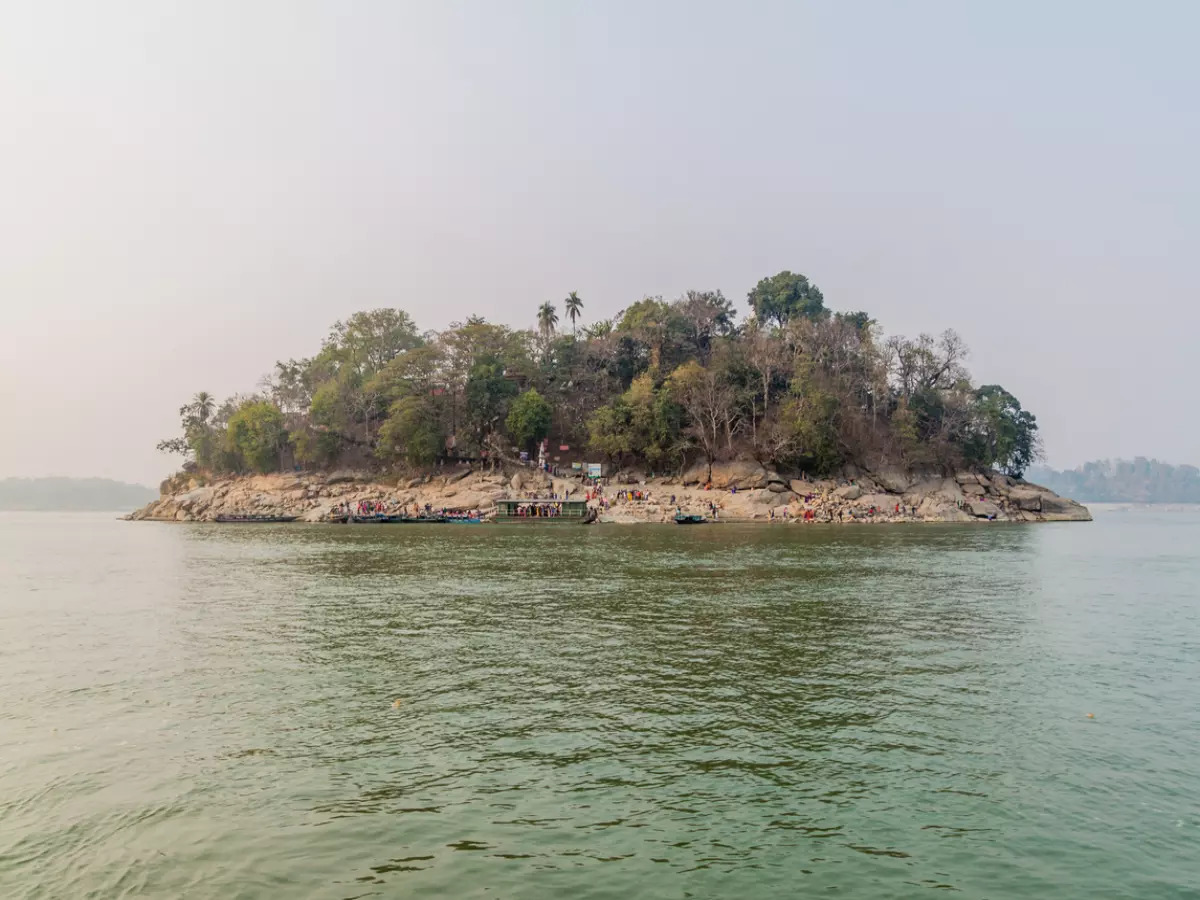
The name "Peacock Island" is a fairly recent nickname that became popular due to a simple visual observation. Here is the explanation for its name:
The British Connection
The name came from British colonial officers during the British Raj. When they first looked at the Brahmaputra River, they saw that the island's shape, with its lush green trees and its particular height, resembled the spread feathers of a peacock when seen from a distance or from the higher riverbanks.
Visual Symbolism
- The Shape. From a specific angle, the narrow part of the island looks like a bird's neck. The wider, forested area resembles the vibrant, rounded tail.
- The Colours. The thick, dark green plants against the blue waters of the Brahmaputra reminded early explorers of the shiny colours seen on a peacock's feathers.
Contrast with the Local Name
While the world knows it as Peacock Island, locals still mainly refer to it as Umananda Island. In the Assamese language and Hindu tradition, the names reflect the island's spiritual roots:
- Umananda: Derived from the words 'Uma', which means 'Goddess Parvati', and 'Ananda', which means 'Happiness/Joy'.
- Bhasmachal: It is also referred to as "Hill of Ashes", which refers to the geological or mythological nature of the rocky outcrop.
WHAT'S NEXT| Which Island is known as the Coral Island of India?
Enter your Blink text here...

Kriti Barua is a skilled digital journalist and communications professional with 4+ years of experience, currently writing for the General Knowledge section at Jagran New Media. She has established herself as a subject matter expert in History, Geography, Trending National and International News, Sports, Science, and Defence, producing clear, reliable, and search-optimised content that connects with readers worldwide.
Kriti holds a BA degree from Delhi University and a one-year diploma in TV Production and Journalism, an academic background that adds research depth and strong storytelling instincts to her writing. Her experience spans brand writing, content marketing, and digital media, giving her a sharp understanding of what makes content both helpful to readers and visible in search.
At Jagran New Media, she applies this expertise to national and international news coverage, query-based articles, and in-depth pieces across her specialist subject areas. Her content is defined by easy language, factual accuracy, strong keyword strategy, and reader-friendly storytelling.