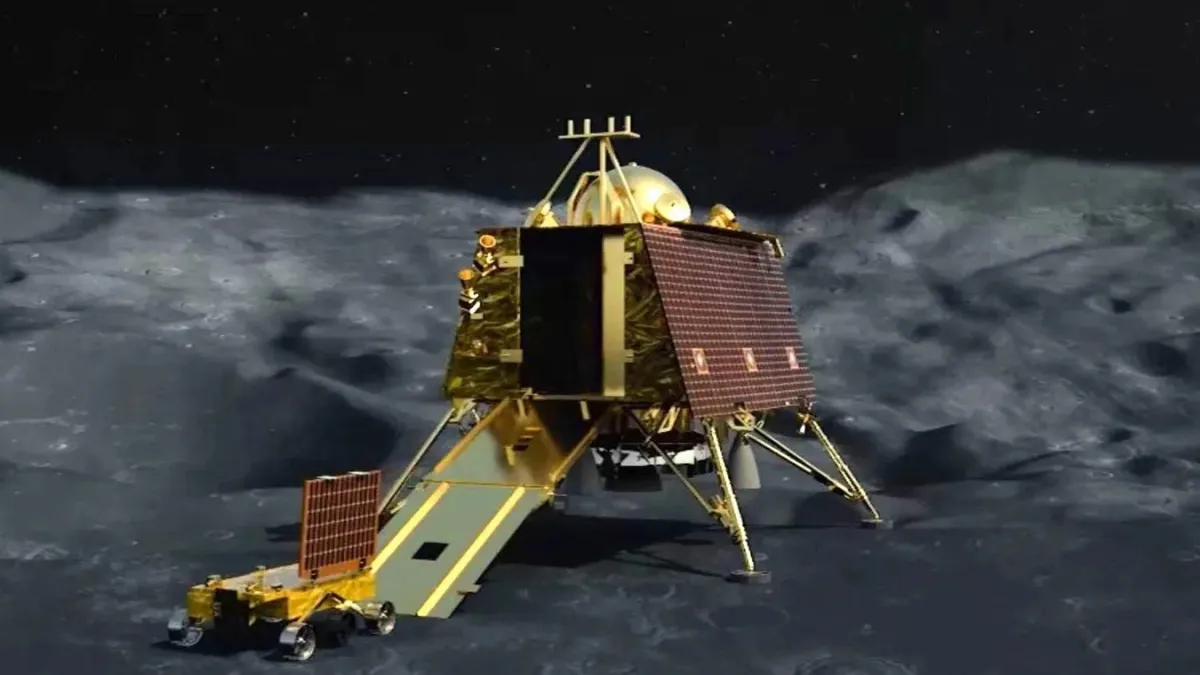
Chandrayaan-3 has revealed that right above the Moon's south pole lies an unexpectedly thick, energetic layer of electrically charged particles. Direct measurements from instruments on the Vikram lander indicate that the nearsurface ionised gas at Shiv Shakti Point is far more energetic than hitherto believed based on remote sensing, with significant implications for polar missions in the future.
Plasma Around the Moon’s South Pole
The Moon does not have a global atmosphere and a global magnetic field like Earth; instead, it is embedded in a plasma sheath created by the solar wind, the radiation of sunlight, and the occasional interaction with Earth's magnetotail. It is bombarded by the stream of solar wind ions and electrons at the dusty surface, where ultraviolet light can knock electrons off from the grains: a tenuous, though very dynamic, plasma layer exists just above the surface.
While this plasma is electrically neutral overall, its charged constituents strongly interact with electromagnetic forces, causing it to behave very differently compared to ordinary gas. Consequentially, it also affects how dust moves, the way the surface charges up, and how signal propagation takes place.
RAMBHA-LP: First Direct Measurements at the South Pole
Central to Chandrayaan-3's revelations is the RAMBHA-LP Langmuir Probe on the Vikram lander at Shiv Shakti Point. Built by the Space Physics Laboratory at VSSC, this instrument is engineered to directly sample the density and temperature of electrons in the near-surface plasma.
By placing a biased probe into the surroundings and mapping current voltage characteristics, RAMBHAlp will be able to determine how many electrons are present and how energetic they are. This will provide, for the first time, in situ data from the lunar south polar surface rather than sole reliance on remote radio-occultation methods.
Key Scientific Findings: Dense and Energetic Plasma
The electron density measured by the Langmuir Probe was approximately 380 to 600 particles per cubic centimeter just above the surface, compared with the very much lower orbit-based radio measurements. Electron kinetic temperatures were around 3,000 to 8,000 Kelvin, which shows that electrons in such a near-vacuum environment are highly energetic.
These results imply that the near-surface plasma in the southern high latitudes of the Moon is thicker and more energetic than expected, signifying the development of stronger interactions among the solar radiation, the solar wind, and the regolith. Such conditions are capable of driving pronounced surface charging, especially in shadowed areas and around equipment, and may cause electrostatic dust lofting.
Variations depending on Solar Wind and Earth's Magnetotail
The data returned by Chandrayaan-3 demonstrate that this plasma is not stationary; it changes with the Moon's orbit around Earth as it moves between full exposure to the Sun and the shielding by Earth's magnetotail. During times when the south-polar region is sunward facing, direct solar wind input increases the density and energy of the charged particles.
As the Moon moves into the magnetotail, streams of terrestrial particles interact with the surface, changing the plasma layer's composition and behavior. The measurements also suggest a contribution from molecular ions, including species such as carbon dioxide and water vapor, hinting at a more complex ionospheric chemistry than previously thought for the polar environment.
Implication for Future Lunar Exploration
These measurements form the necessary baseline data for missions that will be conducted in the years ahead at the south pole, both crewed bases and long-term robotic landers. These dense, energetic plasmas can interfere with radio communications, radar performance, surface charging of landers and rovers, and even the behavior of fine lunar dust around critical hardware.
This electrically active environment is also useful for the design of better shielding, grounding, and communication systems for polar operations. Scientifically, in-situ data from Chandrayaan-3 increases global knowledge of the plasma and ionospheric processes at the Moon by orders of magnitude and underlines India's important role in the contemporary science of the Moon.



-1765541294650.jpg)

Comments
All Comments (0)
Join the conversation