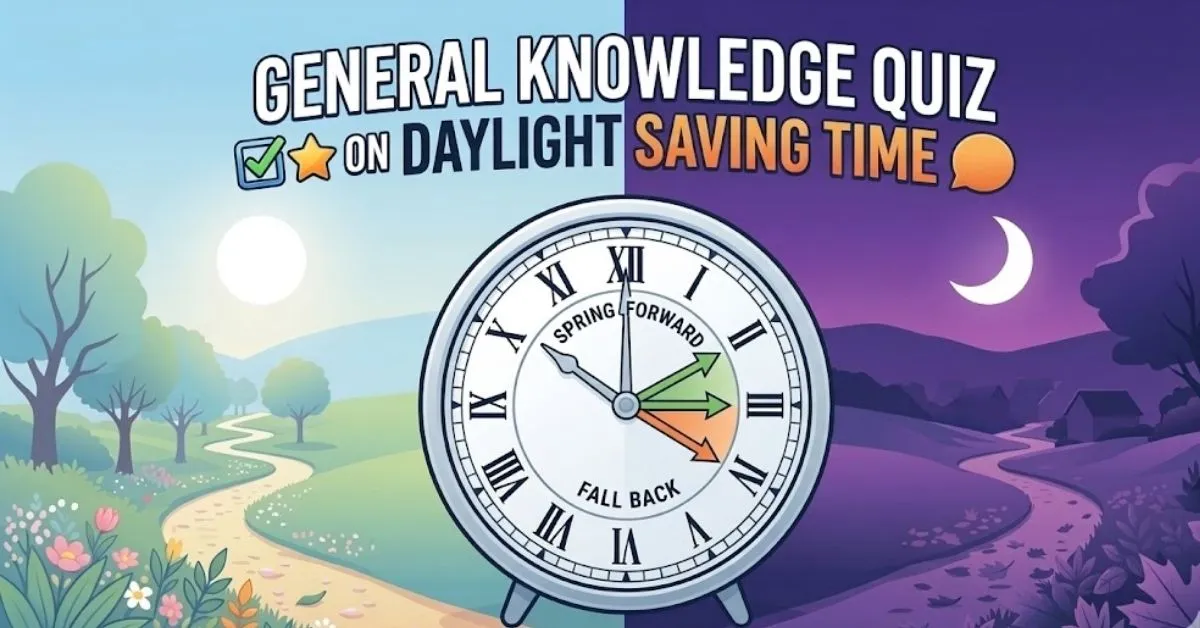
General Knowledge Quiz on Daylight Savings Time
Daylight Saving Time is used in many parts of the world, but how much do you really know about it? Test your understanding with interesting questions related to this unique time system.
Time is one of the most important ways through which humans organise their daily lives. From school schedules to office work and travel, almost every activity in modern society follows a fixed time structure.
Over the years, different countries have introduced several systems and adjustments to make better use of daylight and improve the efficiency of daily routines.
One interesting concept is Daylight Savings Time. It is a system that changes the clock during certain periods of the year. The idea behind it is to adjust the clock so that people can make better use of natural daylight during longer days.
Many competitive exams and quizzes include questions about global practices, time systems, and historical developments related to DST. Understanding the basics of this concept can therefore help students improve their knowledge of international practices and global time systems.
1. How many countries observe Daylight Saving Time today?
A. Around 30
B. Around 50
C. Around 70
D. Around 100
Answer: C. Around 70
Explanation: According to Time and Date, there are roughly 70 countries that observe Daylight Savings Time.
2. In Daylight Saving Time, clocks are usually moved in which direction during the start of the period?
A. One hour forward
B. One hour backward
C. Two hours forward
D. Two hours backward
Answer: A. One hour forward
Explanation: At the start of DST, clocks are usually moved forward by one hour.
3. Which season usually marks the beginning of Daylight Saving Time in many countries?
A. Winter
B. Autumn
C. Spring
D. Monsoon
Answer: C. Spring
Explanation: Shankar IAS mentions: “DST is the practice of resetting clocks ahead by an hour in spring”
4. What is the main purpose of Daylight Saving Time?
A. To reduce daylight hours
B. To make better use of natural daylight
C. To change the calendar system
D. To increase winter nights
Answer: B. To make better use of natural daylight
Explanation: The main idea of DST is to align daily activities with daylight hours and use natural light more efficiently.
5. When Daylight Saving Time ends, what usually happens to the clocks?
A. They remain unchanged
B. They move forward
C. They move backward
D. They stop for one hour
Answer: C. They move backward
Explanation: When DST ends then the clocks are usually turned back by one hour.
6. Which region of the world widely uses Daylight Saving Time?
A. Europe and North America
B. Antarctica
C. Central Africa
D. Pacific Islands only
Answer: A. Europe and North America
Explanation: Many countries in Europe and North America regularly observe Daylight Saving Time.
7. Which country does not follow Daylight Saving Time?
A. Germany
B. United States
C. India
D. Canada
Answer: C. India
Explanation: India does not follow DST and maintains a single time zone called Indian Standard Time.
8. In which year did the United States first implement Daylight Saving Time nationwide?
A. 1918
B. 1935
C. 1947
D. 1955
Answer: A. 1918
Explanation: The United States first introduced DST nationwide in 1918 during World War I.
9. In the United States, DST typically begins in which month?
A. January
B. March
C. June
D. September
Answer: B. March
Explanation: DST in the U.S. usually begins on the second Sunday of March.
10. Daylight Saving Time mainly affects which part of the day?
A. Afternoon sunlight
B. Morning sunrise
C. Evening daylight
D. Midnight hours
Answer: C. Evening daylight
Explanation: DST shifts daylight toward the evening, giving people longer daylight hours after work or school.
In conclusion, Daylight Saving Time is a fascinating topic that connects geography, science, and everyday life. While some countries use it to adjust daily schedules with daylight patterns, others have decided that keeping a constant time system works better for them.

Nikhil is a dedicated digital journalist and communications professional with more than five years of experience, currently working within the General Knowledge section at Jagran Josh. He has established himself as a subject matter expert in Finance, Economy, History, Technology, and Trending News, consistently delivering accurate, engaging, and easy-to-read content for a wide global audience.
Over the course of his career, Nikhil has developed deep expertise in crafting informative listicles, viral trending stories. His editorial portfolio also spans finance, historical research, and technology reporting, making him a versatile and well-rounded content professional. Every piece he produces reflects a strong balance between factual accuracy and reader engagement.