ESIC IMO 2022: Check Syllabus Subject-wise & Latest Exam Pattern for Insurance Medical Grade II Vacancies
ESIC IMO Grade II 2022 Exam on 30th March 2022. Download ESIC IMO Admit Card. Check Syllabus Subject-wise & Latest Exam Pattern for Online Written Exam for 1120 Insurance Medical Officer vacancies.
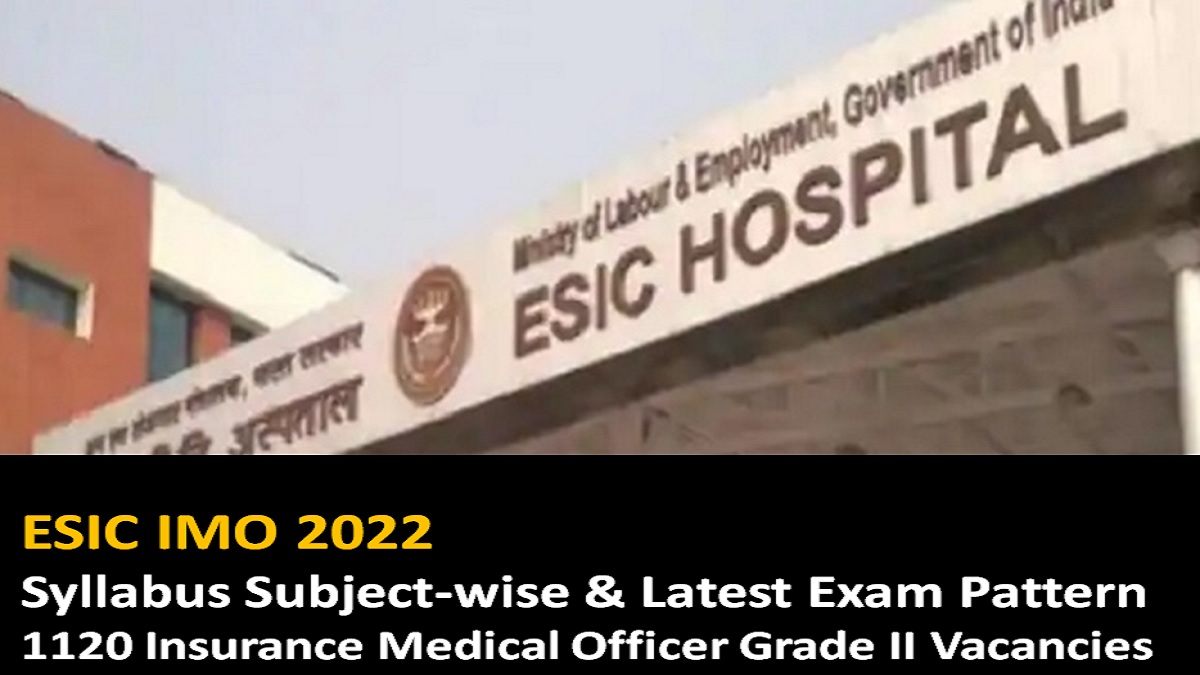
ESIC IMO 2022: The Employees’ State Insurance Corporation (ESIC) will be conducting the ESIC IMO 2022 Written Exam on 30th March 2022. Candidates can download the ESIC IMO Admit Card 2022 till 30th March 2022. ESIC will fill up 1120 Insurance Medical Officer (IMO) Grade-II (Allopathic) vacancies in ESIC Hospitals/Dispensaries. Shortlisted candidates in the written exam will be called for the Interview. ESIC Delhi 2021-22 online registration ended on 31st January 2022. In this article, we have shared the ESIC Delhi 2021-22 Detailed Syllabus Subject-wise and Latest Exam Pattern for the Written Exam.
ESIC IMO 2022 Important Dates
| ESIC IMO 2022 Important Events | Important Dates |
| ESIC IMO 2022 Online Registration Start Date | 31st December 2021 |
| ESIC IMO 2022 Online Registration Last Date | 31st January 2022 (till 11:59 PM) |
| ESIC IMO 2022 Written Exam | 30th March 2022 |
ESIC IMO 2022 Exam Pattern
The ESIC IMO 2022 Selection Process for the post of Insurance Medical Officer (IMO) Grade-II (Allopathic) in ESIC is a two-stage process that includes a Written Exam and Interview. The Written Exam will be held in online mode. It will include Objective Type Multiple Choice questions for a total of 200 marks. It will consist of two sections of 100 marks each. Section I will include questions from General Medicine & Pediatrics while Section II will include questions from Surgery, Gynaecology & Obstetrics & Preventive & Social Medicine.
ESIC IMO 2022 Online Written Exam Pattern
| Section | Syllabus | Marks per Question | No. of Questions | Total Duration |
|
Section I: General Medicine & Pediatrics (100 Marks) | 1. General Medicine | 1 Mark per Question | 80 Questions |
2 Hours |
| 2. Pediatrics | 1 Mark per Question | 20 Questions | ||
|
Section II: Surgery, Gynaecology & Obstetrics & Preventive & Social Medicine (100 Marks) | 1. Surgery | 1 Mark per Question | 34 Questions | |
| 2. Gynaecology & Obstetrics | 1 Mark per Question | 33 Questions | ||
| 3. Preventive & Social Medicine |
1 Mark per Question |
33 Questions | ||
|
| Total | 200 Marks | 200 Questions |
|
NOTE:
- Qualifying Marks in Written Examination are as follows:
| Category | Qualifying Marks Percentage |
| UR | 45 per cent |
| OBC & EWS | 40 per cent |
| SC & ST | 35 per cent |
| PWD | 30 per cent |
ESIC IMO 2022 Interview
The candidates will be shortlisted for the Interview on the basis of their performance in the Written Examination. The final selection will be made on the basis of the performance of candidates in Paper – I (200 Marks) and Interview (50 Marks).
NOTE: Candidates will be shortlisted for Interview in the following ratio:
| No. of Vacancies | No. of Candidates to be shortlisted for interview |
| 1 | 5 |
| 2 | 8 |
| 3 or more | 3 times the number of vacancies |
ESIC IMO 2022 Syllabus
Candidates can check below the ESIC Delhi 2021-22 Syllabus for Section I - General Medicine and Paediatrics, and Section II - Surgery, Gynaecology & Obstetrics, Preventive & Social Medicine.
Section I - General Medicine and Paediatrics
| General Medicine | Paediatrics | |
| Cardiology | Psychiatry | Common childhood emergencies, |
| Respiratory diseases | General | Basic newborn care |
| Gastro-intestinal | Emergency Medicine | Normal developmental milestones |
| Genito-Urinary | Common Poisoning | Accidents and poisonings in children |
| Neurology | Snakebite | Birth defects and counselling including autism |
| Haematology | Tropical Medicine | Immunization in children |
| Endocrinology | Critical Care Medicine | Recognizing children with special needs and management, and |
| Metabolic disorders | Vitamin deficiency diseases | National programmes related to child health |
| Musculoskeletal System | Emphasis on medical procedures |
|
| Nutrition/Growth | Patho physiological basis of diseases |
|
| Diseases of the skin (Dermatology) | Patho physiological basis of diseases |
|
| Infections/Communicable Diseases (Virus, Rickets, Bacterial, Spirochaetal, Protozoan, Metazoan, Fungus) | In psychiatry include – Depression, psychosis, anxiety, bipolar diseases, and Schizophrenia |
|
|
| Vaccines preventable diseases and Non-vaccines preventable diseases |
|
Section II - Surgery, Gynaecology & Obstetrics, Preventive & Social Medicine
| Surgery (including ENT, Ophthalmology, Traumatology, and Orthopaedics) | |
| General Surgery i) Wounds ii) Infections iii) Tumors iv) Lymphatic v) Blood vessels vi) Cysts/sinuses vii) Head and neck viii) Breast ix) Liver, Bile, Pancreas x) Spleen xi) Peritoneum xii) Abdominal wall xiii) Abdominal injuries xiv) Alimentary tract a) Esophagus b) Stomach c) Intestines d) Anus e) Developmental
| Urological Surgery |
| Neurosurgery | |
| Otorhinolaryngology E.N.T. | |
| Thoracic surgery | |
| Orthopaedic surgery | |
| Ophthalmology | |
| Anaesthesiology | |
| Traumatology | |
| Diagnosis and management of common surgical ailments | |
| Pre-operative and post-operative care of surgical patients | |
| Medicolegal and ethical issues of surgery | |
| Wound healing | |
| Fluid and electrolyte management in surgery | |
| Shock pathophysiology and management | |
| Gynaecology & Obstetrics | Preventive & Social Medicine |
| i) OBSTETRICS a) Ante-natal conditions b) Intra-natal conditions c) Post-natal conditions d) Management of normal labours or complicated labour
ii) GYNAECOLOGY a) Questions on applied anatomy b) Questions on applied physiology of menstruation and fertilization c) Questions on infections in genital tract d) Questions on neoplasma in the genital tract e) Questions on displacement of the uterus f) Normal delivery and safe delivery practices g) High risk pregnancy and management h) Abortions i) Intra Uterine growth retardation j) Medicolegal examination in obgy and Gynae including rape
iii) FAMILY PLANNING a) Conventional contraceptives b) U.D. and oral pills c) Operative procedure, sterilization, and organization of programmes in the urban and rural surroundings d) Medical Termination of Pregnancy | Social and Community Medicine |
| Concept of Health, Disease and Preventive Medicine | |
| Health Administration and Planning | |
| General Epidemiology | |
| Demography and Health Statistics | |
| Communicable Diseases | |
| Environmental Health | |
| Nutrition and Health | |
| Non-communicable diseases | |
| Occupational Health | |
| Genetics and Health | |
| International Health | |
| Medical Sociology and Health Education | |
| Maternal and Child Health | |
| National Programmes | |
| Management of common health problems | |
| Ability to monitor national health programmes | |
| Knowledge of maternal and child wellness | |
| Ability to recognize, investigate, report, plan and manage community health problems including malnutrition and emergencies |

Roopashree Sharma is an experienced broadcast journalist with over 7 years of experience, specialising in beats including geopolitics, defence, and general awareness. She has worked in the roles of correspondent and producer for leading media houses, including Zee, WION, and Economic Times. Currently serving as Deputy Manager – Editorial at Jagran New Media, she produces explainer articles and videos for the General Knowledge (GK) section of the Jagran Josh (English) portal. For inquiries, contact her at roopashree.sharma@jagrannewmedia.com.