Fact of the Day: 10 Interesting Facts on the Red Sea
Discover 10 fascinating facts about the Red Sea, a vital waterway linking Africa and Asia. From its tropical northern waters and ancient coral reefs to sailfish, shipwrecks, rich minerals, and deep historical significance, explore why this remarkable sea remains essential for trade, tourism, biodiversity, and global geography.
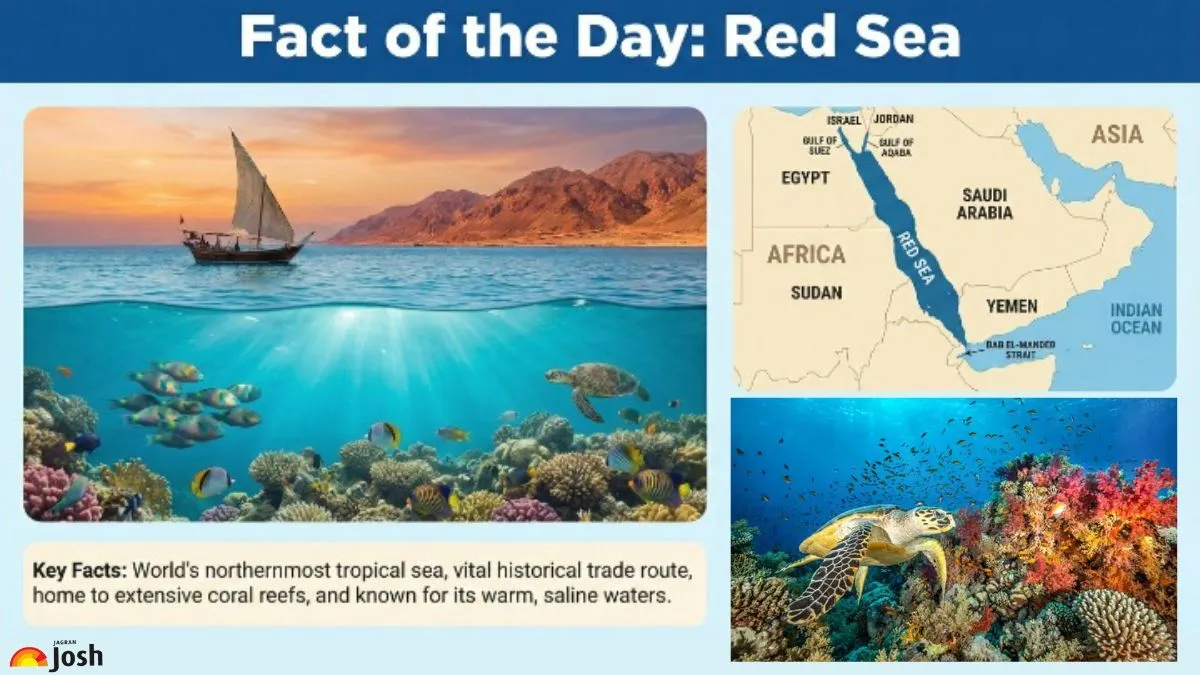
Fact of the Day: In today’s series of daily facts, we will discuss and explore the Red Sea, which has long been an attraction for travellers, traders, and explorers. The ancient waterway, which lies in restrictions between Africa and Asia, is not only the connection point between the continents but also the rich marine life coloured by the mystery and beauty of nature. It also enjoys warm, clear water, very appealing to adventurers and is strategically in favour of international trade and movement.
Daily reading and knowing these facts will help you to understand the core understanding of this topic, which will also help you in clearing various exams like UPSC, SSC, Banking and also many other state exams.
So, let’s explore the Red Sea, which is one of the important topics in Geography, in detail.
About the Red Sea
The Red Sea is a narrow body of water, but long and can be found connecting the Middle East to Northeast Africa. It extends along the Gulf of Suez and Gulf of Aqaba in the North to the Gulf of Aden in the south, where it turns to the Indian Ocean. It is a home to the coral reefs and the marine species that no one on Earth can see without its warm temperatures, saline waters and crystal-clear waters. It has a bustling coastline comprising old lived-in trade centres, modern tourist ports, and busy ports, all of which receive millions of visitors annually. The Red Sea is still central in trade, transportation, tourism, and scientific research.

10 Important Facts About the Red Sea
1. The Red Sea Is the World’s Northernmost Tropical Sea
It is a distinctive sea, which is about 438,000 square kilometres and stretches 2,250 kilometres long north-south. It is tropical and has so much warmth despite being so far north, thus still supporting corals and other marine aquatic life to thrive in the same warm environment as that of equatorial water.
2. Its Name Has Several Fascinating Theories
There is the belief that the sea turns reddish when there is a seasonal appearance of red-colored bacteria. Some people claim that the ancient cultures had a colouring system of depicting directions, with red meaning south. The other theory is associated with the red-haired mountains called Harei Edom, which are near the place where the name originates. Its earlier titles are Mare Mecca and Sinu Arabicus.
3. The Red Sea Is Mentioned in Holy Scriptures
The sea is mentioned in the Quran and the bible. The Red Sea could split to facilitate the escape of the Israelites against the Egyptian military, and it is part of the biblical narrative through which Moses helped them evade the native territory, which is why it is one of the most recognisable spiritual allusions made with respect to a geographic feature.
4. Ancient Civilisations Explored It Early
As early as 2500 BC, the Egyptians started to sail to the unknown land called Punt by the Red Sea. It was used by the Persians, Greeks and subsequently the Romans to chart the trade routes. The earliest navigational account of the area is present in the Periplus of the Erythraean Sea.
5. It Has Been a Vital Trade Route for Thousands of Years
Since Roman merchants bought spices on the Roman roads, pilgrims in the Middle Ages followed their paths through the Red Sea, and today the Suez Canal still remains a world warehouse. It has an enormous portion of the shipping traffic in the world today, with Europe and Asia.
6. The World’s Fastest Fish Lives Here
The sailfish, which achieves a speed of almost 68 mph (110 km/h), is found in the Red Sea. A sailfish is a commonly seen underwater mammal, as it is the favourite of underwater photographers and divers with its characteristic sail-shaped fin and long bill.
7. Its High Salinity Makes Floating Easy
The Red Sea is among the salty seas on earth due to its fast evaporation, absence of major rivers, and scanty precipitation. Its density allows swimmers to float easily. Its waters and sands are also mineral-rich and have therapeutic benefits that are believed to work.
8. The Red Sea Holds Rich Mineral and Energy Resources
Under it, there are evaporite mineral deposits, petroleum, phosphates and natural gas deposits. Although extracting the resources is restricted because of the environmental issues, geologically, the region is of crucial importance, and it still continues to be researched vehemently.
9. It Is Home to Over 1,200 Fish Species and Ancient Coral Reefs
Around 10% of its marine species are found nowhere else. Its 2,000-km coral reef system—mostly fringing reefs aged 5,000–7,000 years—creates spectacular diving sites. The area also hosts sharks, turtles, dolphins, nudibranchs, mangroves, and seagrass meadows.
10. The Red Sea Contains Hundreds of Islands and Many Shipwrecks
Shakespearean in Sholan and Jadid are some of the volcanic formations found in the Red Sea, and with 521 islands, the landscape of the area keeps changing. Its waters conserve past shipwrecks like the SS Thistlegorm, Giannis D, as well as SS Carnatic, which are a heaven of wreck divers.
Conclusion
The Red Sea is that rare combination of natural beauty, historical interest and ecological value. Its warm waters, flourishing corals, and ancient trading routes live up to the day and remain a source of inspiration to both travellers and researchers. The Red Sea is one of the most valuable settings in the world, being a dynamic marine zone of marine life and human presence.
Read others Facts also: |

Prabhat Mishra is a Subject Matter Expert and digital journalist with an extensive background in the competitive exam landscape and over 4 years of experience in education, national and international news, and current affairs. Over his tenure with top knowledge platforms like Mentorship India, IAS BABA, IAS SARTHI, and now Jagran Josh, he has a deep understanding of government exams like UPSC and State PCS, including UP and Bihar, as he has already qualified for the UPPCS 2022 Mains and Bihar 68th Mains. With his core expertise in history, polity, geography & current affairs, he specialises in creating well-researched, aspirant-centric content and simplifying complex topics for competitive examinations.


-1792838780900_t.webp)

-1792643685090_t.webp)




.jpg)
![[OUT] UPSSSC PET Admit Card 2026 LIVE: यूपी पीईटी एडमिट कार्ड जारी, upsssc.gov.in पर Direct Link](https://img.jagranjosh.com/images/2026/October/15102026/UPSSSC-PET-Admit-Card-2026.jpg)