Renowned Physics Professor HC Verma Reacts To IIT Bombay Student Suicide, Flags Exam Ethics


Physicist and author HC Verma has expressed concern over the recent death of IIT Bombay student Sahil Wakode, saying the incident was painful and calling for a wider discussion on academic ethics, examination practices and the pressure surrounding competitive exam preparation.
Renowned physicist and author H C Verma has reacted to the recent death of IIT Bombay student Sahil Wakode, describing the incident as painful and raising concerns over academic ethics, examination practices and the intense preparation culture surrounding students.
Vema, who is widely known for his two-volume ‘Concepts of Physics’, is a former professor of Physics at IIT Kanpur. He completed his PhD at IIT Kanpur and has worked in experimental nuclear physics and physics education. IIT Kanpur lists his teaching areas as classical and quantum mechanics and nuclear physics. His contribution to science education was also recognised with the Padma Shri.
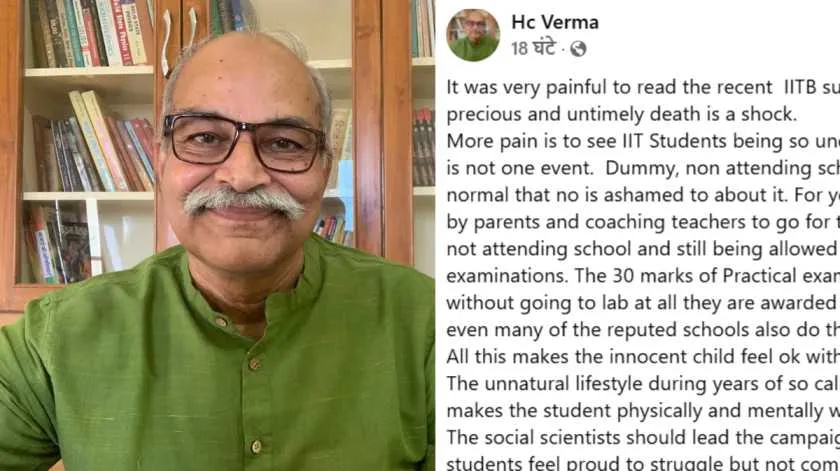
In a statement, Verma said, “It was very painful to read the recent IITB suicide case. Each life is precious and an untimely death is a shock.”
Wakode’s family has also alleged caste-based discrimination and harassment. IIT Bombay has denied receiving any complaint from the student regarding such allegations, while the police investigation into the circumstances of his death is continuing.
Against this backdrop, Verma also raised a broader concern about academic ethics among students. He wrote, “More pain is to see IIT students being so unethical in examnation. This is not one event.”
He then referred to the practice of students enrolling in dummy or non-attending schools while preparing for competitive examinations. “Dummy, non-attending schools have become so normal that no one is ashamed to talk about it,” he said.
Verma further criticised what he described as the routine awarding of practical examination marks without adequate practical participation. “For years, they are encouraged by parents and coaching teachers to go for this unethical practice of not attending school and still being allowed to appear in Board examinations. The 30 marks of practical examination are almost a gift. Without going to the lab at all, they are awarded a minimum of 28 out of 30; even many reputed schools also do this,” he said.
According to Verma, repeated exposure to such practices can influence how students perceive ethical conduct. “All this makes the innocent child feel okay with going unethical,” he said.
He also connected the issue to the lifestyle followed by students during prolonged examination preparation. “The unnatural lifestyle during years of so-called preparation time also makes the student physically and mentally weak,” Verma wrote.
Calling for a broader social response, Verma said, “The social scientists should lead the campaign to make our young students feel proud to struggle but not compromise with ethics at any stage. The whole society must rethink the priorities.”
Verma’s comments extend beyond the immediate IIT Bombay case to questions about how students are prepared for competitive examinations and how schools, parents and coaching systems approach academic success.
The author of Concepts of Physics has spent decades working in physics education. IIT Kanpur’s profile lists his work in physics education alongside his research in experimental nuclear physics, while his books remain widely associated with preparation for competitive engineering examinations.
The remarks come amid an ongoing investigation into the death of Sahil Wakode, a second-year BTech student of IIT Bombay’s Energy Science and Engineering department. Wakode died by suicide on September 18 after he was allegedly caught using a mobile phone during a mid-semester examination. IIT Bombay said he had uploaded the examination question paper on ChatGPT to seek answers during the test. The institute has maintained that no disciplinary action had been initiated against him.
The Mumbai Crime Branch is investigating the circumstances surrounding Wakode’s death. Investigators are examining CCTV footage and other digital evidence to reconstruct the sequence of events inside and outside the examination hall. Recent reports said footage showed Wakode being questioned and taken out of the examination hall before he returned to his hostel.
Sahil Behl is an education journalist at Jagran with over a year of experience in journalism. Prior to joining Jagran, he worked as a Sub-Editor in NDTV’s Education department, where he was responsible for writing and editing education-related content as well as managing the department’s social media presence. At Jagran, he covers a wide range of education topics, including board examinations, school updates, admissions, and job notifications, while leveraging his editorial expertise and strong understanding of digital content strategy. Sahil holds a Bachelor’s degree in Business Administration and has also completed an eight-month certification program in Data Science. Passionate about emerging technologies, particularly artificial intelligence, he closely tracks their growing role in journalism and explores how they are transforming shaping the future of the media industry.