AFCAT Syllabus 2027: Check Subject-Wise Topics and Exam Pattern
Check the AFCAT Syllabus 2027 for English, General Awareness, Numerical Ability and Reasoning. Get the complete subject-wise topics, exam pattern, marking scheme and preparation tips.
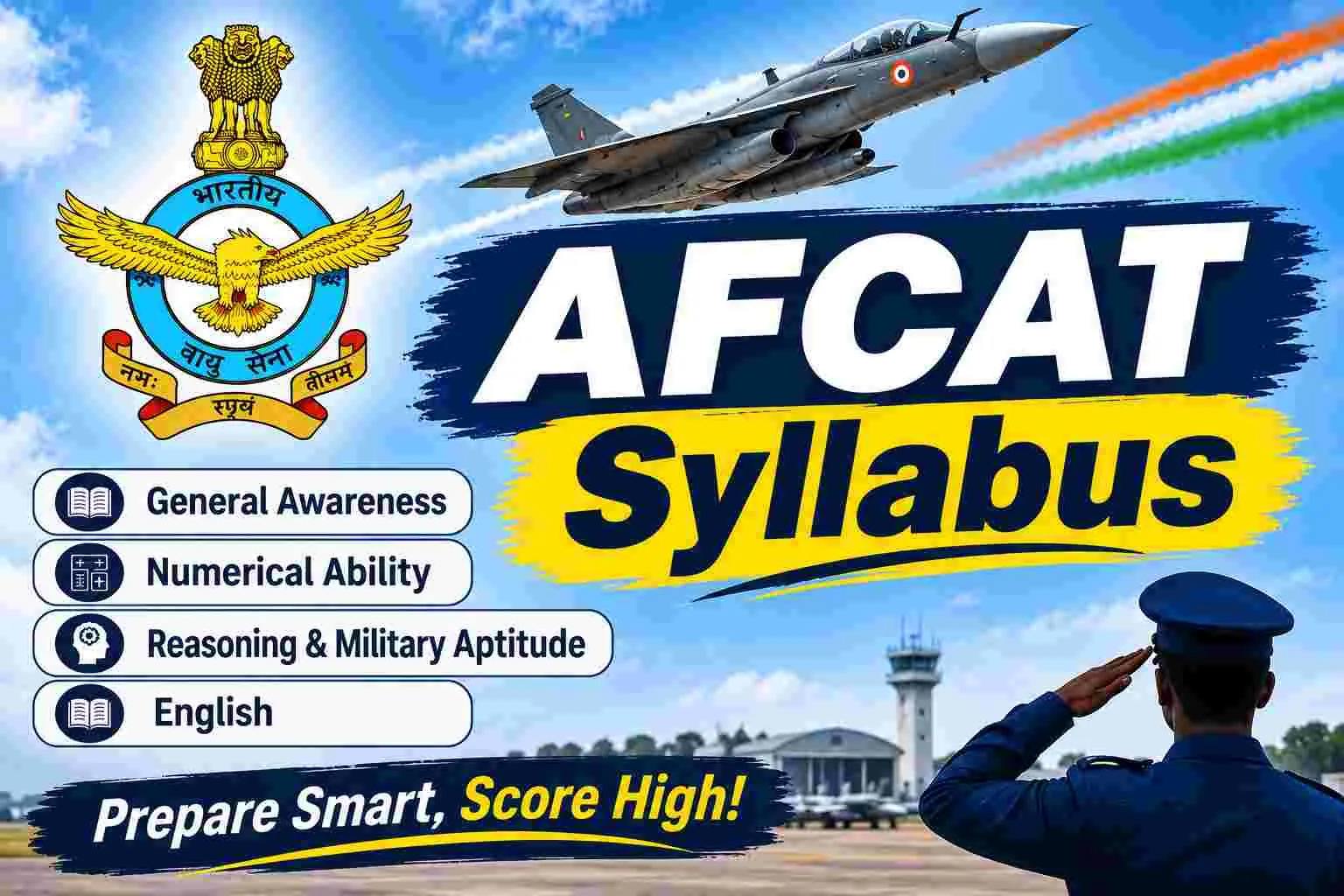
The AFCAT Syllabus 2027 includes four sections: General Awareness, Verbal Ability in English, Numerical Ability, and Reasoning and Military Aptitude Test. The Indian Air Force (IAF) conducts the Air Force Common Admission Test (AFCAT) to recruit candidates for officer-level positions in its Flying Branch and Ground Duty (Technical and Non-Technical) branches.
The Indian Air Force has released the AFCAT 01/2027 notification for courses commencing in January 2028. According to the official notification, the written examination will be conducted on January 31, 2027. Candidates will have two hours to solve 100 objective-type questions carrying 300 marks. Understanding the complete syllabus will help aspirants identify important topics, organise their study schedules and prepare for all four sections effectively. Scroll for complete details.
AFCAT Syllabus 2027: Subject-Wise Topics
The AFCAT examination tests candidates' knowledge of different subjects, including English, Mathematics, General Awareness and Reasoning. The official syllabus provides the topics that candidates need to cover before appearing for the examination. The four sections included in the AFCAT 2027 syllabus are:
- General Awareness
- Verbal Ability in English
- Numerical Ability
- Reasoning and Military Aptitude Test
AFCAT English Syllabus 2027
The English section evaluates candidates' grammar, vocabulary, reading comprehension and understanding of sentence structure. Candidates should practise different types of language-based questions to improve their accuracy. The important topics included in the AFCAT English syllabus are:
| Topics | Details |
|---|---|
| Comprehension | Reading and understanding passages |
| Error Detection | Identifying grammatical errors in sentences |
| Sentence Completion | Filling in the correct words |
| Synonyms and Antonyms | Words with similar and opposite meanings |
| Cloze Test | Filling in missing words in a paragraph |
| Idioms and Phrases | Understanding common expressions |
| Analogy | Identifying relationships between words |
| Sentence Rearrangement | Arranging sentences in the correct order |
| One Word Substitution | Replacing phrases with suitable single words |
| Sentence Transformation | Changing complex sentences into simple sentences |
| Homonyms | Understanding words with the same spelling or pronunciation but different meanings |
AFCAT General Awareness Syllabus 2027
The General Awareness section covers a wide range of topics related to India and the world. It tests candidates' knowledge of important events, historical developments, geographical facts, science, defence and current affairs. The important topics included in this section are:
- History: Important events and developments in Indian history.
- Geography: Physical, political and economic geography of India and the world.
- Sports: Important tournaments, sports personalities and achievements.
- National and International Organisations: Important organisations and their functions.
- Art and Culture: Indian traditions, art forms, festivals and cultural heritage.
- Personalities: Famous national and international personalities.
- Environment and Ecology: Environmental issues and ecological concepts.
- Indian Polity: Constitution, government institutions and the Indian political system.
- Economy: Basic economic concepts and important developments.
- Basic Science: Fundamental concepts of Physics, Chemistry and Biology.
- Science and Technology: Important scientific discoveries and technological developments.
- Current Affairs: Major national and international events.
- Defence: Indian Armed Forces, defence developments and military-related knowledge.
AFCAT Numerical Ability Syllabus 2027
The Numerical Ability section tests candidates' mathematical knowledge, calculation skills and ability to solve numerical problems. The questions are based on fundamental mathematical concepts and require regular practice. The AFCAT Numerical Ability syllabus includes the following topics:
| No. | Topics |
|---|---|
| 1 | Decimal Fraction |
| 2 | Time and Work |
| 3 | Average and Percentage |
| 4 | Profit and Loss |
| 5 | Ratio and Proportion |
| 6 | Simple and Compound Interest |
| 7 | Time and Distance |
| 8 | Races, Trains, Boats and Streams |
| 9 | Area and Perimeter |
| 10 | Probability |
| 11 | Number System and Number Series |
| 12 | Mixture and Alligation Rules |
| 13 | Square and Square Root |
| 14 | Cube and Cube Roots |
| 15 | HCF and LCM |
| 16 | Elementary Mensuration |
| 17 | Heights and Distance |
| 18 | Statistics (Mean, Median and Mode) |
| 19 | Exponents and Powers |
AFCAT Reasoning and Military Aptitude Test Syllabus 2027
The Reasoning and Military Aptitude Test evaluates candidates' logical thinking and ability to understand relationships, patterns and visual information. According to the official syllabus, this section covers two main areas:
Verbal Reasoning: This includes questions that test logical understanding through words, statements and relationships. Candidates need to identify patterns and apply logical thinking to reach the correct answers.
Non-Verbal Reasoning: This area focuses on figures, shapes, visual patterns and relationships between images. Candidates need to observe the given information and identify the correct pattern or answer.
AFCAT 2027 Exam Pattern
The AFCAT 2027 examination will be conducted online as a computer-based test. The question paper will contain objective-type questions in English. Candidates will receive two hours to complete all 100 questions. The examination carries a maximum of 300 marks. The Indian Air Force follows a negative marking system in which marks are deducted for incorrect answers.
| Particulars | Details |
|---|---|
| Examination Name | AFCAT 01/2027 |
| Conducting Authority | Indian Air Force |
| Examination Mode | Online |
| Question Type | Objective-Type |
| Total Questions | 100 |
| Maximum Marks | 300 |
| Examination Duration | 2 Hours |
| Medium of Examination | English |
| Correct Answer | +3 Marks |
| Incorrect Answer | -1 Mark |
| Unattempted Question | 0 Marks |
AFCAT 2027 Difficulty Level
The Indian Air Force has specified the academic standard for the questions asked in the AFCAT examination. Numerical Ability questions are based on the Matriculation level, while the remaining subjects follow the graduation-level standard.
| Subject | Difficulty Level |
|---|---|
| Numerical Ability | Matriculation Level (Class 10) |
| English | Graduation Level |
| General Awareness | Graduation Level |
| Reasoning and Military Aptitude Test | Graduation Level |
How to Prepare for AFCAT 2027?
Preparing for AFCAT 2027 requires a clear study plan, regular practice and a good understanding of all four sections. Candidates should focus on building their concepts rather than simply memorising answers. A balanced preparation strategy can help them improve their speed, accuracy and confidence before the examination.
- Understand the Complete AFCAT Syllabus
Before starting preparation, go through the complete AFCAT syllabus and understand the topics included in each section. Make a separate list of English, General Awareness, Numerical Ability and Reasoning topics. This will help you identify the subjects that need more attention and avoid spending too much time on topics you already understand.
- Prepare a Daily Study Timetable
Divide your daily study hours among all four sections instead of concentrating on only one subject. Give more time to topics that you find difficult, but do not ignore your stronger subjects. Set small daily targets, such as completing a Mathematics chapter, practising English questions or revising current affairs. Following a realistic timetable consistently is more useful than studying for long hours without a proper plan.
- Practise Mathematics Every Day
Numerical Ability requires regular practice because candidates need to solve calculations within a limited time. Start with basic concepts and formulas before moving to more difficult questions. Pay special attention to percentages, profit and loss, ratio and proportion, time and work, time and distance, averages and simple and compound interest. Maintain a separate notebook for important formulas and revise it regularly.
- Improve English Through Regular Reading
For the English section, focus on grammar, vocabulary, comprehension and sentence formation. Read an English newspaper or a good editorial every day to improve your understanding of sentences and learn new words. Practise synonyms, antonyms, idioms, error detection and comprehension questions. Keep a notebook of unfamiliar words and revise their meanings instead of trying to memorise a large number of words in one sitting.
- Keep Yourself Updated with Current Affairs
General Awareness requires preparation from both static general knowledge and current affairs. Read about important national and international events, defence developments, sports, awards, government initiatives and science-related news. Give special attention to the Indian Air Force, Indian Army, Indian Navy, military exercises, aircraft, missiles and important defence operations. Revise important events regularly so that you can remember facts during the examination.
- Practise Reasoning Questions Regularly
Reasoning becomes easier when you understand the logic behind different types of questions. Practise verbal and non-verbal reasoning questions and learn how to identify patterns, relationships and differences. Do not simply look at the solutions after getting an answer wrong. Try to understand why your approach was incorrect and solve similar questions again.
- Solve Previous Year AFCAT Question Papers
Previous year question papers are useful for understanding the types of questions asked in the examination. They also help candidates identify frequently tested topics and understand the overall difficulty level. Try solving these papers in a timed environment without checking the answers in between. After completing a paper, review your mistakes and revise the topics where you lost marks.
- Attempt Full-Length Mock Tests
Mock tests help candidates understand how to manage two hours during the actual examination. Start attempting mock tests after covering the basic concepts of the syllabus. Initially, focus on answering questions correctly rather than trying to complete the paper quickly. As your preparation improves, work on increasing your speed while maintaining accuracy.
- Analyse Every Mock Test
Simply attempting mock tests is not enough. Spend time checking your performance after every test. Identify the questions you answered incorrectly, the topics that took too much time and the questions you could not solve. Maintain a record of these mistakes and revise the weak areas before attempting the next mock test. This will help you avoid repeating the same mistakes.
- Avoid Guesswork and Understand Negative Marking
AFCAT follows a negative marking system, with one mark deducted for every incorrect answer. Therefore, candidates should avoid attempting questions randomly. Read each question carefully, eliminate clearly incorrect options and answer when you have a reasonable understanding of the question. Accuracy is important because unnecessary mistakes can reduce your overall score.
- Keep the Last Few Days for Revision
Avoid starting too many new topics just before the examination. Use the final days to revise mathematical formulas, English grammar rules, important current affairs, static GK facts and reasoning concepts. Attempt a few mock tests to maintain your confidence, but also get enough sleep and avoid exhausting yourself with unnecessary study hours.
- Take the Online Practice Test Before the Examination
Candidates should become familiar with the computer-based examination format before appearing for AFCAT. Practise reading questions on a computer screen, moving between questions and selecting answers. This will help you feel more comfortable with the online examination process and reduce confusion on the actual exam day.
| Also Check: |
Frequently Asked Questions on AFCAT 2027 Syllabus
Q1. How many subjects are included in the AFCAT 2027 syllabus?
The AFCAT 2027 syllabus includes four subjects: General Awareness, Verbal Ability in English, Numerical Ability, and Reasoning and Military Aptitude Test.
Q2. What is the difficulty level of AFCAT Mathematics?
The Numerical Ability section is based on the Matriculation level which is equivalent to Class 10.
Q3. How many questions are asked in the AFCAT 2027 examination?
The AFCAT 01/2027 examination contains 100 objective-type questions carrying a total of 300 marks.
Q4. Is there negative marking in AFCAT 2027?
Yes. Candidates receive three marks for every correct answer, while one mark is deducted for every incorrect answer. No marks are deducted for unanswered questions.
Q5. What is the duration of the AFCAT 2027 examination?
The examination duration is two hours.
Q6. What is the AFCAT 01/2027 examination date?
The Indian Air Force will conduct the AFCAT 01/2027 examination on January 31, 2027.
Q7. What is the standard of English and General Awareness questions in AFCAT?
The standard of English and General Awareness questions is at the graduation level, as specified in the official notification.
Q8. Where can candidates download the AFCAT 2027 syllabus PDF?
Candidates can download the AFCAT 01/2027 official notification from the Indian Air Force career website. The complete subject-wise syllabus is available in Section 8.2.

Faham is an education specialist and has over three years of experience in the education and edtech industry, specializing in digital and educational content creation. He holds an MBA in Marketing and Human Resources from Swami Vivekanand University. Throughout his career, Faham has developed expertise in creating engaging and informative content across diverse educational domains.
In addition to his edtech experience, he worked for two years as a Public Speaking and Creative Writing Expert, helping learners enhance their communication and writing skills. He has also been associated with Testbook and Adda Education as a Content Writer, where he created high-quality content for K–12 education, Management Entrance Examinations, UPSC, Law, and State Defence examinations. His strong understanding of educational content and exam preparation enables him to simplify complex topics and deliver valuable learning resources to students.