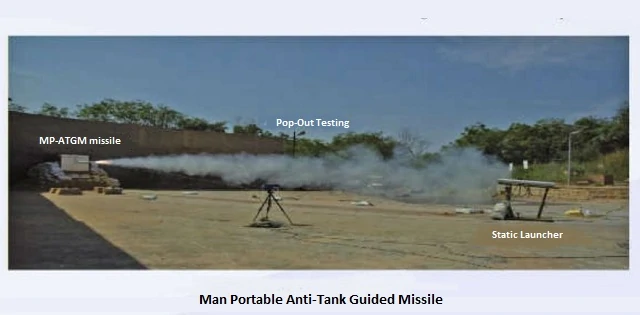
India’s Defence Research and Development Organisation (DRDO) on September 15, 2018 conducted the first successful flight test of its new indigenously designed and developed low weight man-portable anti-tank guided missile (MP-ATGM) at Ahmednagar test range in Maharashtra.
The first successful test firing was followed by another test launch on September 16, which also took place at the same test range. The two successful missions were conducted to test different ranges of the missile, including its maximum range capability. According to DRDO, the two launches met all the test objectives.
What is MP-ATGM? The man-portable anti-tank guided missile (MP-ATGM) is a third-generation anti-tank guided missile, which has been under development with the DRDO in partnership with Indian defense contractor VEM Technologies Ltd. since 2015. The missile, fitted with a high-explosive anti-tank (HEAT) warhead, reportedly boasts of a top attack capability and has a maximum engagement range of about 2.5 kilometers. Significance The missile would help the Indian army destroy enemy tanks during a war in the future. The Indian army needs close to 75,000 such missiles for future battles. |
Background
• The Indian Defence Research and Development Organisation had promised the Indian Army to hand over the first MPATGM prototype by the end of 2018 for user trials.
• The mass production of the missile is expected to begin in 2021. The Indian government scrapped a $500 million deal with Rafael for 321 Spike ATGM systems and 8,356 missiles in favor of the MPATGM system in December 2017.
• The Union Defence Ministry selected the Spike ATGM over the US-made FGM-148 Javelin ATGM system in October 2014.
• The Indian Army intends to equip all of its infantry and mechanised units with a third-generation ATGM by the early 2020s. The third-generation ATGMs are expected to have a strike range of over 2.5 km.
• The requirements of the Indian Army are so huge that they will have to be met with missile systems supplied from other nations along with the ones being developed indigenously by the DRDO.



-1766148564075.jpg)
-1766148959440.jpg)
-1766142159494.jpg)
Comments
All Comments (0)
Join the conversation