Durga Puja of Kolkata gets UNESCO Heritage Tag
Kolkata's Durga Puja has been included in UNESCO's 2021 list of 'Intangible Cultural Heritage of Humanity'. The festival is celebrated in September or October, mainly in Kolkata and also in other parts of India. Read more about it below.
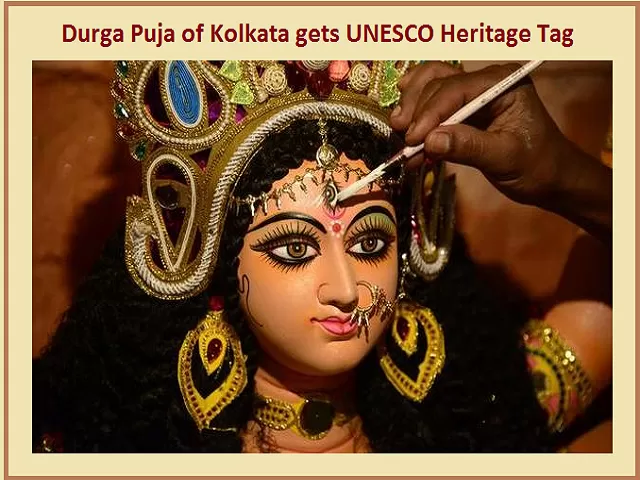
Durga Puja is a ten-day festival that is celebrated annually in September or October, most notably in Kolkata, West Bengal, and also in other parts of India. In the festival, mother-goddess Durga is worshipped.
On December 15, 2021, Durga Puja in Kolkata received important international recognition from UNESCO including it in the list of the Intangible Cultural Heritage of Humanity.
The UNESCO Office in New Delhi tweeted "Durga Puja in #Kolkata has just been inscribed on the #IntangibleHeritage list! Inscriptions to Representative List are one of the several ways by which #UNESCO advocates the promotion and safeguarding of intangible cultural heritage."
Congratulations🇮🇳 #DurgaPuja is now inscribed on the #UNESCO Representative List of the Intangible Cultural Heritage of Humanity!
— UNESCO New Delhi (@unesconewdelhi) December 15, 2021
14 ICH elements from #India have been inscribed on this list by the Intergovernmental Committee for the Safeguarding of Intangible Cultural Heritage pic.twitter.com/TQMqejgxBS
The announcement was welcomed by Prime Minister Narendra Modi, Union Minister of Culture G. Kishan Reddy, and the West Bengal government.
Narendra Modi said "A matter of great pride and joy for every Indian! Durga Puja highlights the best of our traditions and ethos. And, Kolkata’s Durga Puja is an experience everyone must have."
A matter of great pride and joy for every Indian!
— Narendra Modi (@narendramodi) December 15, 2021
Durga Puja highlights the best of our traditions and ethos. And, Kolkata’s Durga Puja is an experience everyone must have. https://t.co/DdRBcTGGs9
Now, the number of elements in the list of intangible Cultural Heritage from India has increased to 14 with the inclusion of Durga Puja. In the list, the latest inclusion prior to the Durga Puja is the Kumbh Mela which was inscribed in 2017, and in 2016, Yoga was included.
READ| UNESCO Intangible Heritage List 2021: All Inclusions From India
About UNESCO's Intangible Cultural Heritage
The content of the term 'Cultural Heritage' has been changed in recent decades, partially owing to instruments developed by UNESCO. It not only includes monuments and collections of objects but also traditions or living expressions inherited from our ancestors and passed on to our descendants. Examples are oral traditions, performing arts, social practices, rituals, festival events, knowledge and practices related to nature and the universe, or the knowledge and skills to produce traditional crafts.
With growing globalisation and maintaining cultural diversity, fragile and intangible cultural heritage is an important factor. It helps in understanding intercultural dialogue and encourages mutual respect for other ways of life.
The significance of intangible cultural heritage is not the cultural manifestation itself but also the wealth of knowledge and skills that is transmitted through one generation to another.
The social and economic value of this transmission of knowledge is important for minority groups and for social groups within State. It is also important for developing States and also for developed ones.
Interesting facts about Durga Puja
Durga Puja is a ten-day festival celebrated in the month of Ashvina (September or October), the seventh month of the Hindu Calendar.
The festival celebrates the victory of the goddess Durga over the demon king Mahishasura.
It is mainly celebrated in Bengal, Assam, and other parts of India as well as among the Bengali diaspora.
A few months before the start of the festival, small artisanal workshops make sculptures of Goddess Durga and her family using clay pulled from the Ganga River.
The worship of Goddess Durga begins on the inaugural day of Mahalaya i.e. the first day of Durga Puja is Mahalaya. Eyes are painted onto the clay images to bring the goddess to life.
During the celebration days, the goddess is worshipped in several forms such as Durga, Lakshmi, and Saraswati. The festival ends on the tenth day (Vijayadashami) when the images are immersed in the river from where the clay came.
The festival signifies 'home-coming' or a seasonal return to one's roots. It is seen as the best instance of public performance of religion and art. It also acts as a thriving ground for collaborative artists and designers.
Durga Puja festival is characterised by large-scale installations and pavilions in urban areas and also by traditional Bengali drumming and veneration of the goddess.
Key facts about UNESCOUNESCO: United Nations Educational, Scientific and Cultural Organisation Established: 16 November 1945 Type: United Nations specialised agency Headquarters: World Heritage Centre Paris, France Head: Director-General Audrey Azoulay Parent Organisation: United Nations Economic and Social Council UNESCO has 195 Members and 8 Associate Members and is governed by the General Conference and the Executive Board. UNESCO mission: To contribute to the building of a culture of peace, the eradication of poverty, sustainable development, and intercultural dialogue through education, the sciences, culture, communication, and information. |
Source: unesco.org



![NIOS Hall Ticket 2026 [OUT] LIVE: Download Class 10th, 12th October Theory Admit Card at sdmis.nios.ac.in, Direct link here](https://img.jagranjosh.com/images/2026/October/16102026/NIOS-Hall-Ticket-2026.jpg)
![[OUT] UPSSSC PET Admit Card 2026 LIVE: यूपी पीईटी एडमिट कार्ड जारी, upsssc.gov.in पर Direct Link](https://img.jagranjosh.com/images/2026/October/15102026/UPSSSC-PET-Admit-Card-2026.jpg)