CBSE Class 10 Social Science Sample Paper 2027 with Solutions, Download Model Paper PDF FREE
The CBSE Class 10 Social Science Sample Paper 2026–27 is an essential preparation tool for 10th-grade students aiming to excel in their board exams. Available as a free PDF download, it allows students to easily integrate official questions into their study routines. The provided marking scheme and solutions enable accurate self-evaluation and a clear understanding of step-by-step grading criteria. Download official CBSE Class 10 Social Science Sample Paper 2026-27 PDF with solutions and marking scheme. Prepare effectively for your 10th board exams.
CBSE Class 10 Social Science Sample Paper 2026–27: The official CBSE Class 10 Social Science Sample Paper for the 2026–27 academic session is an important resource for students gearing up for their upcoming board examinations. As exam preparation gains momentum, practicing with structured, syllabus-aligned study material becomes essential, and this article provides a direct, free PDF download of the latest sample paper.
To ensure comprehensive preparation and accurate self-assessment, this guide also includes the official solution and marking scheme. Practicing with these model questions helps students understand the latest board exam pattern, master time management, and gain clear insights into step-wise grading criteria and expected answer formats.
CBSE Class 10 Social Science Sample Paper 2027: Key Highlights
The CBSE Class 10 Social Science Sample Paper 2026-27 is designed as per the latest exam pattern and evaluation scheme. Below are the key details, including marks distribution, number of questions, and section-wise structure of the paper:
| Particulars | Details |
| Board | Central Board of Secondary Education |
| Class | Class 10 |
| Subject | Social Science |
| Subject Code | 087 |
| Academic Session | 2026-27 |
| Board Exam | CBSE Class 10 Board Exam 2027 |
| Sample Paper | Available |
| Marking Scheme | Available |
| Official Website | cbseacademic.nic.in |
General Instructions for the Social Science Question Paper:
The Social Science question paper comprises 38 compulsory questions distributed across four sections: History, Geography, Political Science, and Economics. Each section is worth 20 marks and includes a variety of question types: Multiple Choice Questions (MCQs), Very Short Answer (VSA), Short Answer (SA), Long Answer (LA), and Case-Based Questions (CBQ).
Word Limits and Marks per Question Type:
- VSA (2 marks): Max 40 words
- SA (3 marks): Max 60 words
- LA (5 marks): Max 120 words
- CBQ (4 marks each, three sub-questions): Max 100 words per question
Map-Based Questions (5 marks total):
- History (Section A): 2 marks
- Geography (Section B): 3 marks
There is no overall choice, but internal choices are provided for some questions. Visually impaired candidates have separate questions in lieu of those with visual inputs or maps.
SECTION A (HISTORY 20 MARKS)
| Q. No. | Question | Marks |
| 1 | Most conservative regimes set up in 1815 introduced strict censorship laws. What was the primary purpose of these laws? a. To regulate information written about the rulers and their policies. b. To control the growing demand for modernising the army. c. To restrict the spread of ideas of liberty and freedom expressed through newspapers and other publications. d. To prevent the circulation of views suggesting that modernisation could strengthen traditional institutions. Options: A. Only a and b B. Only a and c C. Only b and d D. Only c and d | 1 |
| 2 | The Picture shows a procession from which of the following movements? Choose the correct option: 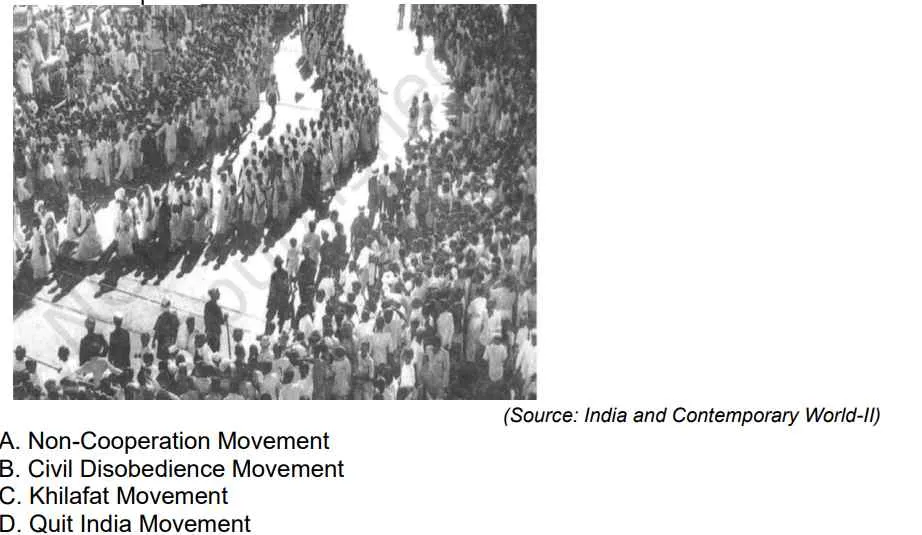
| 1 |
| 3 | Read the statements given below and choose the correct answer: Statement I: A good example of thriving pre- modern commercial and cultural ties connecting far flung regions of the world are silk routes. Statement II: The significance of Chinese silk cargoes traveling the silk route to the west is indicated by the term "silk routes”. A. Statement (I) is correct and (II) is incorrect B. Statement (I) is incorrect and (II) is correct C. Both (I) and (II) are correct D. Both (I) and (II) are incorrect | 1 |
| 4 | Arrange the following events in chronological order, from the earliest to the latest. I. Print culture created the conditions for the French Revolution. II. Martin Luther’s writings led to the beginning of the Protestant Reformation. III. Menocchio reinterpreted the message of the Bible. IV. Johann Gutenberg invented the Printing press. Choose the correct option A. III II I IV B. I II III IV C. IV III II I D. IV II III I | 1 |
| 5 | ‘Most powerful weapon of the Spanish conqueror was not a conventional military weapon at all.’ Justify the statement by giving two reasons. | 2 |
| 6 | 6A. ‘The female figures become an allegory of the nation during the 19th century in Europe.’ Elaborate on the statement with examples. OR 6B. Assess the role of the Greek War of Independence in shaping nationalist consciousness among educated Europeans in the nineteenth century. | 3 |
| 7 | 7A. Evaluate the economic consequences of the Non-Cooperation Movement for colonial rule in India. OR 7B. Analyse how Indian merchants and industrialists associated themselves with the Civil Disobedience Movement, highlighting the forms of support they extended and the reasons for their participation. | 5 |
| 8 | Read the following text and answer the questions that follow: Print comes to India The printing press first came to Goa with Portuguese missionaries in the midsixteenth century. Jesuit priests learnt Konkani and printed several tracts. By 1674, about 50 books had been printed in the Konkani and Kanara languages. Catholic priests printed the first Tamil book in 1579 at Cochin, and in 1713 the first Malayalam book was printed by them. By 1710, Dutch Protestant missionaries had printed 32 Tamil texts, many of them translations of older works. The English language press did not grow in India till quite late. From 1780, James Augustus Hickey edited the Bengal Gazette, a weekly magazine that claimed to be independent of colonial influence. This marked the beginning of English newspaper printing in India. Source-India and the Contemporary World – II, NCERT. Class 10,Chapter 5 8.1 Identify the newspaper that marked the beginning of English newspaper printing in India. (1M) 8.2 Explain how James Augustus Hickey demonstrated independence through his newspaper. (1M) 8.3. Evaluate how the early printing activities contributed to the spread of knowledge in India before English newspapers became popular. (2M) | 4 |
| 9 | MAP SKILL-BASED QUESTION (Map is given at page no 12) Two places A and B have been marked on the given outline map of India. Identify them and write their correct names on the lines marked on the map. A) The place where a violent massacre took place on 13th April, 1919. B) The place where Gandhi ji led indigo peasants against the oppressive plantation system Note: The following question is for Candidates with Visual Impairment only in lieu of Q. No. 9 A) The place where the Civil Disobedience Movement was launched. B) The place where Gandhiji organised ‘Satyagraha’ in favour of cotton mill workers | 2 |
SECTION B (GEOGRAPHY 20 MARKS)
| Q. No. | Question | Marks |
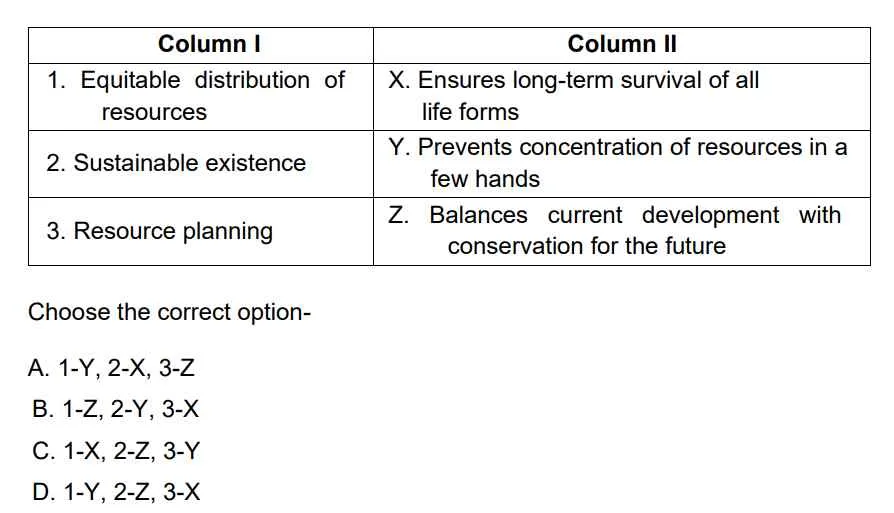
| 10 | A mineral deposit, that is known but cannot be used currently due to lack of technology, fits into which category of resources? A. Renewable resource B. Developed resource C. Potential resource D. Reserve | 1 |
| 11 | Which of the following options is the correct match?
| 1 |
| 12 | Which of the following statements about placer deposits are correct? (a) They are commonly found in valley floors and at the base of hills (b) They mainly contain minerals that easily dissolve in water (c) Gold and platinum are typical minerals found in such deposits (d) They are formed due to deposition by running water Choose the correct option as answer A. (a), (b), (d) B. (b), (c), (d) C. (a), (b), (c) D. (a), (c), (d) | 1 |
| 13 | A steel company requires iron ore with the best physical properties for high-quality steel production. Which mining region would be the most suitable choice, based on the nature of iron ore found there? A. Maharashtra–Goa belt B. Odisha–Jharkhand belt C. Durg–Bastar–Chandrapur belt D. Ballari–Chitradurga belt | 1 |
| 14 | Despite India’s strong capacity in spinning, the weaving sector continues to produce relatively lower-quality fabric. Which of the following is the most appropriate reason? A. Overdependence on imported cotton yarn B. Limited use of high-quality yarn due to decentralised weaving structure C. Excessive mechanisation of weaving mills D. Decline in traditional weaving skills | 1 |
| 15 | In the following question, a statement of Assertion (A) is followed by a statement of Reason(R). Choose the appropriate answer from the options given below as the correct answer: Assertion (A): Bengaluru has developed as one of the leading centres of the Information Technology and electronics industry in India. Reason (R): The city is located close to major ports, which has been the primary factor encouraging the growth of electronics and IT industries there. A. Both A and R are true, and R is the correct explanation of A B. Both A and R are true, but R is not the correct explanation of A C. A is true, but R is false D. A is false, but R is true | 1 |
| 16 | A drought-prone district wants to adopt a sustainable water conservation method using traditional knowledge. Suggest two suitable rainwater harvesting practices that could be implemented. | 2 |
| 17 | 17 A. A farmer plans to shift from food crops to plantation crops and is to choose between tea and coffee. Highlight the difference in the conditions associated with their growth. OR 17 B. Farmers in a region experiencing moderate rainfall, cool winters, and assured irrigation plan to move from mixed cropping to the cultivation of a single cereal crop. Should they opt for rice or wheat? Support your answer with appropriate reasons based on crop requirements. | 5 |
| 18 | Read the given text and answer the following questions: Role of Communities in Forest Conservation In many parts of India, especially in tribal and mountainous regions, local communities depend on forests for fuel, fodder, and livelihood. Over time, people realised that uncontrolled exploitation by contractors and commercial interests was destroying forests and threatening their survival. This led to community-led conservation efforts where people actively protected forests through traditional practices and movements. One such movement began in the Himalayan region, where villagers protected trees by hugging them, highlighting the importance of people’s participation in conservation. Source- Contemporary India – II,NCERT, Chapter 2 18.1 State any one objective of community-based forest conservation. (1M) 18.2 How does people’s participation lead to more effective forest resource management? Elaborate with the help of two examples. (2M) 18.3 Name the forest conservation movement referred to in the given source. (1M) | 4 |
| 19 | MAP SKILL-BASED QUESTION On the outline map of India locate and label the following with suitable symbols I (a) One of the largest water resource projects of India, built over the Narmada River in Gujarat. (1M) OR (b) The dam in the Sutluj-Beas river basin being used both for hydel power production and irrigation. (1M) II Any two of the following: (2M) i. An Iron and steel plant in Tamil Nadu ii. A cotton textile industry in the capital city of Maharashtra iii. Meenambakkam international airport | 1 MARK OR 2 MARKS |
CBSE Class 10 Social Science Course Structure 2026-27
Students and Teachers can check out the below tabulated information as a Course Structure for the academic year 2026-27, for the History, Geography, Civics and Economics
History (India and the Contemporary World - II) | ||||||||||||||
| Section | Chapter No. | Chapter Name | No. of Periods | Marks Allocated | ||||||||||
| I. Events and processes | I | The Rise of Nationalism in Europe | 17 | 18 + 2 map pointing * | ||||||||||
|
| II | Nationalism In India | 17 | |||||||||||
| II. Livelihoods, Economies and Societies | III | The Making of a Global World (To be evaluated in the Board Examination - Subtopics:1 to 1.3 Pre Modern World to Conquest, Disease and Trade) | 6 | |||||||||||
| I nterdisciplinary project as part of multiple assessments (Internally assessed for 5 marks Sub topics 2 to 4.4 The nineteenth century (1815-1914) to end of Bretton Woods & the beginning of “Globalisation.” | 4 |
| ||||||||||||
| IV | The Age of Industrialization (To be assessed as part of Periodic Assessments only) | 6 | ||||||||||||
| III. Everyday Life, Culture and Politics | V | Print Culture and the Modern World | 10 | * Marks as mentioned above | ||||||||||
Geography (Contemporary India - II) | ||||||||||||||
| Chapter No. | Chapter Name | No. of Periods | Marks allocated | |||||||||||
| 1. | Resources and Development | 7 | 17 + 3 map pointing | |||||||||||
| 2. | Forest and Wildlife Resources | 7 | ||||||||||||
| 3. | Water Resources | 7 | ||||||||||||
| 4. | Agriculture | 10 | ||||||||||||
| 5. | Minerals and Energy Resources | 10 | ||||||||||||
| 6. | Manufacturing Industries | 10 | ||||||||||||
| 7. | Lifelines of National Economy Only map pointing to be evaluated in the Board Examination | 2 | ||||||||||||
| Interdisciplinary project as part of multiple assessments (Internally assessed for 5 marks) | 2 |
| ||||||||||||
Political Science (Democratic Politics - II) | ||||||||||||||
| Unit no | Chapter No | Chapter Name | No. of Periods | Marks allocated | ||||||||||
| I | 1 | Power - sharing | 15 | 20 | ||||||||||
|
| 2 | Federalism | ||||||||||||
| II | 3 | Gender, Religion and Caste | 12 | |||||||||||
| III | 4 | Political Parties | 12 | |||||||||||
| IV | 5 | Outcomes of Democracy | 11 | |||||||||||
Economics (Understanding Economic Development) | ||||||||||||||
| Chapter No. | Chapter Name | No. of Periods | Marks allocated | |||||||||||
| 1. | Development | 12 | 20 | |||||||||||
| 2. | Sectors of the Indian Economy | 12 | ||||||||||||
| 3. | Money and Credit | 12 | ||||||||||||
| 4. | Globalisation and The Indian Economy To be evaluated in the Board Examination: What is Globalization? Factors that have enabled Globalisation | 8 | ||||||||||||
|
| Interdisciplinary project as part of multiple assessments (Internally assessed for 5 marks) · Production across the countries · Chinese toys in India World Trade Organisation The Struggle for a Fair Globalisation | 6 |
| |||||||||||
| 5. | Consumer Rights (Project Work) | |||||||||||||
To download the rest of the sample paper, we are providing the link below:
CHECK: CBSE Class 10 Social Science Sample Paper 2026-27 |
CBSE Class 10 Social Science Marking Scheme 2026-27
Since students are now receiving a sample paper, we are also giving them the marking guidelines and the solutions. The marking scheme and answers are available for students to view after completing the example papers.
Students will first be able to view some images of the marking scheme before downloading the PDF for free.
CHECK: CBSE Class 10 Social Science Marking Scheme 2026-27 |
Also Check:
| CBSE Class 10 Sample Paper: Mathematics (Basic) |
| CBSE Class 10 Sample Paper: Mathematics (Standard) |
| CBSE Class 10 Sample Paper: Science |

Apeksha Agarwal is an Education Journalist with over 3.5 years of experience. She covers a wide range of topics, including school board examinations, entrance tests, admissions, results, scholarships, and higher education updates. Over the years, she has closely tracked major examinations such as JEE Main, NEET UG, CUET, and various state-level entrance exams, helping students stay informed throughout their academic journey. Apeksha has a Master's degree in Journalism and Mass Communication and a certificate in Digital Journalism. She is passionate about transforming complex educational developments into clear, accessible, and useful information. Her reporting focuses on providing students, parents, and educators with accurate updates and practical insights on examinations, results, and policy changes. She believes that quality education journalism can make a meaningful difference by helping students make informed decisions about their future.