CBSE Class 12 Chemistry Case Study Question Bank 2026-27: Download PDF, Chapter-Wise Questions and Answers
Download CBSE Class 12 Chemistry Case Study Question Bank 2026-27 PDF. Get chapter-wise questions, extra case studies and answers for Board Exam 2027 preparation.
The Central Board of Secondary Education (CBSE) Class 12 Chemistry Board Exam 2027 will include case-based questions to assess student’s conceptual understanding and ability to apply chemical principles to practical situations. Students preparing for the upcoming board examinations should practise these questions alongside numerical problems, chemical reactions and NCERT exercises.
To help students prepare, a CBSE Class 12 Chemistry Case Study Question Bank 2026-27 has been compiled, covering important chapters from the prescribed Chemistry syllabus. The question bank includes chapter-wise case study questions, application-based problems and detailed answers to help students understand important concepts.
Apart from the chapter-wise questions, extra case studies with answers are also provided for additional practice. These questions will help students revise important concepts from Physical, Organic and Inorganic Chemistry, improve their problem-solving skills and become familiar with the competency-based question format.
Also Read: CBSE Class 12 Chemistry Syllabus 2026-27
CBSE Class 12 Chemistry Case Study Question Bank 2026-27: Overview
| Particulars | Details |
| Board | Central Board of Secondary Education |
| Class | 12 |
| Subject | Chemistry |
| Subject Code | 043 |
| Academic Session | 2026-27 |
| Examination | CBSE Board Exam 2027 |
| Question Type | Case Study-Based Questions |
| Total Theory Marks | 70 |
| Practical Examination | 30 |
| Question Bank | Chapter-wise questions with answers and extra case studies |
Also Check: CBSE Class 12 Chemistry Pre Board Sample Paper 2026-27 (with solutions)
CBSE Class 12 Chemistry Exam Pattern 2026-27
According to the CBSE Class 12 Chemistry Sample Question Paper 2026-27, the theory examination carries 70 marks and is conducted for three hours. The paper consists of 33 compulsory questions divided into five sections, including objective, short-answer, case-based and long-answer questions.
Section D contains two case-based questions carrying four marks each, making the total weightage of case study questions eight marks.
| Section | Question Numbers | Question Type | Marks |
| A | 1-16 | MCQs and Assertion-Reason | 16 |
| B | 17-21 | Very Short Answer | 10 |
| C | 22-28 | Short Answer | 21 |
| D | 29-30 | Case Study-Based Questions | 8 |
| E | 31-33 | Long Answer | 15 |
| Total | 33 Questions | 70 |
Also Read: CBSE Class 12 Chemistry Exam Pattern 2027
CBSE Class 12 Chemistry Case Study Questions with Answers 2026-27, Download PDF

3. Compounds of noble gases except _______ are known.
a. Krypton
b. Radon
c. Helium
d. Xenon
4. Xe is a ___________ ligand
a. ambidentate
b. bidantate
c. unidentate
d. hexadentate
ANSWERS : 1a, 2 b 3 c 4 c
(II) Read the passage given below and answer the following questions:
Boiling point or freezing point of liquid solution would be affected by the dissolved solids in the liquid phase. A soluble solid in solution has the effect of raising its boiling point and depressing its freezing point. The addition of non-volatile substances to a solvent decreases the vapor pressure and the added solute particles affect the formation of pure solvent crystals. According to many researches the decrease in freezing point directly correlated to the concentration of solutes dissolved in the solvent. This phenomenon is expressed as freezing point depression and it is useful for several applications such as freezing concentration of liquid food and to find the molar mass of an unknown solute in the solution. Freeze concentration is a high quality liquid food concentration method where water is removed by forming ice crystals. This is done by cooling the liquid food below the freezing point of the solution. The freezing point depression is referred to as a colligative property and it is proportional to the molar concentration of the solution (m), along with vapor pressure lowering, boiling point elevation, and osmotic pressure. These are physical characteristics of solutions that depend only on the identity of the solvent and the concentration of the solute. The characters are not depending on the solute’s identity. (Jayawardena, J. A. E. C., Vanniarachchi, M. P. G., & Wansapala, M. A. J. (2017). Freezing point depression of different Sucrose solutions and coconut water.)
1. When a non volatile solid is added to pure water it will:
a. boil above 100oC and freeze above 0oC
b. boil below 100oC and freeze above 0oC
c. boil above 100oC and freeze below 0oC
d. boil below 100oC and freeze below 0oC
2. Colligative properties are:
a. dependent only on the concentration of the solute and independent of the solvent’s and solute’s identity.
b. dependent only on the identity of the solute and the concentration of the solute and independent of the solvent’s identity.
c. dependent on the identity of the solvent and solute and thus on the concentration of the solute.
d. dependent only on the identity of the solvent and the concentration of the solute and independent of the solute’s identity.
3. Assume three samples of juices A, B and C have glucose as the only sugar present in them. The concentration of sample A, B and C are 0.1M, .5M and 0.2 M respectively. Freezing point will be highest for the fruit juice:
a. A
b. B
c. C
d. All have same freezing point
4. Identify which of the following is a colligative property :
a. freezing point
b. boiling point
c. osmotic pressure
d. all of the above
Ans 1 (b) 2 (d) 3 (a) 4(c)
To download the complete CBSE Class 12 Chemistry Case Study Based Question Bank, click the link below
CBSE Class 12 Chemistry Case Study Based Question Bank |
CBSE Class 12 Chemistry Case Study Questions with Answers 2026-27
Here are TWO sample case study-based questions from important chapters of the CBSE Class 12 Chemistry syllabus. These questions cover numerical applications, chemical concepts and real-life examples, along with answers and explanations.
Case Study 1: Electrochemistry
Electrochemical cells convert chemical energy into electrical energy through redox reactions. A Daniell cell consists of a zinc electrode dipped in zinc sulphate solution and a copper electrode dipped in copper sulphate solution. Zinc undergoes oxidation at the anode, while copper ions undergo reduction at the cathode.
The overall cell reaction is:
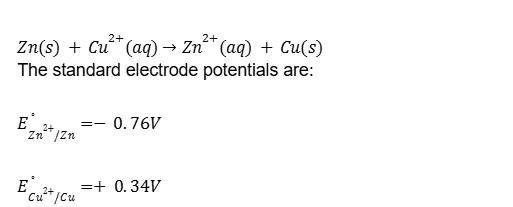
Based on the above information, answer the following questions.
Q1. Which electrode acts as the anode in a Daniell cell?
A. Copper electrode
B. Zinc electrode
C. Both electrodes
D. Neither electrode
Answer: B. Zinc electrode
Q2. What happens to the mass of the copper electrode during the operation of the cell?
A. It decreases
B. It increases
C. It remains unchanged
D. It becomes zero
Answer: B. It increases
Also Read: CBSE Class 12 Chemistry Previous Year Question Papers
Case Study 2: Chemical Kinetics
Chemical kinetics is the branch of Chemistry that deals with the rate of chemical reactions and the factors affecting them. The rate of a reaction depends on factors such as concentration, temperature, pressure and the presence of a catalyst.
Consider a reaction:
A - Products
The rate of the reaction is found to depend on the concentration of reactant A. For a first-order reaction, the rate law is:
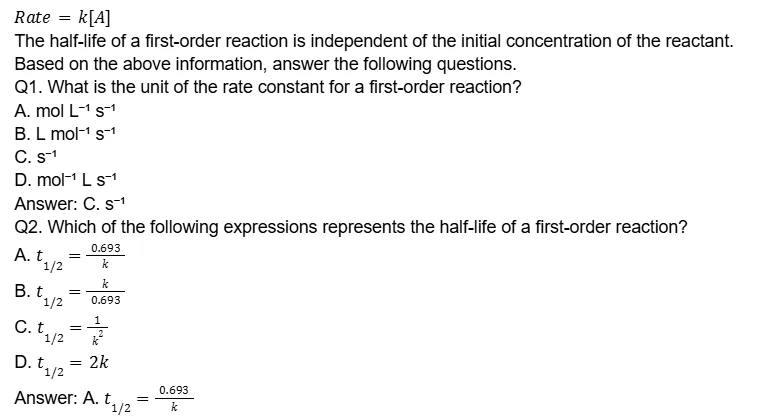
Q3. If the rate constant of a first-order reaction is 0.0693 min⁻¹, calculate its half-life.
A. 5 minutes
B. 10 minutes
C. 15 minutes
D. 20 minutes
Answer: B. 10 minutes
Also Read: CBSE Class 12 Sample Paper: Chemistry
Preparation Tips for CBSE Class 12 Chemistry Board Exam 2027
- Focus on NCERT textbooks: Read all important concepts, chemical reactions, definitions and examples from NCERT.
- Practise numerical questions: Give special attention to Solutions, Electrochemistry and Chemical Kinetics.
- Revise chemical reactions: Learn important named reactions, conversions and mechanisms from Organic Chemistry.
- Understand coordination compounds: Revise nomenclature, isomerism, bonding and properties of coordination compounds.
- Practise competency-based questions: Solve case studies based on experimental observations, chemical applications and real-life situations.
- Solve sample papers: Attempt the latest CBSE sample paper and refer to its marking scheme to understand the expected answer format.
- Attempt extra case studies: Use the additional case studies with answers provided in the question bank for further practice.

Apeksha Agarwal is an Education Journalist with over 3.5 years of experience. She covers a wide range of topics, including school board examinations, entrance tests, admissions, results, scholarships, and higher education updates. Over the years, she has closely tracked major examinations such as JEE Main, NEET UG, CUET, and various state-level entrance exams, helping students stay informed throughout their academic journey. Apeksha has a Master's degree in Journalism and Mass Communication and a certificate in Digital Journalism. She is passionate about transforming complex educational developments into clear, accessible, and useful information. Her reporting focuses on providing students, parents, and educators with accurate updates and practical insights on examinations, results, and policy changes. She believes that quality education journalism can make a meaningful difference by helping students make informed decisions about their future.