National Mathematics Day 2025: Srinivasa Ramanujan, The Indian Genius Who Failed College But Reinvented Math
Ramanujan was an Indian mathematical genius who failed out of college because he refused to study non-mathematical subjects. Despite his lack of formal education and poverty, he independently reinvented large areas of mathematics. His work was eventually recognized by G. H. Hardy at Cambridge, leading to his international acclaim and highest scientific honors. His life, celebrated on National Mathematics Day (December 22), is a testament to the power of pure obsession and a reminder that true brilliance often operates outside conventional academic systems.
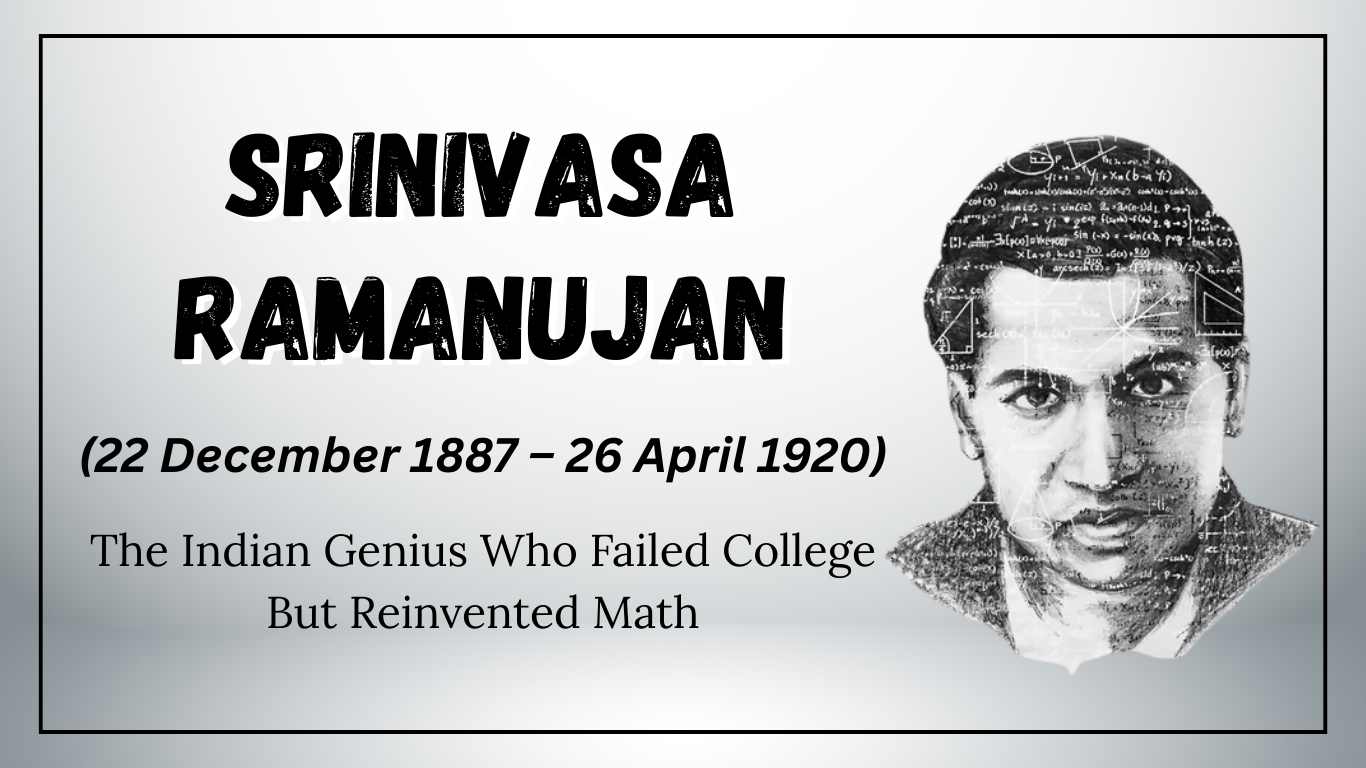
Ramanujan was an Indian mathematical genius who failed out of college because he refused to study non-mathematical subjects.By every academic rule we use today, Srinivasa Ramanujan was a failure. He lost his college scholarship, failed his exams, and never managed to earn a degree. Yet, today, the world’s most brilliant mathematicians are still trying to finish the work he started. His life is a powerful reminder that "marks" on a report card aren't the only measure of a human mind.
Ramanujan's story is about a genius that simply didn't fit into a box. While schools and universities demanded balance and conformity, Ramanujan offered pure, raw obsession. His journey from a struggling clerk in India to a Fellow of the Royal Society in England is one of the most inspiring tales in the history of science.
Which day is National Mathematics Day?
Maths Day, or National Mathematics Day in India, is celebrated every year on December 22nd to honor the birthday of legendary Indian mathematician Srinivasa Ramanujan, recognizing his immense contributions and raising awareness about mathematics' importance.

National Mathematics Day: A Tribute to Curiosity
Ramanujan’s life was tragically short; he passed away at the age of 32. However, in that brief time, he transformed areas of math that today influence everything from computer science to the study of black holes.
In India, we celebrate December 22—his birthday—as National Mathematics Day. We don't just celebrate his formulas; we celebrate the idea that curiosity and independent thought are more valuable than any degree. Ramanujan’s legacy is a message to every student who feels they don't "fit in": your brilliance might just be operating on a level the system hasn't caught up to yet.
Why the College System Failed Him
Born in 1887 in Tamil Nadu, Ramanujan was a child prodigy who saw numbers as his best friends. However, this fascination became a problem when he entered college. At Government College, Kumbakonam, he was expected to study English, Physiology, and other subjects to keep his scholarship.
Ramanujan couldn't do it. He didn't want to study anything that wasn't Mathematics. He spent his classes scribbling complex formulas while his professors lectured on literature. Because he ignored his other subjects, he failed his exams and lost his scholarship. He tried again in Madras, but the result was the same. The system wanted a "well-rounded" student, but Ramanujan was a specialist who had already touched the infinite.
A Genius Without a Teacher
After dropping out, Ramanujan was left in poverty and isolation. He didn't have access to modern libraries or a university mentor. Instead, he taught himself using a single, outdated math book. Working in near-starvation and often in poor health, he filled thousands of pages in his notebooks with original formulas.
What makes this extraordinary is that Ramanujan didn't just "learn" math; he reinvented it. He wrote down results that were so advanced that most trained mathematicians of the time couldn't even understand them. He famously said that his formulas were given to him in dreams by his family goddess, Namagiri. To him, an equation had no meaning unless it expressed a thought of God.
The Letter That Changed Math Forever
In 1913, Ramanujan decided to reach out to the world. He sent a handwritten letter packed with his strange-looking formulas to several famous mathematicians in England. Most thought it was a prank or a hoax and threw it away.
But one man, G. H. Hardy at Cambridge University, stopped to look. Hardy realized that these formulas were so original that they "had to be true," because nobody had the imagination to invent them. Hardy invited the college dropout to England. In the halls of Cambridge, the man without a degree began collaborating with the finest minds in Europe, eventually earning the highest scientific honors, including becoming a Fellow of the Royal Society.

Anisha Mishra is journalist with over 3 years of experience in covering the Indian education sector. She has worked extensively in the K12 domain, with focus on the state board as well as central board examinations, policy structure of seconday and higher secondary education as well as the entrance examinations like JEE, NEET, CLAT, etc. Her extensive experience in the domain has helped her provide students with concise accurate information in all aspectes of school life and education. Her key interest lies in decoding the changes in the curriculum, NEP implementation and changing education ecosystem in the country. Besides working, she enjoys traveling, exploring new places and cultures, and painting.




.jpg)
![[OUT] UPSSSC PET Admit Card 2026 LIVE: यूपी पीईटी एडमिट कार्ड जारी, upsssc.gov.in पर Direct Link](https://img.jagranjosh.com/images/2026/October/15102026/UPSSSC-PET-Admit-Card-2026.jpg)