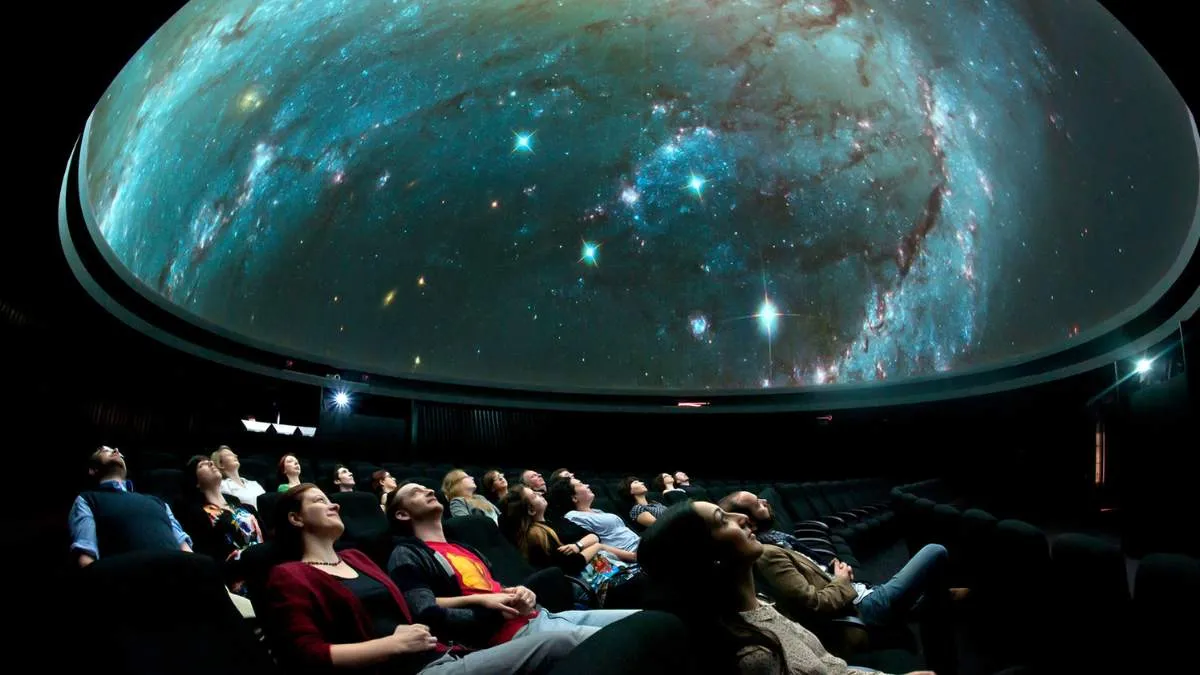
Planetariums fulfil an essential role in the fulfillment of the purpose of Astronomy, as they provide a platform for anyone interested to view the night sky and how celestial bodies move. Planetariums have grown to be large centres of education and science with improved technology through Digital Projections, and immersive dome technology.
They attract millions of visitors annually, with some not only providing exceptional digital and immersive technology but also having massive seating capacities.
There are many planetariums that exist across the globe, from North America to Asia, that are among the largest on earth and therefore of importance for the purposes of general understanding and competency examination.
The Largest Five Planetariums in the World ranked according to the size of their domes and the number of seats available in their theatres.
Check Out: List of Top 7 Largest Stepwells in India
Top 5 Largest Planetariums in the World
Here are the top 5 largest planetariums in the world along with their country, city and approximate dome size:
| Rank | Planetarium Name | Country | City | Approx. Dome Size |
| 1 | Nagoya City Science Museum Planetarium | Japan | Nagoya | 35 metres diameter |
| 2 | Shanghai Astronomy Museum Planetarium | China | Shanghai | 30 metres diameter |
| 3 | Planetarium Science Center (PSC) | China | Shenzhen | 28 metres diameter |
| 4 | ESO Supernova Planetarium | Germany | Garching | 14 metres diameter |
| 5 | Nehru Planetarium | India | New Delhi | 15 metres diameter |
1. Nagoya City Science Museum Planetarium, Japan
The Hong Kong Space Museum features a planetarium with one of the largest domes in the world (diameter approximately 30 m).
It has been designed to present scientific teachings and ideas about astronomy in a way that is highly realistic.
2. Shanghai Astronomy Museum Planetarium, China
Located in one of the largest and oldest cities in the world, the Beijing Planetarium is a modern facility that contains many different types of astronomy displays.
It also has state of the art cultural programs and research laboratories.
3. Planetarium Science Center, Shenzhen, China

The International Planetarium Conference is the main scientific and professional association for scientists who study planets, stars, galaxies and other astronomical objects.
Annually, the association hosts a conference that brings together scientists from around the world to discuss the scientific advancements and research that they have conducted.
4. ESO Supernova Planetarium, Germany

The ESO Supernova Planetarium located in Garching is operated by the European Southern Observatory.
It houses one of the largest tilted domes in Europe, providing visuals of the universe through HD (high-definition) technology based on astronomical data.
The planetarium's emphasis is primarily on research-based education and increasing public awareness about space science.
5. Nehru Planetarium, India
The Nehru Planetarium is very large for people who want to learn about Astronomy in India, and it is one of the biggest Planetariums in India.
The Planetarium provides many different options for students and the public including Sky shows, Lectures, and Workshops.
Many students preparing for competitive exams also visit the Planetarium for research, and many school groups visit as well.
Conclusion
These facilities represent a combination of technology, education, and science in discovering and understanding our universe.
Their size and advanced technologies have made these facilities essential to astronomy education globally and significant contributors to knowledge as well as competitors' exams.





Comments
All Comments (0)
Join the conversation