When is the Solar Eclipse in September 2025? Is It Visible in India? Check Here
Solar Eclipse in September 2025: The solar eclipse on September 21, 2025, will be a partial eclipse, visible mainly in the Southern Hemisphere, including Australia and parts of Antarctica. In India, the eclipse will occur during nighttime hours, making it not visible to observers. Though not seen from India, the event is astronomically significant and coincides with the September equinox.
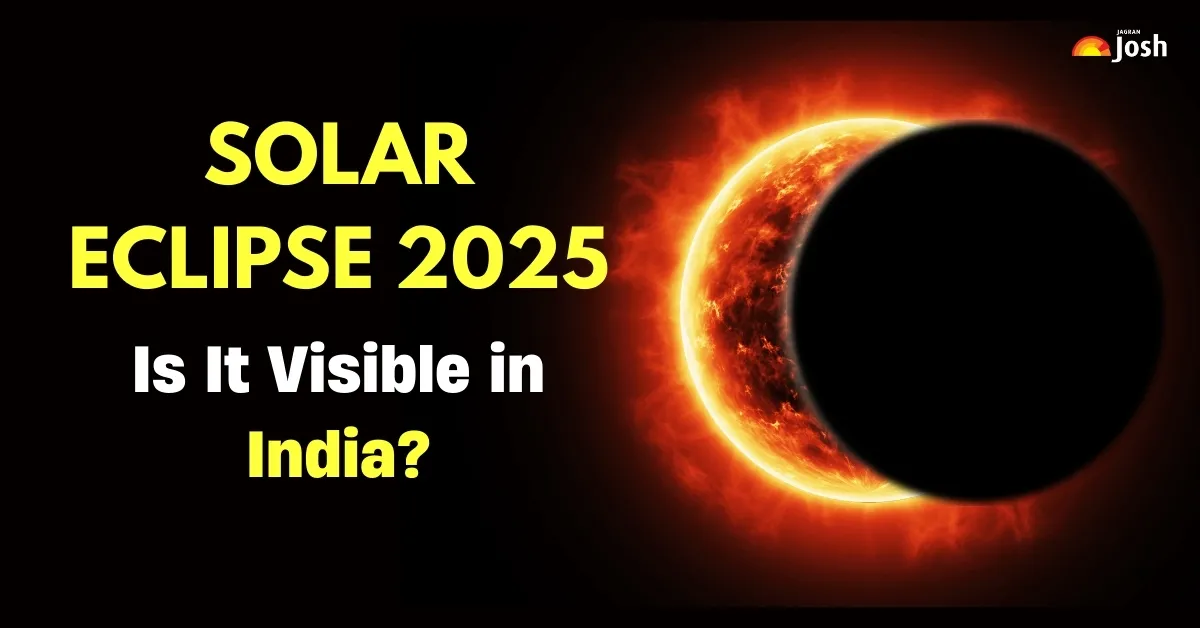
A solar eclipse, also known as Surya Grahan, is set to occur on September 21, 2025. This will be the last solar eclipse of the year. It will be a partial eclipse, which means the Moon will cover only a part of the Sun. People in some parts of the world will see a crescent-shaped Sun in the sky. However, this eclipse will not be visible from India. It will mainly be seen in the Southern Hemisphere, including places like Australia, New Zealand, and parts of Antarctica. In India, the eclipse will happen during the night, so skywatchers here will miss out on seeing it live. Still, it remains an important celestial event.
In this article, we'll take a look at the date and time of the eclipse, where it will be visible, and why it's special. We'll also explore some interesting facts about Surya Grahan and its significance.
Surya Grahan in September 2025: Will it be Visible from India?
The Surya Grahan (solar eclipse) on September 21, 2025, will be a partial solar eclipse, meaning the Moon will cover only a portion of the Sun. This celestial event will be visible mainly across the Southern Hemisphere, including regions like Australia, New Zealand, the South Pacific Islands, and parts of Antarctica.
However, for viewers in India, the eclipse will occur late at night, between 11:00 PM and 3:23 AM IST, making it not visible from any part of the country. Since the eclipse happens outside daylight hours in India, skywatchers here will miss the live spectacle.
Solar Eclipse September 2025: When Is It? Date And Time
The partial solar eclipse of September 2025 will occur on Sunday, September 21, 2025. It's essential to note that, due to time zones, the eclipse will extend into the early morning of Monday, September 22, in specific locations.
Eclipse Times
The eclipse is a partial one, meaning the Moon won't completely cover the Sun. The entire event will last over four hours. Here are the key times in Coordinated Universal Time (UTC):
- Partial eclipse begins: 17:29 UTC (22:59:43 IST) on September 21
- Maximum eclipse: 19:41 UTC (01:11:59) on September 21
- Partial eclipse ends: 21:53 UTC (03:23:45) on September 21
Visibility and Path
Unlike a total solar eclipse, which has a narrow path of totality, this partial eclipse will be visible over a wider area. It's best seen from the Southern Hemisphere, primarily in:
- Australia and New Zealand: Viewers will see the eclipse during their early morning hours.
- Antarctica: This location will have the longest viewing period.
- Various Pacific Islands and Oceania nations.
Unfortunately, this eclipse will not be visible from North or South America, Europe, Africa, or most of Asia, including India.
List of Countries to Witness the Solar Eclipse 2025
According to the real-time data, here's the list of the countries which will be witnessing the Solar Eclipse in September 2025:
| Country/Territory | Eclipse Type | Start of Eclipse | End of Eclipse |
| American Samoa | Partial Solar Eclipse | 06:29 SST | 08:12 SST |
| Antarctica | Partial Solar Eclipse | 04:49 DDUT | 18:53 CLST |
| Australia | Partial Solar Eclipse | 06:13 AEST | 07:36 AEST |
| Cook Islands | Partial Solar Eclipse | 07:32 CKT | 09:41 CKT |
| Fiji | Partial Solar Eclipse | 05:42 FJT | 07:27 FJT |
| French Polynesia | Partial Solar Eclipse | 07:41 TAHT | 10:04 TAHT |
| Kiribati | Partial Solar Eclipse | 06:38 PHOT | 08:56 LINT |
| New Caledonia | Partial Solar Eclipse | 05:24 NCT | 06:27 NCT |
| New Zealand | Partial Solar Eclipse | 05:41 NZST | 08:36 NZST |
| Niue | Partial Solar Eclipse | 06:31 NUT | 08:26 NUT |
| Norfolk Island | Partial Solar Eclipse | 05:37 NFT | 06:43 NFT |
| Samoa | Partial Solar Eclipse | 06:29 WST | 08:09 WST |
| Solomon Islands | Partial Solar Eclipse | 05:34 SBT | 06:00 SBT |
| Tokelau | Partial Solar Eclipse | 06:31 TKT | 07:52 TKT |
| Tonga | Partial Solar Eclipse | 06:30 TOT | 08:33 TOT |
| Tuvalu | Partial Solar Eclipse | 05:50 TVT | 06:52 TVT |
| Vanuatu | Partial Solar Eclipse | 05:30 VUT | 06:22 VUT |
| Wallis and Futuna | Partial Solar Eclipse | 05:34 WFT | 07:08 WFT |
What You Need to Know:
- This partial solar eclipse will occur on Sunday, September 21, 2025. Due to time zone differences, it will continue into the early hours of Monday, September 22, in some locations, such as New Zealand.
- The eclipse will be visible primarily in the Southern Hemisphere, including much of Oceania and Antarctica.
- At its peak, the eclipse will have an obscuration of approximately 72-85% in the most favourable viewing areas, such as southern New Zealand.
- This is a partial solar eclipse, meaning the Moon will only cover a portion of the Sun, and the sky will not go completely dark.
- The event is not visible from North or South America, Europe, Africa, or most of Asia.

Kriti Barua is a skilled digital journalist and communications professional with 4+ years of experience, currently writing for the General Knowledge section at Jagran New Media. She has established herself as a subject matter expert in History, Geography, Trending National and International News, Sports, Science, and Defence, producing clear, reliable, and search-optimised content that connects with readers worldwide.
Kriti holds a BA degree from Delhi University and a one-year diploma in TV Production and Journalism, an academic background that adds research depth and strong storytelling instincts to her writing. Her experience spans brand writing, content marketing, and digital media, giving her a sharp understanding of what makes content both helpful to readers and visible in search.
At Jagran New Media, she applies this expertise to national and international news coverage, query-based articles, and in-depth pieces across her specialist subject areas. Her content is defined by easy language, factual accuracy, strong keyword strategy, and reader-friendly storytelling.