Which is the Oldest Stepwell in India?
Located in Abhaneri, Chand Baori stands as a testament to early medieval engineering, dating back to the 8th-9th century . With 3,500 steps across 13 storeys, this monumental structure provided a cool communal retreat and served as a sophisticated solution for water conservation in Rajasthan's arid climate.
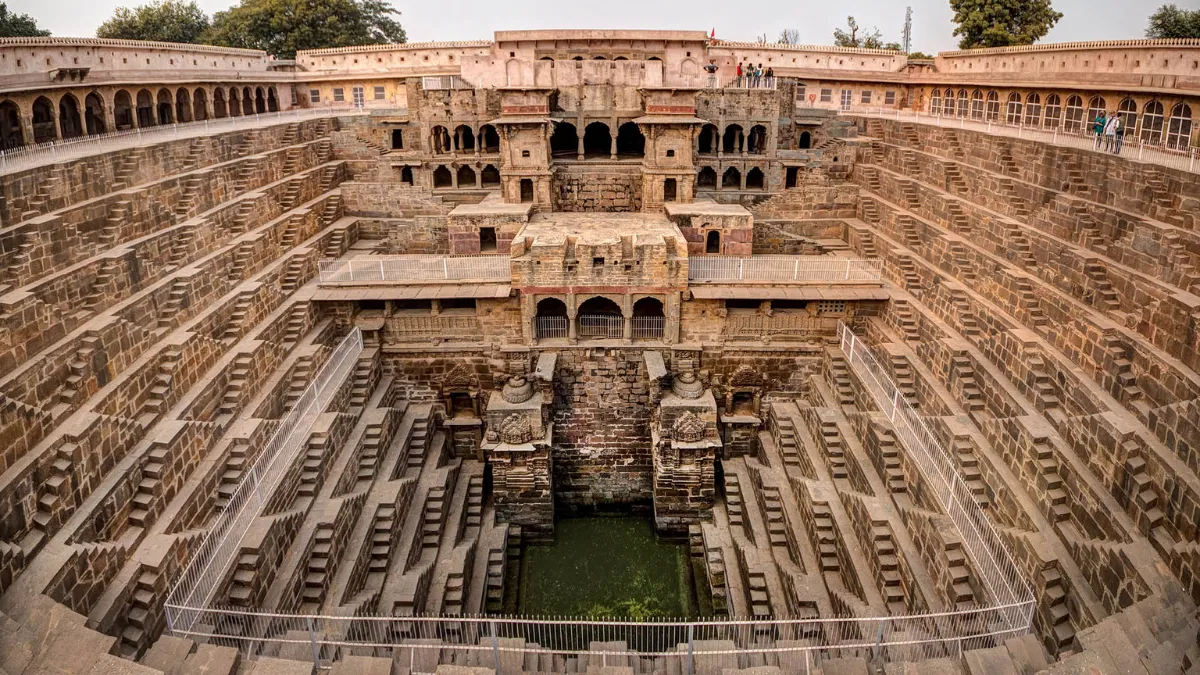
The oldest stepwell in India is generally believed to be Chand Baori at Abhaneri, Rajasthan according to the International Journal of Research in Engineering, Science and Management . It was constructed in the 8th-9th century of the Common Era and still largely preserved. There are older step-like water structures archeologically, but Chand Baori is the first monumentally-scale stepwell that still exists.
What Is a Stepwell and How old are they?
The underground water structures, known as stepwells (vavs/baolis/baoris) are designed such that a staircase reaches downward to a well or tank, where water can be accessed even though its level may change. They were water-catching mechanisms, leisure spots and frequently religious or communal areas in the arid and semi-arid areas of western India.
Similar stepped water structures have been dated to at least the 3rd-4th century CE (e.g. rock-cut pools at Uperkot caves in Junagadh and early wells like Navghan Kuvo in Gujarat). Those are proto-forms however; the multi-storey typology of stepwells is fully developed later, Chand Baori being one of the earliest complete examples which survive.
Chand Baori: the Oldest Surviving Stepwell in India
Chand Baori is found in Abhaneri village (Dausa district), 90-100km east of Jaipur in eastern Rajasthan. It is over 1,100-1,200 years old, and most of the scholars have dated the date of its construction to the 8th-9th centuries CE of King Chanda (or Chandra) of the Nikumbh/Gujara-Pratihara line.
The stepwell has a depth of approximately 30-20 metres (and that is approximately 64-100 feet) and has about 3,500 tightly spaced steps in an inverted-pyramid structure covering 13 storeys. This has made it not only one of the oldest but also among the deepest and the largest stepwells in India, known in terms of the geometric precision and visual symmetry.
Why is Chand Baori considered the Oldest Stepwell?
Historians and travel literature refer to Chand Baori as the oldest surviving (or oldest and deepest) stepwell in India due to the following factors:
-
Early medieval dating: The date of its construction (8th -9th century) is earlier than most other known stepwells, including Rani ki Vav in Gujarat (11th century) or the stepwell at Mata Bhavani (11th century).
-
Monumental totality: Deceased stepped tanks are known but these are either of rock cut pools or somewhat preserved; Chand Baori is a complete and full fledged baori with multiple flights of steps, landings, and attached pavilions.
-
Constant use and conservation: It was situated opposite to the Harshat Mata temple and served as a source of water, as well as a social-ritual area, which contributed to preserving it until the medieval time.
-
Due to this early date, size and preserved architecture it is widely used in scholarly literature, travel books and government/ heritage accounts as the oldest surviving stepwell in India.
The Precursors of the Type Proto-Stepwells
The oldest stepped water structures are technically earlier than Chand Baori but they are not of the later baori/vav type. Examples include:
-
Harappan and post-Harappan sites, and rock-cut tanks such as the 4th-century Uperkot cave pool of Junagadh.
-
Some of the earliest wells include Navghan Kuvo and Adi Kadi Vav at Junagadh whose estimated date lies between c. 200-400 CE and as late as the 11th century respectively depending on the scholar.
-
These buildings reveal the technological and ritual origins of stepwells, and their dating is controversial, and they are not yet characterized by the multi-storey, pavilion-connected layout that is fully developed at Chand Baori.
Therefore, Chand Baori is in a crossroad between bare foot stepped access and a full fledged underground water architecture.
Also Read |10 Most Beautiful Stepwells in India: Check the full list here
Chand Baori’s Importance in the Water Heritage of India.
Chand Baori is also the reflection of the way of solving the problem of water shortage by early medieval India, which involved complex engineering combined with religious and social life. The deep shaft provided a cool microclimate in the hot, semi-arid climate of eastern Rajasthan: the temperature at the bottom is several degrees colder than on the surface, making the stepwell a communal retreat during hot weather seasons.
It is now a large heritage and tourist attraction often referred to as the largest and the deepest stepwell in India and an extremely photogenic water monument in the world. The fact that it was the oldest extant stepwell highlights the ancient and the cleverness of the ancient Indian culture of water management.

Kirti Sharma is a journalist in the education domain with three and a half years of experience creating high-quality content for the education technology (EdTech) and digital media industries. She has an expertise in covering education news. Kirti has experience in writing data backed informational pieces on General knowledge.
Kirti holds a Bachelor of Arts degree, which helped build her strong foundation in writing and research. Over the course of her career, she has brought her skills to a variety of well-known companies, including ThoughtPartners Global, Infinite Group, and MIM-Essay. Through these roles, she has learned how to take complex information and turn it into engaging, easy-to-understand content for readers online.


-1792761794673_t.webp)
-1792850902708_t.webp)





.jpg)
![[OUT] UPSSSC PET Admit Card 2026 LIVE: यूपी पीईटी एडमिट कार्ड जारी, upsssc.gov.in पर Direct Link](https://img.jagranjosh.com/images/2026/October/15102026/UPSSSC-PET-Admit-Card-2026.jpg)