Which Snake is Called the Flying Snake in the World?
Flying snakes are real reptiles that glide through the air using advanced body control. They are usually found in Asian rainforests, these snakes flatten their bodies to generate lift, making them one of nature’s most fascinating aerial animals. But, do you know, which Snake is Called the Flying Snake in the World? Let's explore this article in more detail know about the Flying Snake.
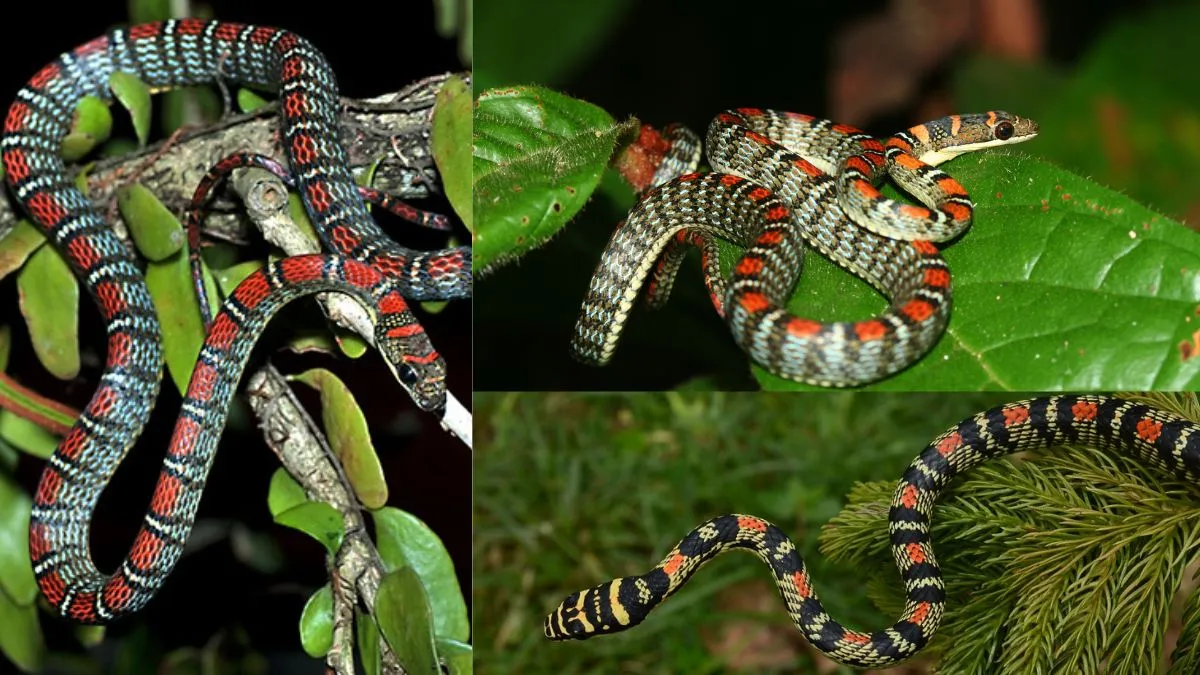
Think about going through a thick rainforest, and then, according to the snapshots, you are just walking there, and suddenly, you look at the tree,e and what comes out of it is a snake, and then it slides along in the air. It reads like a piece of a thriller movie, yet flying snakes are a fact, and they are one of nature's unbelievable survival stories.
Flying snakes are found all over the South and Southeast Asia and have left scientists and wildlife enthusiasts stunned by the fact that they have possessed the ability to transform their free fall into a form of controlled flight.
In this article, we will explore in detail the Flying Snake in the World.

Source: nationalgeographic
Which Snake is Called the Flying Snake in the World?
The snake that is called the flying snake is the Chrysopelea. It gets this name because it can glide through the air from one tree to another. Found in the forests of South and Southeast Asia, this snake doesn’t grow wings or actually fly. Instead, it jumps from high branches, flattens its body, and moves in gentle waves to control its glide. This amazing skill helps it escape predators, travel easily across trees, and survive high in the forest canopy, making it one of the most fascinating snakes in the world.
Quick Facts About Flying Snakes
|
Do Flying Snakes Really Fly?
Having such a dramatic name, flying snakes do not fly as birds do. Rather, they are gliding masters. They jump off tall trees with the help of gravity, speed and amazing body control and manipulate their path in the air with precision.
The really amazing thing about this is that they do it without wings, with no limbs, or membranes; doing this is nothing but pure body mechanics.
How does a Snake fly itself into the Air?
A flying snake makes a calculated setup before sliding:
-
It slugs down to the tree branch edge.
-
It usually hangs in a J-shape downwards.
-
Kicks off with all the might of the lower part of the body.
By the twitch of his eyelid, the snake flies up in the air--and then the magic itself.

Source: nationalgeographic
How do Chrysopelea turn into a Living Wing?
Once in the air, the Chrysopelea believably reforms itself::
-
It stretches out its ribs and makes its body flatter, almost twice its breadth.
-
The body takes the shape of a concave form C, entraping the air underneath it.
-
It takes the shape of S-shaped waves, running parallel to each other.
This motion allows the snake to:
-
Generate lift
-
Stay balanced
-
Make turns mid-air
-
Extend its glide distance
Research has found that flying snakes can glide even better than the flying squirrels, thus becoming one of the most proficient gliders in the animal kingdom.

Source: nationalgeographic
Why Do Flying Snakes Glide?
For aerial survival, scientists suppose that flying snakes exploit their aerial capabilities for many survival benefits:
-
Escaping predators quickly
-
Going between trees without having to go down to the forest.
-
Conserving energy when going through thick forests.
-
Perhaps, attacking the prey above.
Due to the danger on the forest floor, gliding is a way for these snakes to stay safely in the canopy.
What are the locations of Chrysopelea Snakes?
They are distributed across:
-
Western India
-
Sri Lanka
-
Southeast Asia
-
Indonesia
They are very arboreal and spend the majority of their lives up in the trees, and that is the reason they are rarely seen, and it is like seeing things which are not real.
What Do Chrysopelea Snakes Eat?
Chrysopelea snakes are carnivores that have a diverse diet that consists of:
-
Lizards
-
Frogs
-
Small birds
-
Rodents
-
Bats

Source: nationalgeographic
They are not very poisonous and do not present any actual danger to man. They have very small rear fangs since it is extremely hard to give them the ability to deliver a good venom shot; bites are very infrequent.
Are Flying Snakes Dangerous to Humans?
Flying snakes are reserved, non-aggressive and shy towards contact with human beings. They have weak venom, no major accident cases involving them have ever been recorded.
What are the Nature’s Gravity-Defying Wonder of the Chrysopelea Snakes?
The flying snakes provide the ideal illustration of the way evolution comes up with incredible answers. Having neither wings nor legs, these reptiles have come to know how to defy the law of physics--to make a fall the course of a flight and trees the beams.
They make us remember that nature is flying without feathers, that all the time, it only requires imagination that is written into DNA.
Conclusion
One of the most incredible evolutionary phenomena of nature is flying snakes. They have no wings or limbs and move through body control, physics and instinct with ease. They survive predators, conserve energy and dominate forest canopies with the aid of their aerial movements, and this has shown that in many cases, evolution finds solutions to problems that we as humans would never have thought of.
Whenever you see a snake fly by in a rainforest, you need not panic, but you should count yourself as a lucky individual. You have just seen one of the very rare air shows of nature.

Prabhat Mishra is a Subject Matter Expert and digital journalist with an extensive background in the competitive exam landscape and over 4 years of experience in education, national and international news, and current affairs. Over his tenure with top knowledge platforms like Mentorship India, IAS BABA, IAS SARTHI, and now Jagran Josh, he has a deep understanding of government exams like UPSC and State PCS, including UP and Bihar, as he has already qualified for the UPPCS 2022 Mains and Bihar 68th Mains. With his core expertise in history, polity, geography & current affairs, he specialises in creating well-researched, aspirant-centric content and simplifying complex topics for competitive examinations.





.jpg)
![[OUT] UPSSSC PET Admit Card 2026 LIVE: यूपी पीईटी एडमिट कार्ड जारी, upsssc.gov.in पर Direct Link](https://img.jagranjosh.com/images/2026/October/15102026/UPSSSC-PET-Admit-Card-2026.jpg)