Pure and Mixed Substances: Definition, Characteristics and Example
This article is an informative source for students to understand the definition, meaning, key difference with example and more for the pure and mixed substances

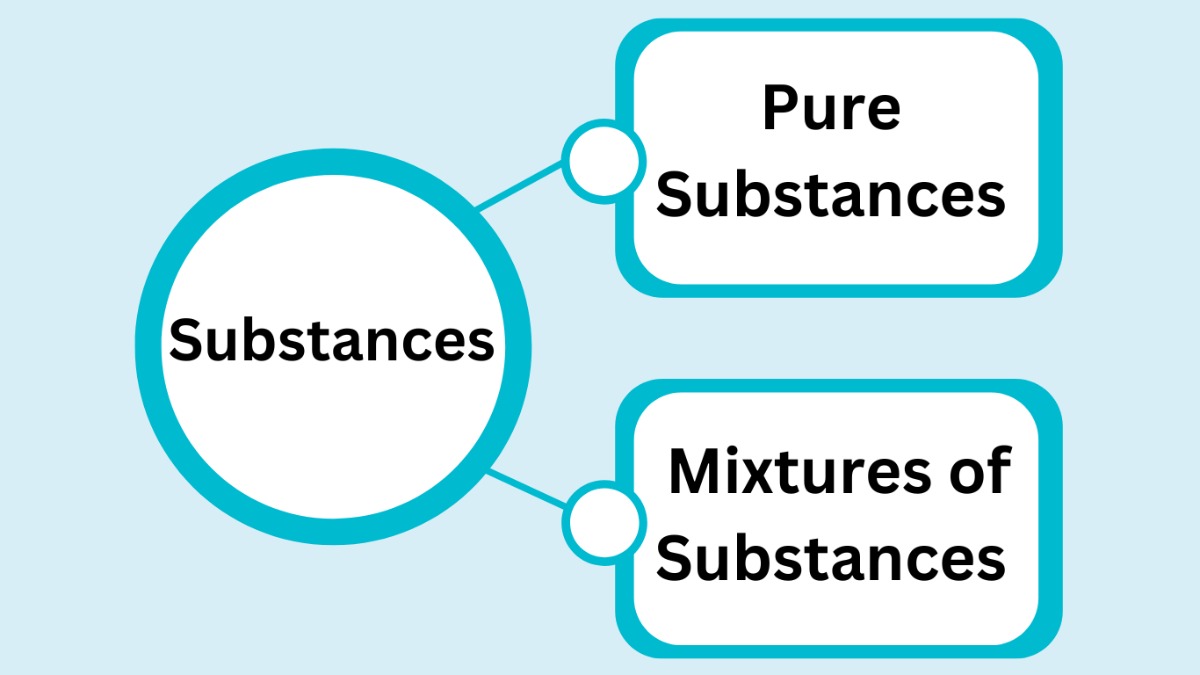
Pure and Mixed Substances: In the world of chemistry, substances are broadly classified into two fundamental categories: pure and mixed substances. Understanding these distinctions is crucial as they form the basis for comprehending the compositions and behavior of matter. Pure substances are characterized by their uniformity of composition and distinct chemical properties, representing elements or compounds that cannot be separated into simpler substances by physical means alone.
Whereas, mixtures are combinations of two or more substances, each retaining its own properties, which can be separated through various physical methods.
Pure Substances
Definition: A pure substance is a substance that consists of only and only one type of particle like atom, molecule, or ion and has a fixed composition. It cannot be separated into simpler substances by physical methods.
Characteristic:
- Pure substances have definite and constant physical and chemical properties, such as melting point, boiling point, density and chemical reactivity.
- Examples include elements like oxygen, gold and compounds like water, sodium chloride.
Mixture Substances:
Definition: A mixture is a combination of two or more substances that are physically combined but not chemically bonded. Mixtures can be separated into their components using physical methods.
Characteristics:
- Mixtures do not have a fixed composition, their properties can vary depending on the proportions of the components present
- Examples include solutions like saltwater, suspension like muddy water, and colloids like milk..
Difference Between Pure Substances and Mixtures
Find the difference between pure and mixture substances in the below table:
Pure Substances | Mixture Substances |
| It cannot be broken down or separated into new products. | It can be separated with different separation methods |
| The chemical and physical properties are constant | Physical and chemical properties vary with mixtures |
| Pure substances are made up of single elements | Its a mixture is the combination of two compounds or elements |
Key Differences:
Compositions: Pure substances have a fixed composition, whereas mixtures have variable compositions.
Separations: Pure substances cannot be separated into simpler substances by physical means, while mixtures can be separated using methods such as filtration, distillation, and chromatography.
Properties: Pure substances have specific and regular properties and mixtures showcase properties that depend on the proportions of their components.
Understanding these concepts is important and basic in chemistry as they lay the foundation and groundwork for studying the behavior. Properties, and different substances in our world.
Check:

Anisha Mishra is journalist with over 3 years of experience in covering the Indian education sector. She has worked extensively in the K12 domain, with focus on the state board as well as central board examinations, policy structure of seconday and higher secondary education as well as the entrance examinations like JEE, NEET, CLAT, etc. Her extensive experience in the domain has helped her provide students with concise accurate information in all aspectes of school life and education. Her key interest lies in decoding the changes in the curriculum, NEP implementation and changing education ecosystem in the country. Besides working, she enjoys traveling, exploring new places and cultures, and painting.