Competitive examinations in India have shown visible changes in applicant numbers. Exams that once attracted a very high number of candidates are now witnessing lower registrations or reduced attendance. This shift has raised serious discussions among students, parents, education experts, and exam authorities.
The decline in exam applicants does not mean that students have lost interest in education. It reflects changing career choices, exam fatigue, policy changes, and growing awareness about alternative career paths.
Many aspirants now carefully evaluate the effort, time, and uncertainty involved in long exam cycles. So several national and state-level exams have seen fewer candidates compared to previous years. This article explains the competitive exams fewer applicants and analyses the reasons behind the government exams decline in candidates using verified data and recent trends.
List of Exams Saw a Decline in Applicants Compared to Previous Years
Several important entrance and recruitment exams have recorded a decline in applicants or attendance. Check the table below for an overview:
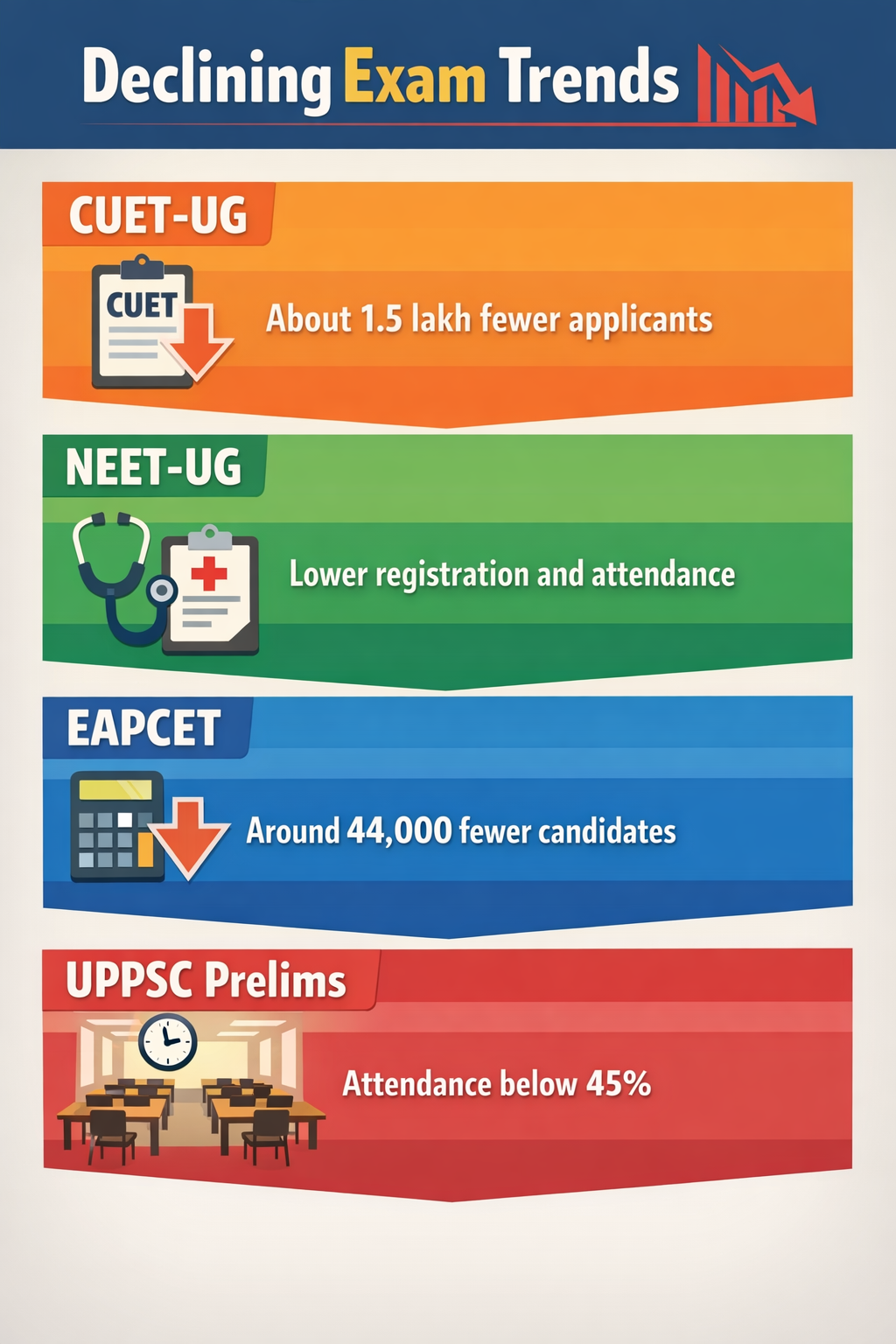
| Exam Name | Trend Observed | Key Reason |
| CUET-UG | About 1.5 lakh fewer applicants | Fewer unique candidates despite more subjects |
| NEET-UG | Lower registration and attendance | Stricter checks and reduced fake entries |
| EAPCET | Around 44,000 fewer candidates | Policy changes and fewer exam centres |
| UPPSC Prelims | Attendance below 45% | Long recruitment cycle and uncertainty |
Decline in Exam Applicants Compared to Previous Years
The following are important competitive exams that saw a decline in exam applicants as compared to previous years:
National Entrance Exams
National-level entrance exams play a major role in shaping higher education opportunities. However, recent data show that some of these exams are seeing reduced participation.
CUET-UG was introduced to bring uniformity in university admissions. It reported a fall of nearly 1.5 lakh applicants compared to the previous year. Candidates selected more subjects, but the number of unique applicants decreased. This suggests that while serious candidates remained engaged, overall participation declined.
This decline in exam applicants can be linked to adjustment issues with the new exam system, confusion about subject combinations, and students choosing direct university admissions or private colleges instead.
Also Check:
Highest Paying Government Jobs in India 2025
Medical Entrance Tests
Medical entrance exams are known for their high pressure and intense competition. NEET-UG has long been considered one of the toughest exams in India.
In NEET-UG 2025, both registrations and attendance declined. The number of candidates appearing for the exam was the lowest since 2021. Authorities stated that stricter verification processes removed inauthentic registrations, leading to more accurate numbers.
However, this also reflects growing stress among aspirants. Long preparation periods, limited seats, and repeated attempts have discouraged many students. This situation clearly shows competitive exams fewer applicants, even in high-demand fields like medicine.
State Level Exams
State-level entrance exams are equally affected by changing education policies and student preferences.
EAPCET recorded a major drop in candidates in the engineering stream. Participation fell by more than 40,000 candidates compared to the previous year. Agriculture and pharmacy streams also saw fewer applicants.
Officials linked this change to quota removal, reduced exam centres, and students opting for other exams or management seats. This confirms the trend of exams with reduced applications due to policy and system-level changes rather than lack of interest in education.
Government Exams
Government recruitment exams traditionally attract lakhs of aspirants. However, actual attendance is falling sharply.
The UPPSC Preliminary exam recorded very low participation, with more than 3.6 lakh registered candidates not appearing. Attendance remained below 45 percent for the second year in a row.
This government exams decline in candidates is mainly due to delayed recruitment processes, uncertainty in vacancies, repeated postponements, and long waiting periods. Many aspirants now prefer private jobs, skill-based careers, or exams with faster results.

.jpg "GATE CE Previous Years Cut off; Check Civil Engineering Past Years Qualifying Marks Trends")


-1766568967270.jpg)

Comments
All Comments (0)
Join the conversation