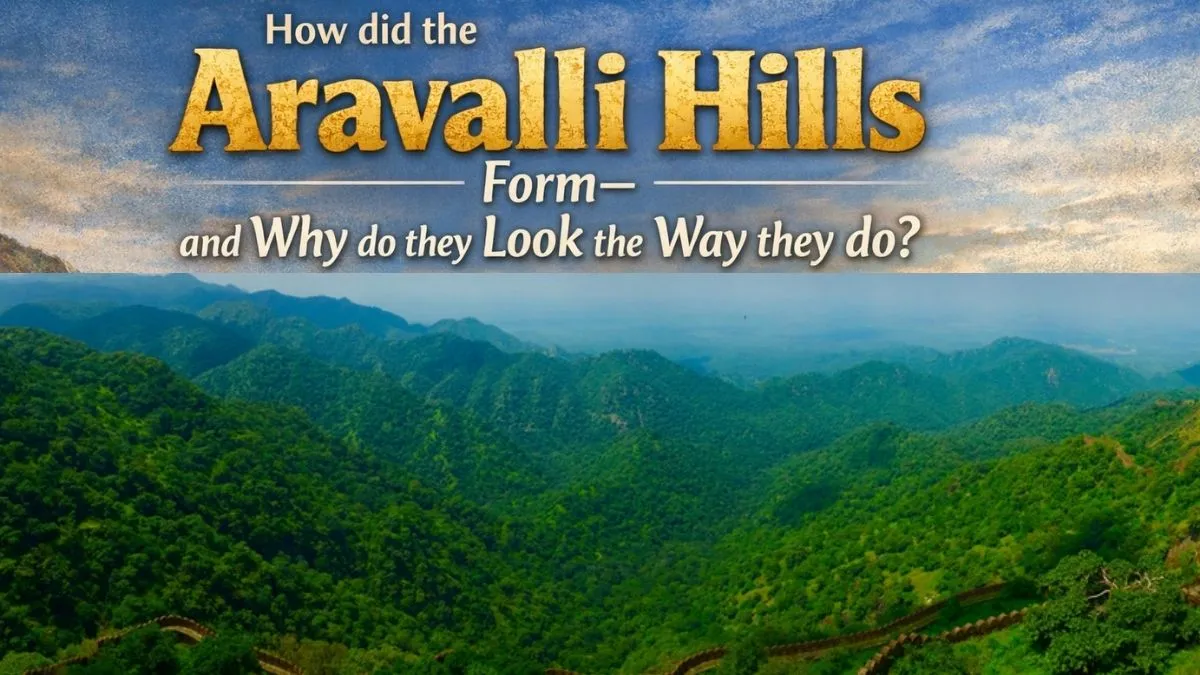
The Aravalli Hills may appear low and worn today, but they represent one of the oldest surviving mountain systems on Earth.
The Aravalli Hills, stretching across Gujarat, Rajasthan, Haryana, and Delhi, and it represents one of the oldest mountain systems on Earth.
Far from being young hills, the Aravallis preserve a geological record that spans over 2.5 billion years, making them crucial to understanding India’s ancient crust, tectonic evolution, groundwater behaviour, and environmental fragility.
According to the Geological Survey of India (GSI) and multiple peer-reviewed studies cited by government agencies, the Aravallis are not a single ridge formed at one time.
Instead, they are the eroded remnants of a massive ancient mountain belt known as the Aravalli–Delhi Orogenic Belt.
So, let’s dive more into detail through this article and know more about the Aravalli Range.
Also Read: List of Top 7 Animals Found in Arravllis in 2025
What is the Aravalli–Delhi Orogenic Belt?
The Aravalli–Delhi Orogenic Belt (ADOB) is a long, linear zone of deformed rocks that records repeated episodes of sedimentation, tectonic collision, metamorphism, and magmatic intrusion.
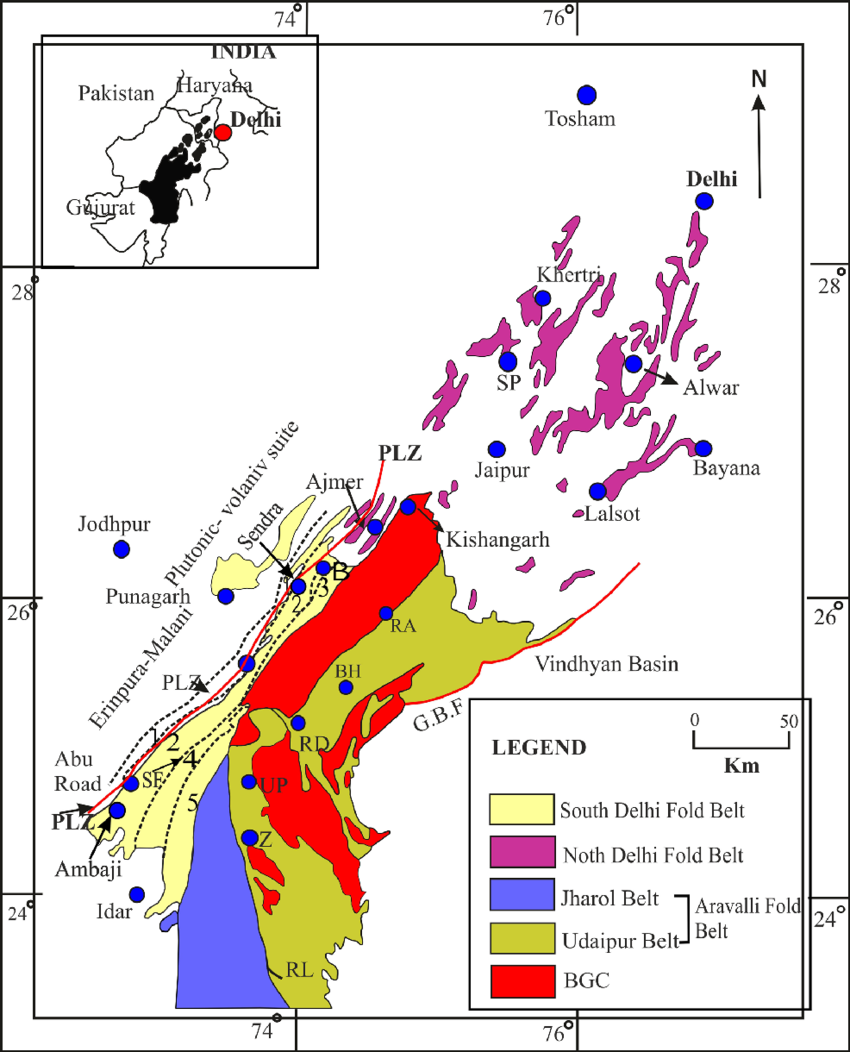
Source: researchgate
Key Geological Divisions
Geologists, including those from the Geological Survey of India, divide this belt into two major rock successions:
| Rock Group | Relative Age | Key Characteristics |
| Aravalli Supergroup | Older (≈ 2.5–1.8 billion years) | Sedimentary rocks later metamorphosed into quartzite, phyllite, and marble |
| Delhi Supergroup | Younger (≈ 1.7–1.0 billion years) | Volcanic-sedimentary rocks with intense folding and intrusion |
These groups together document the birth, burial, deformation, and erosion of an ancient mountain system.
Also Read: Aravali Range: Uniform Definition of Aravali Hills Explained Here as per Supreme Court
How were the Aravalli Hills formed?
The Aravalli Hills formed over 2 billion years ago from ancient tectonic plate collisions, specifically the meeting of the Bundelkhand and Marwar cratons, creating one of the world's oldest fold mountain systems through intense folding (orogeny)
But, before the formation of the Aravallis, is there an older crust?
Source: researchgate
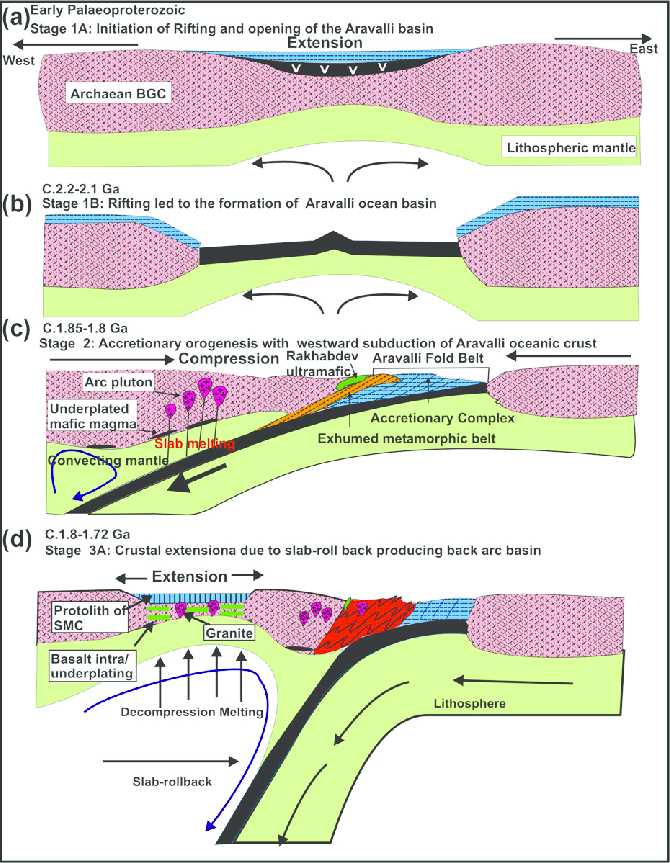
Yes. Studies referenced by theEarth Dynamics confirm that a pre-existing continental crustalready existed in northwestern India before the Aravalli sediments were deposited
So, before the formation of the Aravallis, the crystal stretching and thinning processes were executed, which led to the formation of basins.
These basins were gradually filled by:
-
Usually with River-borne sand and mud
-
Shallow marine sediments were deposited
-
Carbonate deposits (future limestone) were also found
-
Occasional volcanic material was also deposited
Important insight:
The Aravallis did not begin as hills. Their “raw material” first appeared as flat sedimentary layers.
Also Read: List of Top 7 Oldest Mountain Ranges in India
How did Sediments Turn into the Aravalli Hills Mountains?
Later, large-scale tectonic compression pushed crustal blocks together. According to GSI structural maps:
-
Sedimentary layers were folded
-
Rocks broke along faults
-
Massive slabs moved over each other along thrust faults
This process thickened the crust and built a mountain belt, similar in mechanism (but not age) to the Himalayas.
Why did the Aravalli Rocks Change its Nature?
As rocks were buried deeper, rising temperature and pressure transformed them:
| Original Rock | Metamorphosed Form |
| Sandstone | Quartzite |
| Mudstone | Phyllite / Schist |
| Limestone | Marble |
These transformations are widely documented in GSI memoirs and regional geological maps of Rajasthan and Delhi.
Did Magma Play a Role in Shaping the Aravallis?
Yes. Several phases of magmatic intrusion occurred long after sedimentation. The method which was used by GSI, Zircon dating,proves the age of the Aravalli Hills
| Intrusion | Age (Million Years) | Method |
| Chang Pluton | 967.8 ± 1.2 | Zircon U–Pb dating |
This proves that tectonic and thermal activity continued for hundreds of millions of years.
Also Read: List of Top 10 Youngest and Oldest Mountain Ranges in the World 2025
Why do the Aravalli Hills Look Low and Broken Today?
Do you know, is the Aravallis are Always in this Modest in Height? The answer is No. According to Science Direct, the Aravallis were once much taller.
So, What are the reasons behind the modest in height of the Aravalli Hills?
The answer is time.
-
It has been seen the continuous erosion by wind and water
-
Also, there is a differential weathering of rock types
-
There is also a lack of recent mountain-building activity
Hard rocks like quartzite survived as ridges, while weaker rocks eroded faster. As noted in a 2022 Delhi Basin review, today’s Aravallis are erosional remnants, not young mountains.
Source: forest.delhi.gov
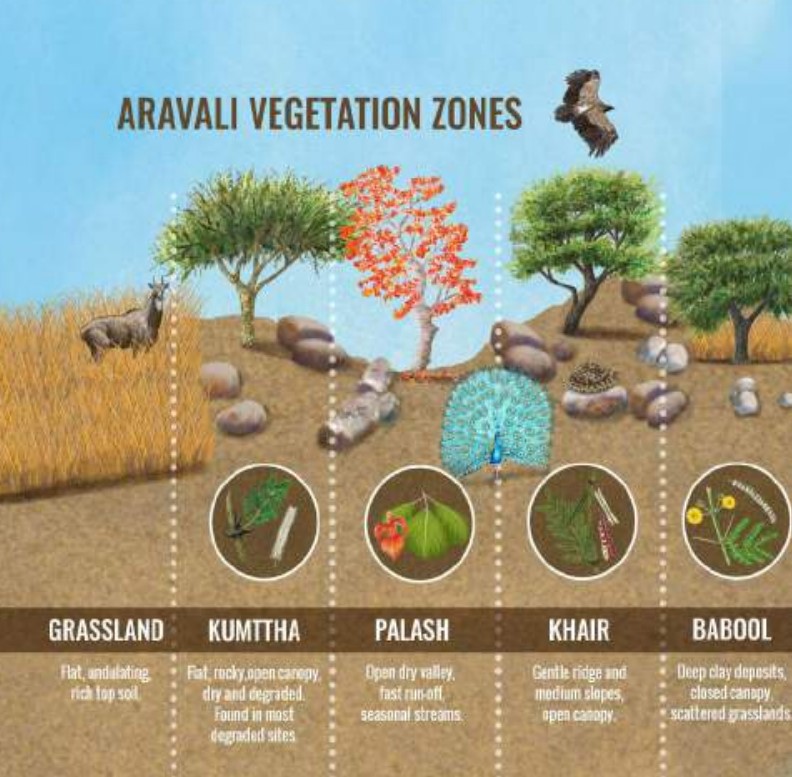
How does Aravalli Geology Influence Soil and Vegetation?
Aravalli Soils are so thin due to Quartzite-dominated ridges:
-
Break down slowly
-
Produce shallow, nutrient-poor soils
-
Retain little moisture
This directly affects to :
-
Forest regeneration in these areas
-
Agricultural potential also affected
-
Erosion vulnerability
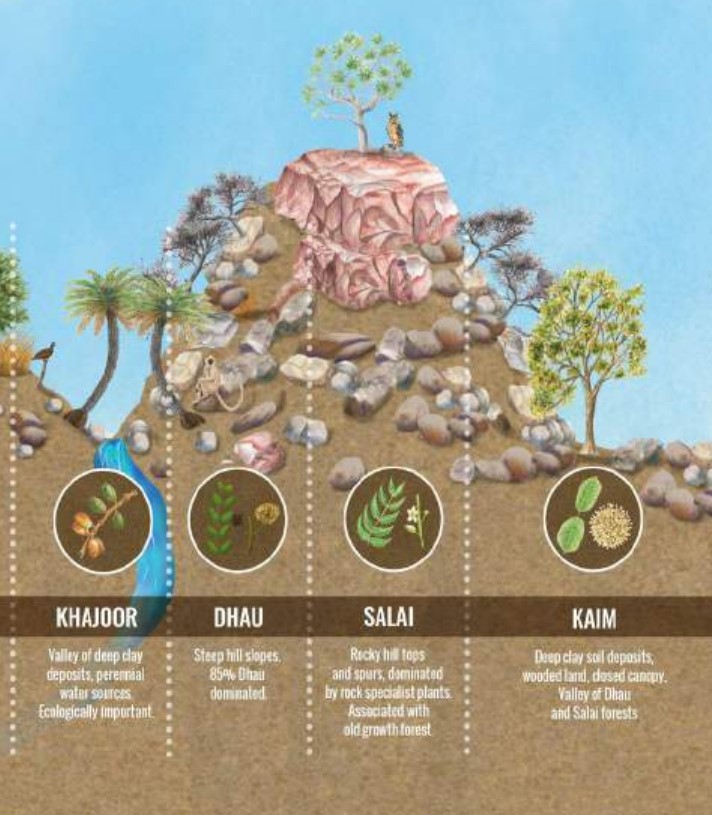
Source: forest.delhi.gov
How Do the Aravallis Control Groundwater Availability?
According to the Central Ground Water Board (CGWB):
-
Crystalline and metamorphic rocks have low primary porosity
-
Groundwater occurs mainly in:
-
Fractures
-
Joints
-
Weathered zones
Result:
Water availability is uneven—one village may have wells, while a nearby area remains dry.
What Role Does Climate Play in the Aravalli Ecosystem?
A 2025 government-linked climate study of Delhi’s Northern Ridge was recorded from Journal of Urban Ecology:
-
Average annual rainfall: Around 710 mm
-
Rain is concentrated in monsoon months
-
Long dry seasons with extreme heat
This climate favours:
-
Drought-resistant vegetation
-
Slow soil formation
-
High sensitivity to disturbance
Why Are the Aravallis Environmentally Fragile?
The Aravallis are so Environmentally Fragile because of:
-
Thin soils
-
Seasonal water availability
-
Slow natural regeneration
What Do Field Studies Show? A 2018 Asola Bhatti field study, cited in environmental assessments, observed:
-
Increased soil erosion due to quarrying
-
Reduced soil biodiversity
-
Partial recovery only where the disturbance stopped
Why are the Aravalli Hills so Important in the Modern Era?
There are various Strategic Importance of the Aravallis, which are :
-
Act as a climatic barrier limiting desert expansion
-
Recharge groundwater in semi-arid regions
-
Support biodiversity near major urban centres
-
Protect Delhi–NCR from extreme dust and heat
Government bodies, including the MoEFCC, recognise the Aravallis as a critical ecological zone, despite ongoing debates over their legal definition.
Conclusion
What Do the Aravalli Hills Truly Represent? By seeing today’s nature barrier created by various human activities, the Aravalli Hills are not only low ridges, but also these hills have a very deep-time memory of India’s earliest continental history.
The appearance of the Aravalli Hills is related to ancient oceans, tectonic collisions, magma intrusions, and billions of years of erosion.
Knowing about the Aravalli Hills is not only for science, but alsothe Aravalli Hills play a very important role in water security, climate resilience, and environmental protection, not only in the northwestern region of India, but also it is very important for pan India.



-1767600655249.png)


Comments
All Comments (0)
Join the conversation