Who Was the First Indian Mathematician to Study at Cambridge University?
Srinivasa Ramanujan was a pioneering Indian mathematician who overcame barriers to study at Cambridge University, under G.H. Hardy. His extraordinary talent and work in number theory, series, and continued fractions left a profound and inspiring legacy for future Indian scholars.
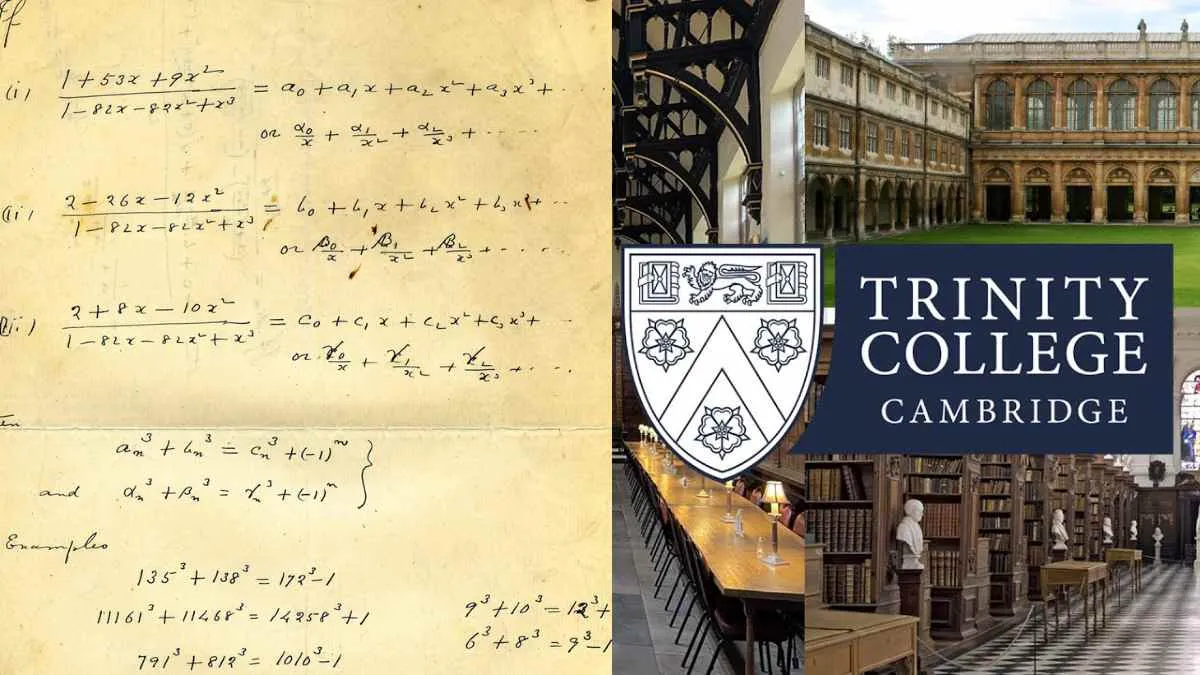
The innovative mathematical ideas that were created by talented mathematicians in India over many centuries helped to create modern science. Unfortunately, during the colonial period, very few places in India offered advanced maths training (e.g. at universities like Cambridge) compared to what was available to other countries. This means that an Indian going to a university like Cambridge would have not only been considered an amazing accomplishment academically, but also a significant moment culturally and historically.
Among the few early Indian scholars to have been able to overcome this barrier of entry into these western higher educational institutions, one man stands out because of his determination, creativity, and worldwide influence. He brought the mathematical heritage of India through many obstacles and difficulties to the halls of one of the finest universities in the world, and thus opened doors to future generations of Indian scholars, who now have the ability to realise that talent and intellectual ability are able to cross all barriers of time, place, culture, and circumstance.
Check Out: Who Invented Zero (0)?
Srinivasa Ramanujan’s Journey to Cambridge University
Srinivasa Ramanujan (1913): G.H. Hardy, a prominent British mathematician at Cambridge University received an extensive manuscript from Ramanujan containing many of his mathematical discoveries and results.
G.H. Hardy's Recognition of Ramanujan: Hardy saw Ramanujan's mathematical capabilities immediately and offered him an opportunity to work closely with Hardy and to study advanced mathematics at the University of Cambridge.
Arrangements for Travel and Finances: Through local sponsors and mathematicians in India, Ramanujan obtained the funding needed for travel to England to study advanced mathematical subjects.
The Journey to England: Ramanujan made his way to England in 1914 from India, leaving both his family and his homeland for the first time in order to attend Trinity College, Cambridge.
Experience at Cambridge: Ramanujan adjusted quickly to the academic atmosphere at Cambridge growing into a leading researcher through the publication of important research articles and the solution of difficult mathematical problems. While at Cambridge, Ramanujan and Hardy developed a good working relationship.
Contributions Made While at Cambridge: Ramanujan made significant advances in the fields of number theory, series, and continued fractions during his tenure at Cambridge.
Legacy of Ramanujan: Ramanujan's mathematical contributions while at Cambridge have made him one of the most respected mathematicians of all time and have provided inspiration to future generations of Indian mathematicians.
Conclusion
The experience of Srinivasa Ramanujan in coming to Cambridge demonstrates his extraordinary talents, steadfastness, and devotion, and will continue to motivate mathematicians for many years; they also illustrate India's role in contributing to Mathematics on a global scale.
Ayukta Zisha is an education journalist with over three years of experience in digital media. A graduate of St. Xavier’s College, she holds a Master’s degree in English along with a certification in Digital Marketing from IIT Delhi. Backed by a strong academic foundation in the humanities, she specializes in creating educational and general knowledge content across history, geography, literature, and current affairs. During her tenure at Jagran Josh, she worked extensively on U.S. news and global developments, curating informative and engaging content for a diverse readership. Her subject expertise and ability to simplify complex topics enable her to make complex information accessible to a wide audience. Beyond journalism, Ayukta is an avid reader and a published author.


![NIOS Hall Ticket 2026 [OUT] LIVE: Download Class 10th, 12th October Theory Admit Card at sdmis.nios.ac.in, Direct link here](https://img.jagranjosh.com/images/2026/October/16102026/NIOS-Hall-Ticket-2026.jpg)
![[OUT] UPSSSC PET Admit Card 2026 LIVE: यूपी पीईटी एडमिट कार्ड जारी, upsssc.gov.in पर Direct Link](https://img.jagranjosh.com/images/2026/October/15102026/UPSSSC-PET-Admit-Card-2026.jpg)