5 Eclipses in 2027: Check All Solar and Lunar Eclipse Dates, Timings and Visibility in India
Check the complete list of 5 solar and lunar eclipses in 2027, including annular, total and penumbral eclipses, their dates, timings and visibility in India.
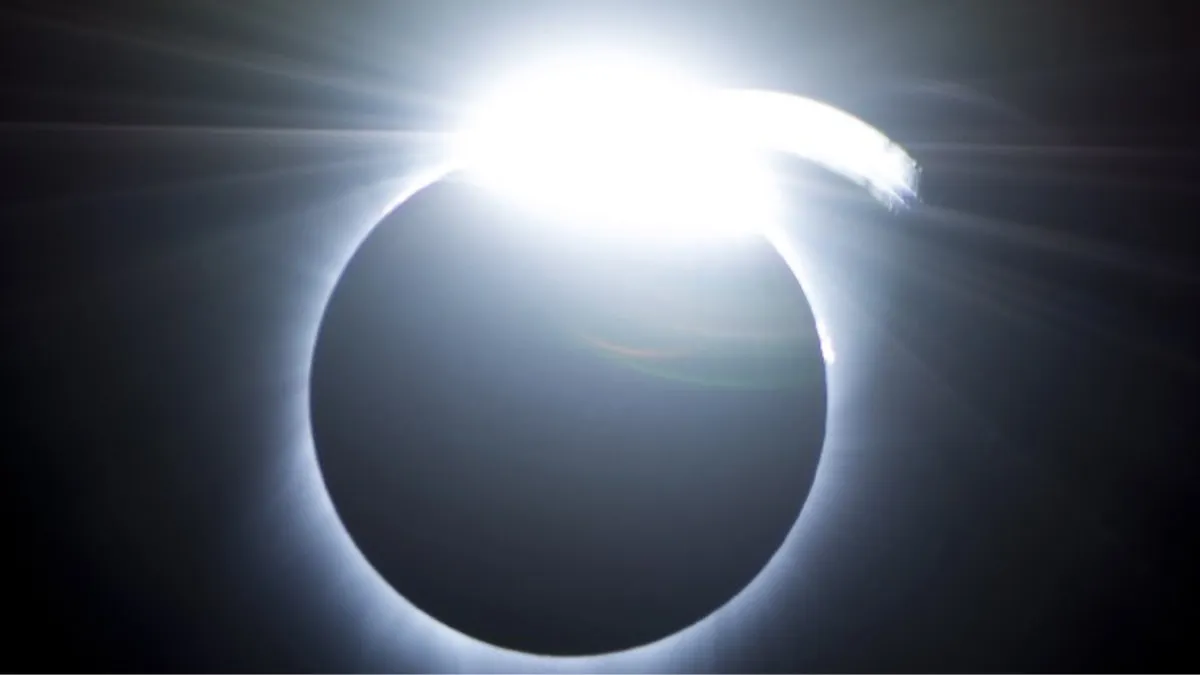
5 Eclipses in 2027: This year, 2027 will witness five astronomical eclipses, including two solar eclipses and three lunar eclipses. These celestial events will take place between February and August 2027, giving skywatchers several opportunities to observe different types of eclipses.
According to NASA, the five eclipses will include an annular solar eclipse on February 6, three penumbral lunar eclipses and a total solar eclipse on August 2, 2027.
Among these events, the August 2 total solar eclipse is particularly special because the Moon will completely cover the Sun along a narrow path across parts of Europe, North Africa and the Middle East.
Here is the complete list of solar and lunar eclipses in 2027, along with their dates, types and visibility details.
Dates of All Solar and Lunar Eclipses in 2027
According to NASA's eclipse calendar, five eclipses will occur in 2027. These include two solar eclipses and three lunar eclipses.
| Date | Day | Type of Eclipse | Eclipse Category |
| February 6, 2027 | Saturday | Solar Eclipse | Annular |
| February 21, 2027 | Sunday | Lunar Eclipse | Penumbral |
| July 18, 2027 | Sunday | Lunar Eclipse | Penumbral |
| August 2, 2027 | Monday | Solar Eclipse | Total |
| August 17, 2027 | Tuesday | Lunar Eclipse | Penumbral |
Note: The February 20 lunar eclipse date in NASA's Universal Time calendar falls on February 21 in Indian Standard Time (IST).
Solar and Lunar Eclipses in 2027: Complete Details
Let's understand the five eclipses expected in 2027, including their types, important features and visibility.
1. Annular Solar Eclipse: February 6, 2027
Source: NASA
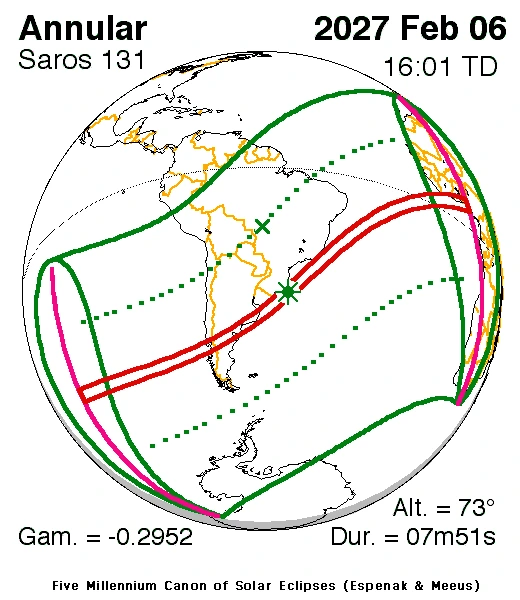
The first eclipse of 2027 will be an annular solar eclipse on February 6, 2027. During this event, the Moon will pass between the Earth and the Sun but will not completely cover the Sun.
As a result, a bright ring of sunlight will remain visible around the Moon's dark silhouette. This appearance is commonly known as the Ring of Fire.
-
Date: February 6, 2027
-
Day: Saturday
-
Type: Annular Solar Eclipse
-
Visibility: Parts of South America and Africa, along with Antarctica and surrounding ocean regions.
-
Visibility in India: Not visible
According to NASA, the maximum duration of the annular phase along the central path will be approximately 7 minutes and 51 seconds.
2. Penumbral Lunar Eclipse: February 21, 2027 as per India Indian Standard Time (IST)
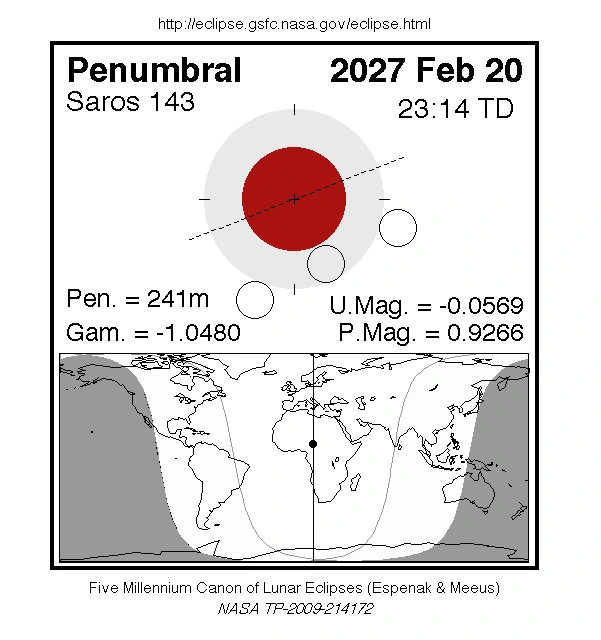
The second eclipse of 2027 will be a penumbral lunar eclipse on February 21, according to Indian Standard Time.
| Important Point To Note Down: February lunar eclipse falls on February 20 in UTC but February 21 in Indian Standard Time. |
Source: NASA
A penumbral lunar eclipse occurs when the Moon passes through the outer, lighter part of Earth's shadow, known as the penumbra.
During this event, the Moon may appear slightly darker than usual. Unlike a total lunar eclipse, it does not turn completely red.
-
Date: February 21, 2027 (IST)
-
Day: Sunday
-
Type: Penumbral Lunar Eclipse
-
Visibility: Asia, Europe, Africa, the Americas and other regions.
-
Visibility in India: Yes
The eclipse will be visible in India during the early morning hours. Its predicted timings for New Delhi are approximately 2:42 AM to 6:43 AM IST, with the maximum eclipse around 4:42 AM.
3. Penumbral Lunar Eclipse: July 18, 2027
Source: NASA
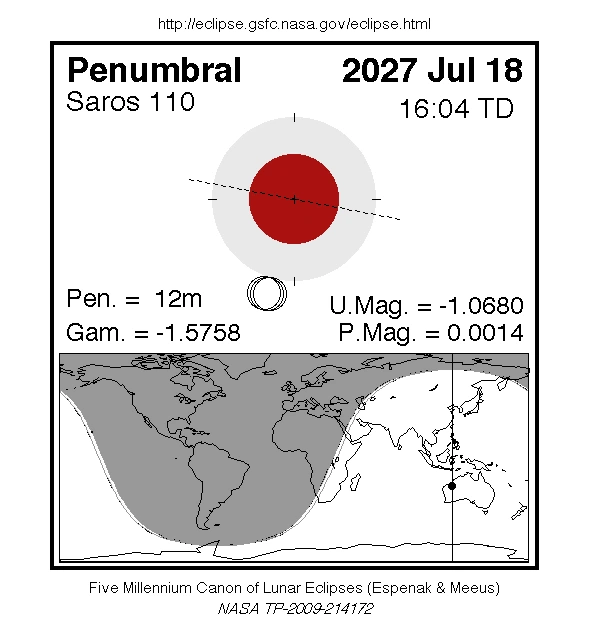
The third eclipse of 2027 will be another penumbral lunar eclipse on July 18.
During this event, the Moon will pass through the outer region of Earth's shadow. However, this eclipse will be extremely weak and difficult to notice with the naked eye.
According to NASA, the penumbral magnitude of this eclipse will be just 0.0014, making it one of the least noticeable lunar eclipses.
-
Date: July 18, 2027
-
Day: Sunday
-
Type: Penumbral Lunar Eclipse
-
Visibility: Parts of Asia, eastern Africa, Australia and the Pacific region.
-
Visibility in India: The event is extremely faint and may not be noticeable to observers.
The eclipse will reach its maximum at approximately 16:03 UTC (9:33 PM IST).
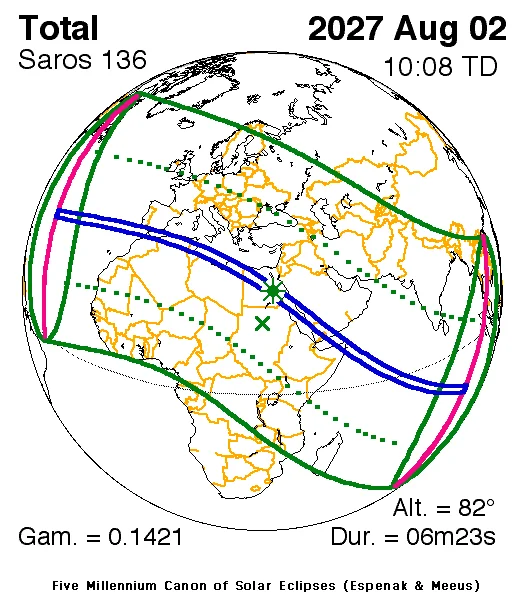
4. Total Solar Eclipse: August 2, 2027
Source: NASA
The eclipse is over, but the science is just starting — balloon data and corona images now head into analysis. The next total solar eclipse isn’t far off: Aug. 2, 2027, over southern Spain, North Africa, and the Middle East. Mark your calendars! 🗓️ Relive Aug 12's live show: https://t.co/aDbUi93d6s 📸: NASA/Bill Ingalls
— NASA Solar System (@NASASolarSystem) August 13, 2026
The fourth eclipse of 2027 will be a total solar eclipse on August 2. It is expected to be one of the most remarkable astronomical events of the year.
A total solar eclipse occurs when the Moon completely covers the Sun from the observer's viewpoint, making the Sun's outer atmosphere, known as the corona, visible.
The August 2 eclipse will be particularly special because its path of totality will pass through parts of southern Europe, North Africa and the Middle East.
-
Date: August 2, 2027
-
Day: Monday
-
Type: Total Solar Eclipse
-
Visibility: Spain, Morocco, Algeria, Tunisia, Libya, Egypt, Saudi Arabia and Yemen, among other regions.
-
Visibility in India: Partial solar eclipse.
According to NASA, the maximum duration of totality along the central path will be approximately 6 minutes and 23 seconds.
Although this will be a total solar eclipse globally, people in India will see only its partial phase. In New Delhi, the eclipse is expected to begin at approximately 3:53 PM and end at 5:02 PM IST.
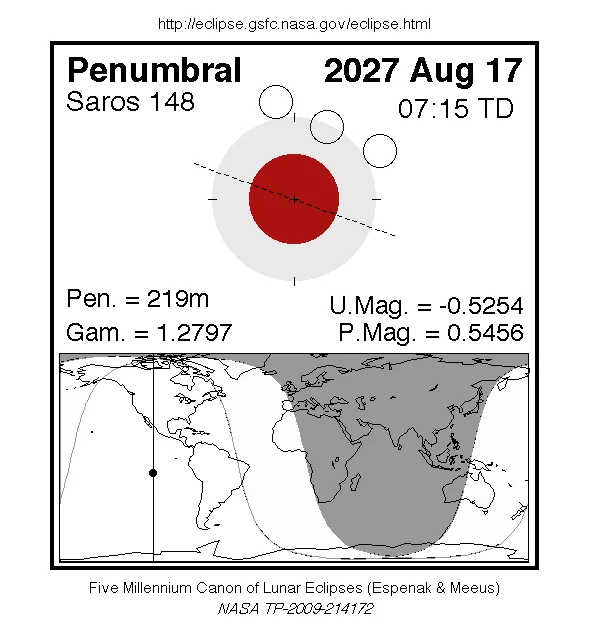
5. Penumbral Lunar Eclipse: August 17, 2027
Source: NASA
The fifth and final eclipse of 2027 will be a penumbral lunar eclipse on August 17.
During this event, the Moon will pass through Earth's outer shadow, causing a slight reduction in its brightness.
-
Date: August 17, 2027
-
Day: Tuesday
-
Type: Penumbral Lunar Eclipse
-
Visibility: Parts of the Americas, Australia, eastern Russia, New Zealand and other regions.
-
Visibility in India: Not visible.
According to NASA, the eclipse will begin at 05:24 UTC, reach its maximum at 07:14 UTC and end at 09:03 UTC. These timings fall during the daytime in India.
Which Eclipses Will Be Visible in India in 2027?
Out of the five eclipses scheduled in 2027, the February 21 penumbral lunar eclipse and August 2 partial solar eclipse will be observable from India. The July 18 event is exceptionally faint and should not be confused with an easily observable eclipse.
Here is a quick overview:
| Date | Eclipse | Visibility in India |
| February 6 | Annular Solar Eclipse | Not visible |
| February 21 | Penumbral Lunar Eclipse | Visible |
| July 18 | Penumbral Lunar Eclipse | Extremely faint |
| August 2 | Total Solar Eclipse | Partially visible |
| August 17 | Penumbral Lunar Eclipse | Not visible |
Important: Never look directly at the Sun during a solar eclipse. Always use certified solar eclipse glasses or appropriate solar viewing equipment. Ordinary sunglasses cannot protect your eyes from solar radiation.
What Is the Difference Between a Solar and Lunar Eclipse?
Solar and lunar eclipses occur when the Sun, Earth and Moon align in space. However, the position of these three celestial bodies determines the type of eclipse.
| Aspects | Solar Eclipse | Lunar Eclipse |
| Meaning | The Moon comes between the Sun and Earth. | Earth comes between the Sun and Moon. |
| Occurs During | New Moon | Full Moon |
| Shadow Falls On | Earth | Moon |
| Main Types | Total, Partial, Annular and Hybrid | Total, Partial and Penumbral |
| Viewing Safety | Requires special eye protection. | Safe to watch with naked eyes. |
What Are the Different Types of Eclipses?
There are different types of solar and lunar eclipses depending on how the Sun, Earth and Moon align.
| Eclipse Type | Meaning |
| Total Solar Eclipse | The Moon completely covers the Sun from the observer's viewpoint. |
| Partial Solar Eclipse | The Moon covers only a part of the Sun. |
| Annular Solar Eclipse | The Moon covers the centre of the Sun, leaving a bright ring around it. |
| Total Lunar Eclipse | The entire Moon passes through Earth's dark central shadow (umbra). |
| Partial Lunar Eclipse | Only a part of the Moon enters Earth's umbra. |
| Penumbral Lunar Eclipse | The Moon passes through Earth's lighter outer shadow (penumbra). |

Prabhat Mishra is a Subject Matter Expert and digital journalist with an extensive background in the competitive exam landscape and over 4 years of experience in education, national and international news, and current affairs. Over his tenure with top knowledge platforms like Mentorship India, IAS BABA, IAS SARTHI, and now Jagran Josh, he has a deep understanding of government exams like UPSC and State PCS, including UP and Bihar, as he has already qualified for the UPPCS 2022 Mains and Bihar 68th Mains. With his core expertise in history, polity, geography & current affairs, he specialises in creating well-researched, aspirant-centric content and simplifying complex topics for competitive examinations.