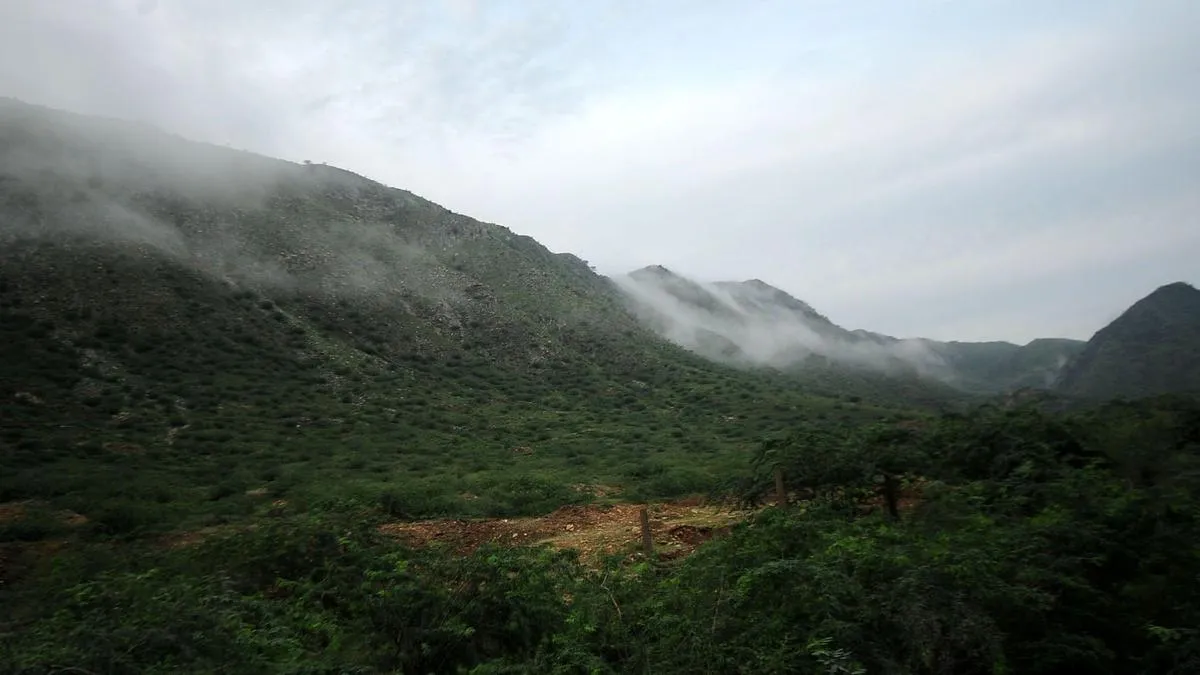
The Aravalli Range, which goes over 700 km from Gujarat to Delhi via Rajasthan and Haryana, is one of the earth's oldest mountain systems that date back to the Proterozoic Eon more than 2 billion years ago. The mountains were born from the collision of the floor plates long ago, but erosion has chipped away these peaks to them being just hills now, however, they are still very much alive and culturally significant as far as geology is concerned.
Geological Formation: A Billion, Year Tectonic Saga
-
Archean Basement (Over 2. 5 Billion Years Ago)
The Aravalli is based on the Archean Bhilwara Gneissic Complex, which was formed around 3. 02. 5 billion years ago by high grade metamorphism of ancient sedimentary and igneous rocks. The rigid sialic crust that resulted from this later changed to granitic batholiths, thus marking the early stages of cratonization.
-
Aravalli Orogeny (2. 21. 8 Billion Years Ago)
The collision of the Bundelkhand Craton (east) with the Marwar Craton (west) at around 2. 2 Ga impelled rifting, sedimentation, and volcanic activity in the basin that lied between them.
Eventually, the Aravalli Supergroup was formed by sediments and metavolcanic rocks, after which subduction, island arc formation, and continental suturing took place. The ice melted deep rocks under extreme pressure and thus forming syn, orogenic granites (1. 85 Ga); the elevation created the first Aravalli proto, mountains that were higher than present day Himalayas at the time of their formation.
Delhi Orogeny (1.7–1.0 Billion Years Ago)
-
A second crash (~1. 7 Ga) of the Aravalli, Bundelkhand block with Marwar Craton gave rise to the Delhi Supergroup, whose members include quartzites that form ridges such as Delhi Ridge.
-
Marked by the Great Boundary Fault (suture zone) and Phulad Ophiolite Suite.
Erosion and Modern Profile
The range was reduced from Himalayan heights to its present 6001, 722 m elevations (highest: Guru Shikhar, 1, 722 m) by billions of years of rain, wind, and temperature changes.
While erosion has worn down the mountain range, it is still tectonically active, as the earthquakes that continue to occur are evidence of its slow growth.
Ancient Human Presence
-
Pre, Harappan sites (Sothi, Siswal culture, ~6600 BP) and early stromatolites (3. 5 Ga) that were found in the Aravalli point to it as a birthplace of life and later of civilization.
-
Sacred to Hindus (e. g. , Mount Abu temples), Jains, and tribal communities; the area is full of stories and has many places for spiritual journeys.
Mineral Wealth and Economy
-
The area has the oldest mines in India (e. g. , Zawar lead, zinc, ~2 Ga) and is rich in copper, gold, iron, marble, and gypsum.
Quick Facts
| Aspect | Details |
| Length | ~700–800 km |
| States Covered | Gujarat, Rajasthan, Haryana, Delhi |
| Highest Peak | Guru Shikhar (1,722 m, Mt. Abu) |
| Age | 2.5–1.0 Ga (Proterozoic) |
| Key Events | Archean basement (>2.5 Ga); Aravalli Orogeny (2.2–1.8 Ga); Delhi Orogeny (1.7–1 Ga) |
| Geological Type | Eroded fold mountains |
Significance Today
The Aravalli acts as a vital ecological barrier, preventing desertification in Rajasthan and moderating Thar Desert expansion. However, mining, urbanization, and deforestation threaten its biodiversity hotspots
You may also like...
What is the Chemical Name of Table Salt?
What is the highest denomination note ever printed in India?





Comments
All Comments (0)
Join the conversation