List of Top 7 Animals that Turn White in Winter: Revealed
When winter arrives in the Arctic and high-altitude regions, nature executes a brilliant survival trick called seasonal camouflage. Animals like the Arctic Fox and Snowshoe Hare trade their brown summer coats for snowy white fur. This physiological change, triggered by daylight cycles, aids in stealth and insulation against freezing temperatures.
Key Points
- Daylight, not temperature, triggers color change in Arctic animals.
- White fur provides camouflage and insulation due to hollow hair shafts.
- Climate change causes a mismatch; white coats stand out with less snow.
Animals that turn white in winter: Did you know that daylight, not temperature, triggers the colour change in many Arctic animals? As the days grow shorter, the pineal gland in species like the Arctic Fox and Snowshoe Hare suppresses melanin production, causing their new fur to grow in pure white. This phenomenon, known as seasonal polyphenism, is distinct from albinism in animals, which is a genetic mutation.
According to the Alaska Department of Fish and Game, this white coat is not just for camouflage; hollow hair shafts in winter fur also trap warm air, acting as a high-tech insulator. Below, we reveal the top 7 animals that master this ghostly transformation to survive the brutal cold.
List of Animals that Turn White in Winter
Nature’s winter wardrobe is exclusive. The following animals are masters os seasonal camouflage. They have evolved to sync their appearance perfectly with the snowy landscape. This adaptation is critical for both predators, who need to hunt unseen, and prey, who must blend into the drift to survive.
| S.No. | White Animal Name | Scientific Name | Key Feature |
| 1 | Arctic Fox | Vulpes lagopus | Can survive temps as low as -58°F |
| 2 | Snowshoe Hare | Lepus americanus | Huge feet act as natural snowshoes |
| 3 | Ermine (Stoat) | Mustela erminea | Retains a black tail tip to confuse predators |
| 4 | Ptarmigan | Lagopus muta | Feathers cover even their feet for warmth |
| 5 | Peary Caribou | Rangifer tarandus pearyi | The only caribou subspecies to turn white |
| 6 | Collared Lemming | Dicrostonyx groenlandicus | Grows large "winter claws" to dig snow |
| 7 | Siberian Hamster | Phodopus sungorus | Coat whitens due to lack of sunlight |
Check Out: List of Animals that Hibernate the Longest on Earth
1. Arctic Fox

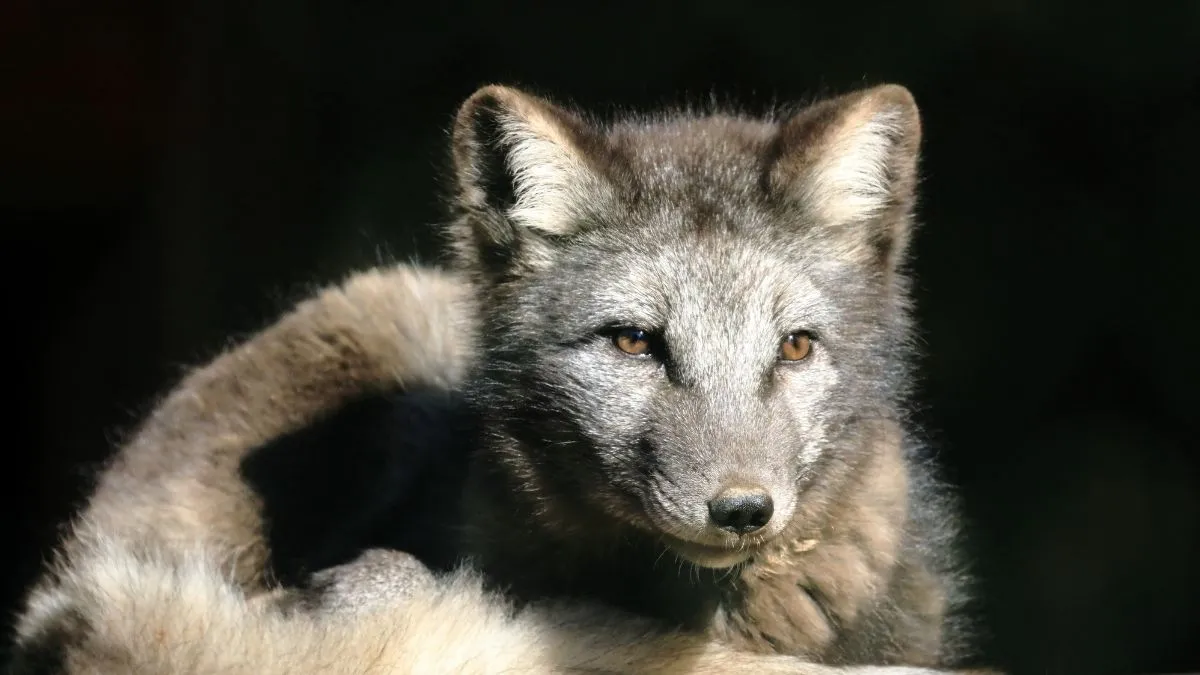
The Arctic Fox is the icon of the frozen north. Unlike albinism in animals, its white coat is a seasonal switch. In summer, they are brown or grey to match the tundra rocks. Come winter, their fur becomes incredibly dense, the warmest of any mammal for its size, allowing them to sleep on open snow at -50°C. Their white coat makes them nearly invisible to prey.
2. Snowshoe Hare

Named for their massive hind feet, Snowshoe Hares are the masters of evasion. Their transformation is triggered by the number of hours of sunlight (photoperiod). Interestingly, climate change is causing a "mismatch" for these animals that turn white; sometimes the snow melts early, leaving the white hares glowing like beacons on brown earth, making them easy targets for lynx and eagles.
3. Ermine (Stoat)

A fierce predator in a tiny package, the Ermine (or short-tailed weasel) turns pure white in winter, except for the black tip of its tail. This "white weasel" uses the black tip as a decoy; predators like owls strike at the tail tip instead of the body, allowing the Ermine to escape. Historically, their winter pelt was used to trim the robes of royalty.
4. Ptarmigan

While most birds migrate south, the Ptarmigan stays put. It is one of the few birds that moult their feathers to become completely white. Even their eyelids have white feathers to prevent frostbite! Their winter plumage is filled with air pockets that increase insulation, keeping their body heat trapped against their skin even during violent Arctic blizzards.
5. Peary Caribou

Found in the high Arctic of Canada, the Peary Caribou is the smallest caribou subspecies and the only one to turn white. While other caribou remain grey or brown, the Peary adopts a shaggy white coat to blend into the relentless ice fog. Their fur is hollow, which helps them float when swimming and traps vital body heat during the long, dark winter.
6. Collared Lemming

Image Credit - Govt. of Canada (canada.ca)
These small rodents are the primary food source for many Arctic predators. In the winter, they are the only rodents in North America that turn completely white. They also get huge, shovel-like claws on their front feet that change colour. This special adaptation lets them dig through hard-packed snow to get to willow twigs and roots, which keeps them fed and out of sight of snowy owls.
7. Siberian Hamster

Often kept as pets, the Siberian Hamster (or Winter White Dwarf Hamster) displays this trait even in captivity. If kept in a room with natural light cycles, their grey stripe fades, and they turn white as winter approaches. It is a rare example of animals that turn white in winter that you might actually see in a domestic setting, proving that biology is hard-wired.
Check Out: List of 5 Most Famous Animals that Migrate in Winter: Revealed
These animals show how smart evolution is, like how the Arctic Fox hunts and how the Snowshoe Hare gets away. But as the world's temperatures rise, this delicate balance is in danger because less snow makes these white coats more of a problem than a benefit. We can learn more about how fragile our winter ecosystem is by learning about these unique adaptations.

Harshita Singh is an education and general knowledge journalist with over 5 years of experience in educational writing. Specializing in US affairs and GK, Harshita has a track record of breaking down intricate geopolitical and historical subjects into clear, digestible insights for learners. Her strong background in text analysis, coupled with a Bachelor of Arts (Hons) in English from the University of Delhi, helps her produce authoritative, thoroughly researched content that empowers readers to engage confidently with global current affairs. For inquiries or academic insights, you can reach out to her directly at harshita.singh@jagrannewmedia.com.

-1789481527292_t.webp)