Who is the next CJI of India? Justice Surya Kant Becomes the 53rd Chief Justice of India
Next Chief Justice of India 2025: Justice Surya Kant has been formally recommended by outgoing Chief Justice B.R. Gavai to succeed him as the 53rd Chief Justice of India, with his swearing-in scheduled for November 24, 2025. His tenure, expected to last until February 2027, will span about 14 months, during which he is anticipated to steer the judiciary through crucial constitutional and societal challenges.
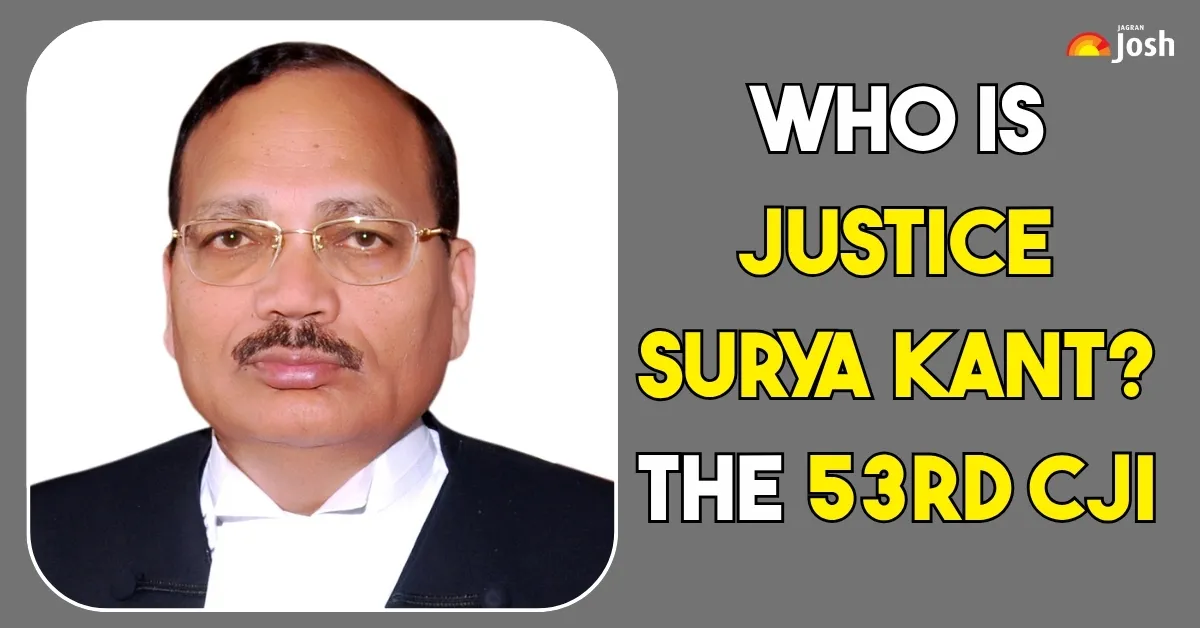
Justice Surya Kant has officially taken oath as the 53rd Chief Justice of India on November 24, 2025, succeeding Justice Bhushan R. Gavai, who retired a day earlier. Born on February 10, 1962, in Hisar, Haryana, Justice Kant is the first person from the state to hold the country’s top judicial post. Known for his sharp legal acumen and sensitivity to social issues, he began his career as an advocate in the Punjab and Haryana High Court before rising to become the Chief Justice of the Himachal Pradesh High Court and later a Supreme Court judge. He also serves as the Executive Chairman of NALSA, working to expand access to justice for marginalised communities. His tenure as CJI, which will run until February 9, 2027, is expected to focus on strengthening constitutional jurisprudence, clearing case backlogs, and advancing social justice initiatives. His appointment marks a significant milestone in India’s judiciary, blending continuity with a fresh regional representation at the highest level.
Who is Justice Surya Kant?

Justice Surya Kant is a sitting Judge of the Supreme Court of India. He is currently the second-most senior judge of the Supreme Court. He has been recommended for appointment as the 53rd Chief Justice of India (CJI), a position he is slated to assume on November 24, 2025. He will be the first person from Haryana to hold the top judicial post.
Education
Justice Surya Kant was born on February 10, 1962, in the village of Petwar in the Hisar district of Haryana.
- Early Schooling: He studied in a village school that lacked benches until he was in Class VIII.
- Graduation (1981): He graduated from the Government Post Graduate College, Hisar.
- Bachelor of Laws (LLB) (1984): He earned his law degree from Maharshi Dayanand University (MDU), Rohtak.
- He continued his academic pursuits while on the bench, securing a First Class First in his master's degree in law from the Directorate of Distance Education, Kurukshetra University.
Career
Chief Justice of India, Justice Bhushan Ramkrishna Gavai, recommends the name of Justice Surya Kant, the senior-most Judge of the Supreme Court, as his successor to be the 53rd Chief Justice of India.
— ANI (@ANI) October 27, 2025
Photo source: Supreme Court of India pic.twitter.com/3ibrilRFNe
Legal Practice
- Start of Practice (1984): Began practising law at the District Court, Hisar.
- High Court Practice (1985): Shifted his practice to Chandigarh to practice in the Punjab and Haryana High Court, specialising in Constitutional, Service, and Civil matters. He represented several universities, boards, corporations, banks, and the High Court itself.
- Advocate General, Haryana (2000): He was appointed the youngest Advocate General of Haryana on July 7, 2000, and held the office until his elevation to the bench.
- Senior Advocate (2001): He was designated as a Senior Advocate in March 2001.
Judicial Career
- Punjab and Haryana High Court (2004-2018): Elevated as a permanent Judge of the Punjab and Haryana High Court on January 9, 2004, where he served for over 14 years.
- Chief Justice, Himachal Pradesh High Court (2018-2019): Assumed charge as the Chief Justice of the High Court of Himachal Pradesh on October 5, 2018.
- Supreme Court of India (2019-Present): Elevated as a Judge of the Supreme Court of India on May 24, 2019.
Other Details
- Family Background: Born into a middle-class family in Hisar, Haryana. His father was a teacher. His journey is described as one from modest circumstances in a village, unlike many from families with strong legal backgrounds.
Notable Judgements and Contributions:
- Part of the bench that upheld the abrogation of Article 370.
- Part of the bench that kept the colonial-era sedition law in abeyance (directing no new cases be registered) until the government completed its review.
- Authored the Jasvir Singh judgement at the Punjab and Haryana High Court, directing the state to frame a scheme for conjugal and family visits for jail inmates.
- Directed the government to frame protections for domestic workers.
- Directed that one-third of seats in bar associations be reserved for women.
- Part of the bench that upheld the One Rank-One Pension (OROP) scheme as constitutionally valid.
- Directed a probe into the security lapse during the Prime Minister's 2022 Punjab visit.
- Other Positions: Served as a Member of the Governing Body of the National Legal Services Authority (NALSA) for two consecutive terms (2007-2011). He also serves as the Chairman of the Supreme Court Legal Services Committee (w.e.f., November 12, 2024).
- Retirement: He is due to retire on February 9, 2027.
Who is the new Chief Justice of India?
Shri Justice Surya Kant sworn in as the Chief Justice of India at Rashtrapati Bhavan. pic.twitter.com/M4nFbPjp11
— President of India (@rashtrapatibhvn) November 24, 2025
The new Chief Justice of India is Justice Surya Kant, who was sworn in on November 24, 2025, as the 53rd Chief Justice of India. He succeeded Justice B.R. Gavai and will serve until February 9, 2027.
Key Details About Justice Surya Kant:
- Appointment & Tenure: Justice Surya Kant took oath as the 53rd Chief Justice of India at Rashtrapati Bhavan, administered by President Droupadi Murmu. His tenure will last for about 15 months, ending on February 9, 2027, when he reaches the retirement age of 65.
- Predecessor: He succeeded Justice B.R. Gavai, who demitted office on November 23, 2025.
- Background: Born on February 10, 1962, in Hisar district, Haryana, Justice Kant rose from being a small-town lawyer to the country’s highest judicial office.
- Education: He earned his Master’s degree in Law from Kurukshetra University, securing first class first distinction.
Judicial Career:
- Served as Chief Justice of Himachal Pradesh High Court before elevation to the Supreme Court in May 2019.
- Known for landmark judgments on Article 370 abrogation, Bihar’s electoral rolls revision, and the Pegasus spyware case.
- Authored several notable rulings in the Punjab and Haryana High Court earlier in his career.
Why This Matters
The Chief Justice of India (CJI) is the head of the judiciary and plays a pivotal role in shaping constitutional interpretation, safeguarding rights, and ensuring justice. Justice Surya Kant’s tenure, though relatively short, will likely influence key constitutional and national issues given his track record of handling sensitive cases.

Kriti Barua is a skilled digital journalist and communications professional with 4+ years of experience, currently writing for the General Knowledge section at Jagran New Media. She has established herself as a subject matter expert in History, Geography, Trending National and International News, Sports, Science, and Defence, producing clear, reliable, and search-optimised content that connects with readers worldwide.
Kriti holds a BA degree from Delhi University and a one-year diploma in TV Production and Journalism, an academic background that adds research depth and strong storytelling instincts to her writing. Her experience spans brand writing, content marketing, and digital media, giving her a sharp understanding of what makes content both helpful to readers and visible in search.
At Jagran New Media, she applies this expertise to national and international news coverage, query-based articles, and in-depth pieces across her specialist subject areas. Her content is defined by easy language, factual accuracy, strong keyword strategy, and reader-friendly storytelling.