What is Article 4 of the NATO Treaty? Poland Calls for NATO Action After Russian Drones Cross Border
Article 4 of NATO allows any member country to request urgent consultations when it feels its security, political independence, or territorial integrity is under threat. It does not trigger military action but opens the door for dialogue and joint decisions. This article has been used in times of rising tensions, such as during conflicts near NATO borders. It helps members stay united and respond quickly to potential dangers through discussion and cooperation.
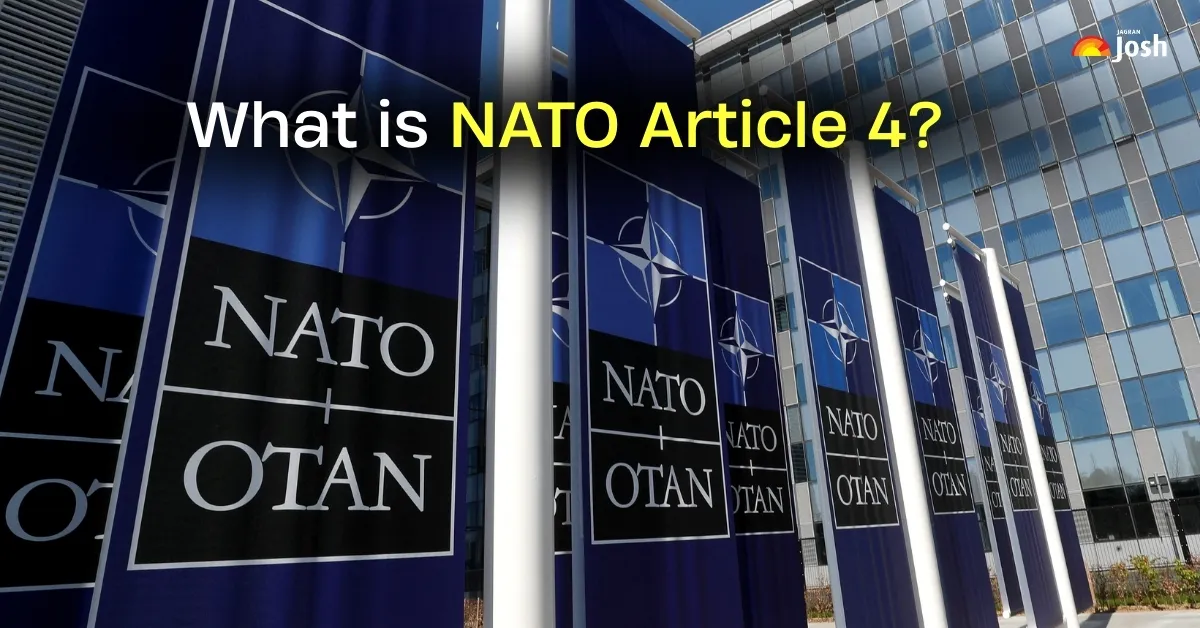
NATO stands for the North Atlantic Treaty Organisation. It is a group of countries that work together to keep peace and protect each other. NATO was formed in 1949 after World War II. Today, it has 31 member countries from Europe and North America. Article 4 is one of the key parts of NATO's founding treaty. It allows any member country to ask for a meeting when it feels threatened. This could be due to a security issue, political tension, or danger to its borders.
The goal is to discuss, share concerns, and determine the following steps to take. Article 4 does not mean war—it means discussion and support. In this article, we'll examine how Article 4 operates, its historical applications, and its relevance today. We'll also explore recent examples, like Poland's request after Russian drones entered its airspace.
What is NATO Article 4?
Article 4 of the North Atlantic Treaty is a foundational principle of the NATO alliance that allows a member country to request consultations with other members when its "territorial integrity, political independence or security" is threatened. It is essentially a diplomatic "early warning" system. Unlike Article 5, which is the collective defence clause, Article 4 does not automatically trigger a military response.
Instead, it convenes the North Atlantic Council, NATO's main political decision-making body, for an official discussion on the threat and a potential coordinated response. This response can range from a diplomatic statement to increased surveillance, joint exercises, or other measures, but it does not obligate allies to take military action.
How it works
When a member nation feels its security is threatened, it can formally invoke Article 4. Once invoked, all member countries meet to discuss the situation.
This process enables them to share information, assess the level of the threat, and determine a joint approach to address the issue. Since the founding of NATO in 1949, Article 4 has been invoked multiple times, often in response to geopolitical crises. Notable examples include:
- 2003: Turkey invoked Article 4 during the Iraq War, concerned about the potential for conflict to spill over its borders.
- 2014: Poland invoked the article after Russia annexed Crimea.
- 2022: Several Eastern European nations, including Poland, invoked it on the day of Russia's full-scale invasion of Ukraine to address the threat to the alliance's eastern flank.
- 2025: Poland again invoked the article after Russian drones violated its airspace.
What is NATO Article 5?
Article 5 is the cornerstone of the North Atlantic Treaty Organisation (NATO), embodying the principle of collective defence. It states that an "armed attack against one or more of them in Europe or North America shall be considered an attack against them all."
This means that if a NATO member nation is attacked, every other member is obligated to come to its assistance. This assistance can be any action that the individual member deems necessary, which could include the use of armed force. The principle of "one for all, and all for one" is what gives the alliance its strength and is its primary deterrent.
How it works
If a member country is subjected to an armed attack, it can request the invocation of Article 5. Once invoked, the North Atlantic Council—NATO's primary political decision-making body—meets to discuss the situation and determine a coordinated response. This response is not necessarily limited to military action. Members can provide a range of support, including:
- Military aid and reinforcement
- Economic sanctions against the aggressor
- Diplomatic pressure
- Intelligence sharing
Each member nation decides for itself what actions it will take to assist the attacked ally. However, the ultimate goal is always to "restore and maintain the security of the North Atlantic area."
History of Article 5 invocation
Since the founding of NATO in 1949, Article 5 has been formally invoked only once: after the terrorist attacks on the United States on September 11, 2001.
In the aftermath of the 9/11 attacks, NATO declared that the attacks were a foreign-directed act of aggression against the United States, thereby triggering the collective defence clause.
As a result, NATO launched Operation Eagle Assist, deploying Airborne Warning and Control System (AWACS) aircraft to patrol the skies over the United States, and Operation Active Endeavour, a naval operation in the Mediterranean to deter terrorist activity. NATO also led the International Security Assistance Force (ISAF) in Afghanistan.

Kriti Barua is a skilled digital journalist and communications professional with 4+ years of experience, currently writing for the General Knowledge section at Jagran New Media. She has established herself as a subject matter expert in History, Geography, Trending National and International News, Sports, Science, and Defence, producing clear, reliable, and search-optimised content that connects with readers worldwide.
Kriti holds a BA degree from Delhi University and a one-year diploma in TV Production and Journalism, an academic background that adds research depth and strong storytelling instincts to her writing. Her experience spans brand writing, content marketing, and digital media, giving her a sharp understanding of what makes content both helpful to readers and visible in search.
At Jagran New Media, she applies this expertise to national and international news coverage, query-based articles, and in-depth pieces across her specialist subject areas. Her content is defined by easy language, factual accuracy, strong keyword strategy, and reader-friendly storytelling.