-1764574158293.webp)
Choosing the right educational environment is one of the most critical decisions a parent makes, as the school shapes a child's character, academic foundation, and future career path. In India, parents primarily weigh the merits of two contrasting systems: private institutions and government-run schools. While both sectors are crucial pillars of the nation's education policy, they operate under fundamentally different funding models, objectives, and regulatory pressures.
The ongoing debate centers on quality versus access. Government schools, financed by public funds, prioritize equality and social integration, ensuring that education is accessible to every child up to age 14, as mandated by the Right to Education Act. Conversely, private schools, relying on tuition fees and private management, focus on delivering a premium educational product, often boasting better infrastructure and academic results that appeal directly to a highly aspirational, fee-paying clientele. Understanding the deep differences across core factors like cost, curriculum, and faculty quality is essential for making an informed decision.
Check: Difference between kendriya vidyalaya and navodaya vidyalaya
Things to Know: Private vs. Government Schools
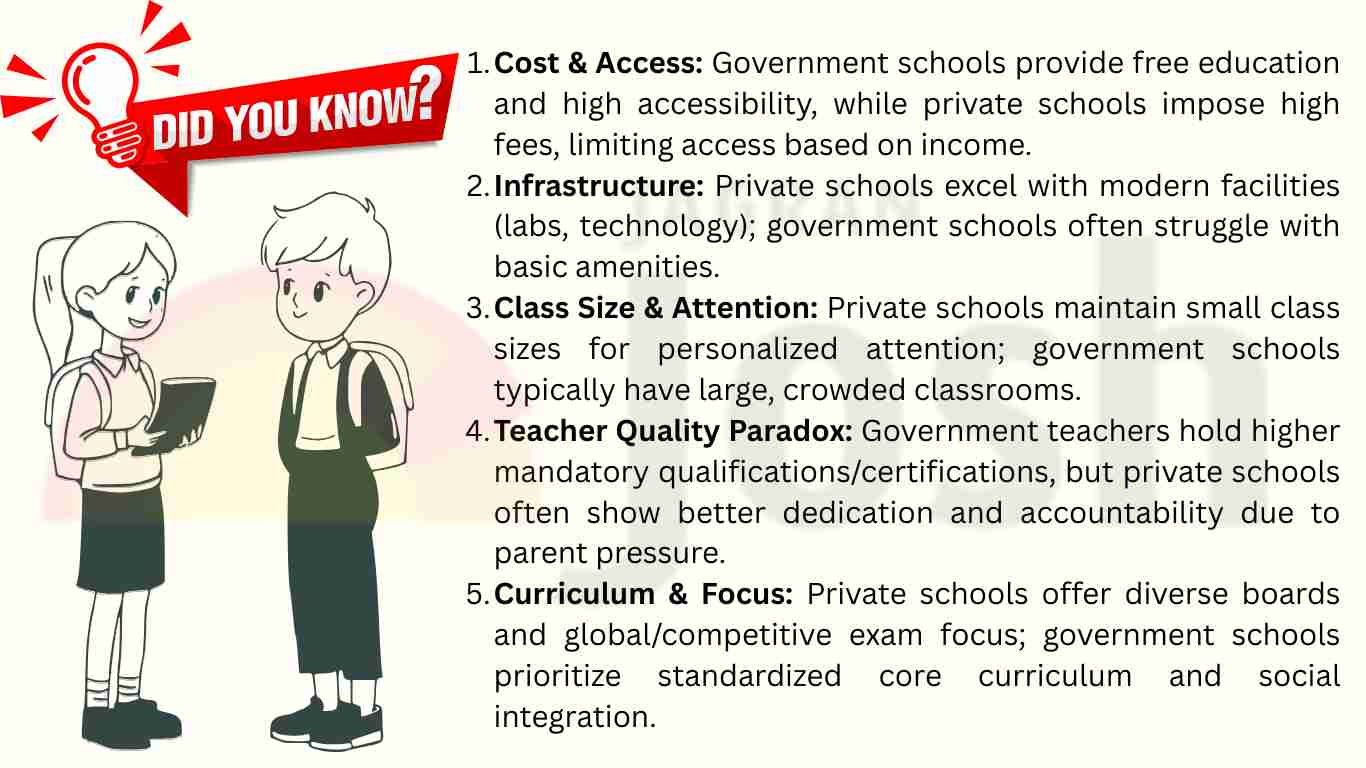
Private Schools vs Government Schools: Key Differences
Here is a detailed, point-by-point comparison of the two schooling systems:
S.No. | Feature | Private Schools (Unaided) | Government Schools (Public/State-funded) |
| 1. | Funding Source | Primarily funded by Tuition Fees and private entities. | Funded entirely by Local/State/Central Government taxes. |
| 2. | Cost to Parents | High; requires payment of annual fees, tuition, and extra activity charges. | Free or very low cost (often free up to Class 8 under the RTE Act). |
| 3. | Class Size | Generally smaller (e.g., 1:25 to 1:35), allowing for more individual attention. | Often much larger (e.g., 1:40 to 1:60), leading to generalized instruction. |
| 4. | Curriculum Used | High flexibility; often follow national boards (CBSE) or international boards (ICSE/IB). | Strictly follow the State Board or CBSE syllabus prescribed by the government. |
| 5. | Medium of Instruction | Usually English is the primary medium of instruction. | Often the Regional Language (Vernacular) is the primary medium. |
| 6. | Infrastructure | High-end facilities, smart classrooms, advanced labs, and well-maintained sports grounds. | Often basic, sometimes lacking essential amenities like functional labs or computer rooms. |
| 7. | Teacher Qualification | Teachers are often highly qualified (Post-Graduate), but state certification is sometimes optional. | Teachers are mandated to be certified and recruited through state examinations. |
| 8. | Teacher Accountability | Higher accountability to management and fee-paying parents for results. | Lower direct accountability to parents; regulated by government norms. |
| 9. | Extracurriculars | Wide range: music, swimming, robotics, drama, specialized sports coaching. | Limited range, typically basic sports and mandated national programs (NCC, Scouts). |
| 10. | Admission Process | Highly selective, often requiring entrance tests, interviews, and specific demographic quotas. | Open and non-selective to all students in the local area; focus is on inclusion. |
| 11. | Academic Focus | Performance and competitive exam success (grade-driven environment). | Foundational knowledge and universal basic education. |
| 12. | Transferability | CBSE-Private schools offer easy national transfer; ICSE can be harder. | Transfers within the same state system are usually easier. |
| 13. | Technology Use | High adoption rate of smart boards, tablets, and AI-assisted learning. | Variable; often limited by budget and infrastructure availability. |
| 14. | Student Diversity | Less socio-economic diversity due to high fee barriers. | High socio-economic diversity (children from all backgrounds study together). |
| 15. | Innovation in Pedagogy | High freedom to adopt new teaching methods (AI integration, project-based learning). | Limited by standardized syllabi and government protocols. |
| 16. | Parental Involvement | High; often mandatory participation in school events and governance. | Variable; usually limited to parent-teacher meetings (PTMs). |
| 17. | Accountability for Fees | Directly accountable to parents for quality delivered against fees charged. | Accountable to the state government and education department. |
| 18. | Academic Pressure | Generally higher academic pressure due to competition and parent expectations. | Generally lower academic pressure; more relaxed environment. |
The debate between private and government schools is ultimately a matter of aligning the school's strengths with the child's needs. While private schools provide better physical infrastructure and lower student-teacher ratios, which benefit academic results, they create a steep financial and social barrier. Government schools, conversely, offer high social equity and free access, led by highly qualified, certified teachers. The best choice is the system that addresses your child's learning style while remaining financially sustainable for the family, recognizing that consistency and parental engagement matter most in determining a child's success.
Also Check: CBSE vs ICSE vs State Boards – Which One Is Better for You?
Also Check: Rote Learning vs. Competency-Based Learning (CBQ)


-1764501141623.jpg)
-1764576422611.jpg)

Comments
All Comments (0)
Join the conversation