Which is the Largest Monument in India?
India's monumental landscape features diverse record-holders, led by the Statue of Unity, the world’s tallest statue at 182 meters . This scale extends to massive religious sites like the Temple of Vedic Planetarium and engineering marvels like the Sardar Sarovar Dam, representing a fusion of ancient heritage and modern ambition.
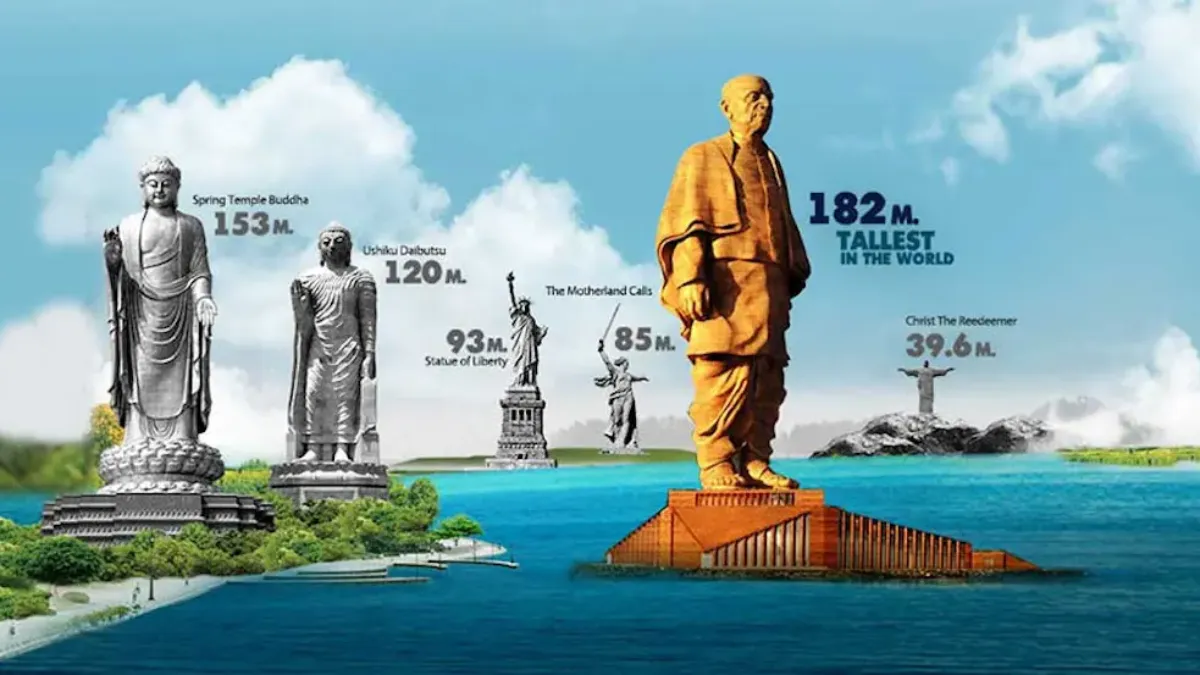
The Statue of Unity, standing at 182 meters, in Gujarat, is the tallest monument in India as a statue. Other contenders emerge depending on metrics like area or volume, such as vast temple complexes or ancient structures.
Defining "Largest" within India
India boasts monumental architecture from ancient temples to modern mega-statues, but "largest" varies by criteria like height, volume, or area. Of course, the Statue of Unity dominates in terms of being the world's tallest statue; sprawling religious sites vie for scale. Recent projects such as the Temple of Vedic Planetarium aim at rewriting records.
Largest by Height : Statue of Unity
The Statue of Unity, dedicated to Sardar Vallabhbhai Patel, stands 182 meters tall and is the tallest statue in India and the world. The statue is situated near the Sardar Sarovar Dam in Kevadia, Gujarat, and was unveiled in 2018 after using 70,000 tonnes of materials, including bronze cladding. Overall, it covers an area of more than 2 hectares with viewing galleries and is surrounded by a man-made lake measuring 12 kilometers in length.
Recommended Reading:
List of 9 Fruits That Grow In the Desert
Largest in area: Temple complexes
Angkor Wat-scale faith destinations place India in the forefront, with the under-construction Temple of Vedic Planetarium in Mayapur, West Bengal, which when completed will be the largest in the world at 700 acres. The delayed-beyond-2024 ISKCON project includes a 1.5-acre sanctum that can fit 10,000 visitors and will incorporate research centers. Historic sites like the Brihadisvara Temple in Thanjavur measure 102,400 square meters as major Hindu complexes.
Largest by Volume: Dams and Pyramids?
No one pyramid overshadows the landscape like Mexico's Cholula, but the Sardar Sarovar Dam-which is connected to the Statue of Unity-is India's second-biggest concrete gravity dam by volume at 6.82 million cubic meters. Ancient structures, such as those which compose much of the Taj Mahal and Ellora Caves, also contribute hugely but without any records of exact volumes well beyond modern dams. Traditional monuments are often eclipsed in bulk by such feats of engineering.
Key Monuments Comparison
| Monument | Type | Height (m) | Area/Volume | Location |
|---|---|---|---|---|
| Statue of Unity | Statue | 182 | 2+ hectares | Gujarat |
| Temple of Vedic Planetarium | Temple Complex | N/A | 700 acres | West Bengal |
| Sardar Sarovar Dam | Engineering Monument | 163 | 6.82M m³ | Gujarat |
| Brihadisvara Temple | Temple | N/A | 102,400 m² | Tamil Nadu |
| Taj Mahal | Mausoleum | 73 | ~17 hectares | Uttar Pradesh |
Other Notable Contenders
India's monuments landscape includes: Upcoming giants: Vrindavan Chandrodaya Mandir-213 m tall, 62 acres, and Viraat Ramayan Mandir targeting tallest religious records.
Historical statues include the following: Hanuman Murti in Nandura, 32 meters; different Bahubali figures, up to 31 meters. Iconic mausoleums: Taj Mahal, vast by cultural footprint but not by raw metrics.
Also Read: Why Did Saudi Arabia Witness Snowfall in the Desert after 30 years? Know more here

Kirti Sharma is a journalist in the education domain with three and a half years of experience creating high-quality content for the education technology (EdTech) and digital media industries. She has an expertise in covering education news. Kirti has experience in writing data backed informational pieces on General knowledge.
Kirti holds a Bachelor of Arts degree, which helped build her strong foundation in writing and research. Over the course of her career, she has brought her skills to a variety of well-known companies, including ThoughtPartners Global, Infinite Group, and MIM-Essay. Through these roles, she has learned how to take complex information and turn it into engaging, easy-to-understand content for readers online.


-1792838780900_t.webp)



.jpg)
![[OUT] UPSSSC PET Admit Card 2026 LIVE: यूपी पीईटी एडमिट कार्ड जारी, upsssc.gov.in पर Direct Link](https://img.jagranjosh.com/images/2026/October/15102026/UPSSSC-PET-Admit-Card-2026.jpg)