Who Was Archimedes? Check Biography, Inventions & Key Discoveries!
Disocver who Archimedes was. Learn about his biography, inventions, mathematical breakthroughs, engineering innovations, and enduring scientific legacy.
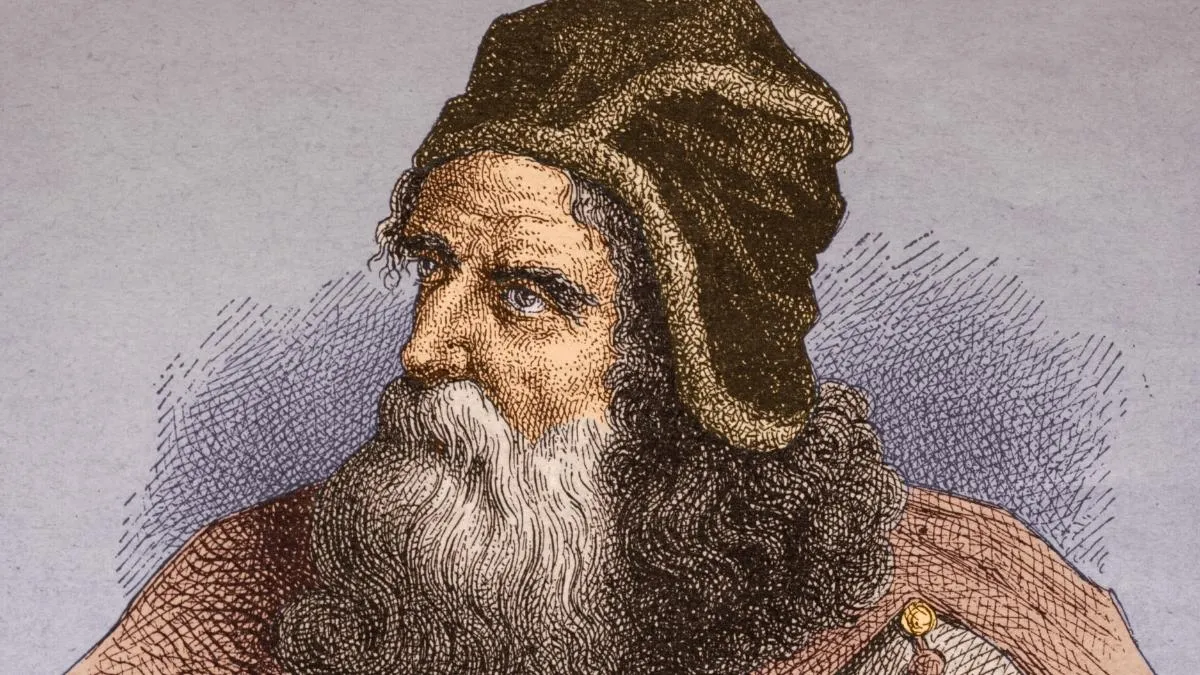
Do you know Archimedes of Syracuse (c. 287–212 BCE) is celebrated as one of history’s greatest scientific minds?
He was a mathematician, physicist, engineer, inventor, and astronomer. Moreover, he shaped principles that still underpin modern science. Born in the Greek colony of Syracuse in Sicily, he is believed to have studied in Alexandria before returning home, where he spent his life solving problems for King Hiero II and pushing the boundaries of mathematics and engineering. Let us learn about his early life, education, achievments and more through this blog.
Early Life and Education
Archimedes was born around 287 BCE in Syracuse, Sicily, to an astronomer father, Phidias. He likely came from a well‑to‑do or noble family, possibly connected to the city’s ruling dynasty, as per Archimedes Palimpsest.
As a young man, he travelled to Alexandria, Egypt, a major centre of learning, to study mathematics and geometry, where he was influenced by the successors of Euclid.
After completing his education, Archimedes returned to Syracuse, dedicating himself to research, inventions, and the defence of his city. This blend of elite upbringing and exposure to advanced scholarship laid the foundation for great work in mathematics, physics, and engineering.
Archimedes and His Groundbreaking Mathematical Work
He has been one of the greatest contributors to geometry were he laid transformative foundations for integral calculus nearly two thousand years later. At the centre of Archimedes’ legacy is his remarkable ability to blend abstract mathematics with real-world application.
Some of Archimedes’ Key Mathematical Achievements
-
Calculated areas and volumes of complex shapes with unprecedented accuracy
-
Approximated π (pi) more precisely than any mathematician before him
-
Discovered the ratio between a sphere and its circumscribed cylinder (2:3)
-
Pioneered methods that foreshadowed modern calculus
One of his proudest discoveries was the sphere-to-cylinder ratio. It was so meaningful that he requested it be engraved on his tombstone.
Engineering Innovations That Changed the Ancient World: Archimedes was equally influential as an engineer. His mechanical inventions demonstrated an advanced grasp of physics and practical mechanics.
Major Inventions Attributed to Archimedes
-
Archimedes’ Screw: It was a rotating spiral device used for lifting water
-
Compound pulley systems: They enabled heavy loads to be moved with minimal effort
What are the Key Contributions of Archimedes?
One of the major achievements and contributions of Archimedes are shown in the table below:
| Contribution Type | Notable Achievement | Impact |
| Mathematics | Approximation of π using 96-sided polygons | Foundation for modern calculations involving circles |
| Geometry | Sphere-to-cylinder volume ratio | Landmark result in the study of solids |
| Physics | Archimedes’ Principle of buoyancy | Core concept in fluid mechanics |
| Engineering | Archimedes’ Screw | Still used today for irrigation and drainage |
| Mechanics | Lever and pulley systems | Revolutionised mechanical advantage theory |
(Source Note: Information on Archimedes’ life, work, and mathematical contributions is drawn from Encyclopaedia Britannica, the Stanford Encyclopedia of Philosophy, the MacTutor History of Mathematics Archive, and classical historical texts. Interpretations of his discoveries may vary slightly across sources.)
What was the Eureka Moment and Scientific Legacy?
The famous “Eureka!” story highlights his discovery of buoyancy while solving a problem about a possibly impure royal crown. By noticing water displacement in a bath, he articulated the principle now known as Archimedes’ Principle, a fundamental law in physics classes across the world.
Despite being a peaceful scholar, Archimedes also designed defensive mechanisms during the Roman siege of Syracuse. Sadly, he was killed in 212 BCE by a Roman soldier while engrossed in a geometric drawing, reportedly saying, “Do not disturb my circles.”
Archimedes is widely regarded as one of the greatest mathematicians of ancient history. You can explore more legendary figures from the same era in our List of Greatest Mathematicians in Ancient History.
Therefore, his influence endures across mathematics, engineering, physics, architecture, and scientific philosophy.