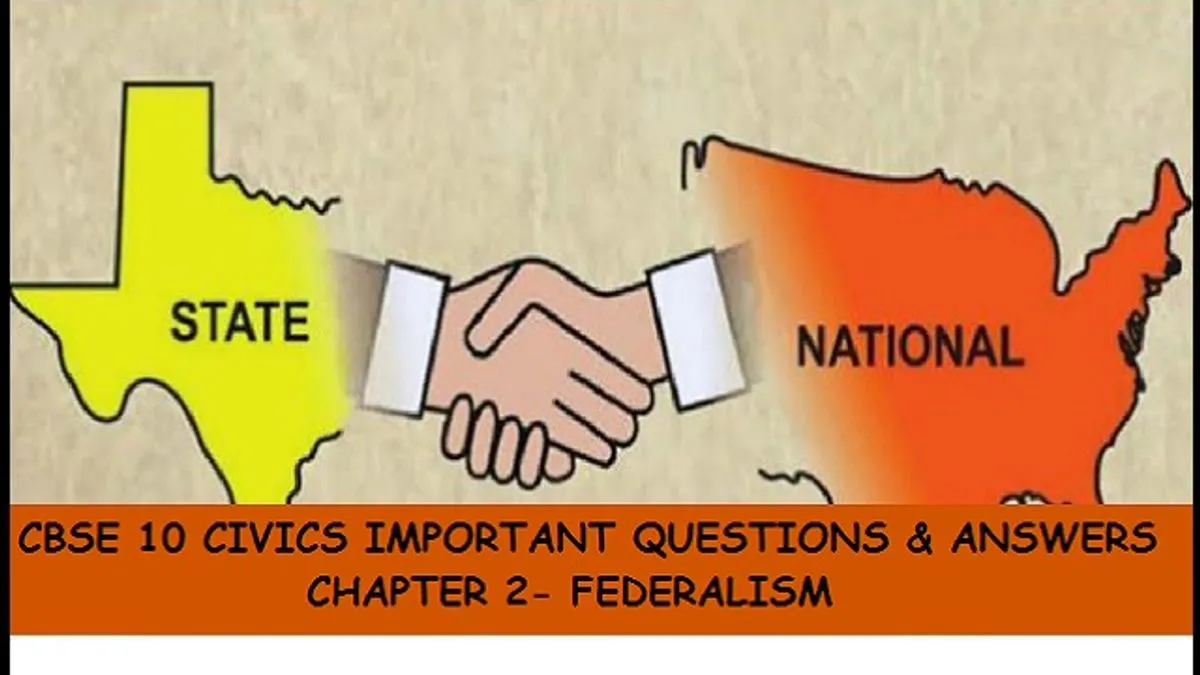
CBSE 10th Social Science Board exam is on 18th March 2020. For your chapter-wise preparation of Civics, check some of the important questions and answers of Chapter 2- Federalism. The mentioned questions are from the NCERT textbook (Democratic Politics- II) and the latest CBSE Sample paper. The given questions are expected in CBSE Class 10 Board Exam 2020.
Q1- Mention three features of Indian Federalism.
Ans- The three features of Indian Federalism are:
- Indian Federalism has a threefold distribution which is based on three lists i.e. Union, Concurrent and State list
- Supreme court and High Court are responsible for sorting out the dispute between the centre and the state
- The centre can legislate on residuary subjects
CBSE 10th Social Science Board Exam 2020: Important MCQs of Civics (All the Chapters)
Q2- What is that one feature in the practice of Federalism of India that is similar to Belgium and one that is different.
Ans- Just like Belgium, the Central government of India has to share its power with the regional governments. However, Belgium has a community government in addition to state and central government, which doesn’t exist in India.
Q3- Mention the main difference between the federal form of government and the unitary one.
Ans- Central government in a federal form shares its powers with various constituent units of the country.
While in a Unitary government, the power is exercised by only one form of government.
Q4- What were the major steps that were taken by the Indian government towards decentralization in 1992.
Ans- The major steps taken towards decentralization in 1992 were:
- Bringing reservation of at least one-third of all the positions for women
- Constitution bought mandate for holding regular elections of local government bodies
- The state governments are to share some revenue and power with local government bodies
CBSE 10th Social Science Board Exam 2020: Important MCQs of History (All the Chapters)
CBSE 10th Social Science Board Exam 2020: Important Questions & Answers of History - All Chapters
Q5- Distinguish in points between the Federal and Unitary systems of Government.
Ans- The difference is mentioned in the points below:
- Under the unitary system of the government, either there is only one level of government or there are sub-units that are subordinate to the central government. The central government is authorized to pass orders to local and provincial
- In the federal system government, the powers are divided at Union and State level. In some countries, it is even at local self-level. In the Federal system, the central government is not authorized to order the state government to do something.
Q6- Mention two differences between the local government before and after the constitutional amendment in 1992.
Ans- The two differences are:
| Before the Constitutional Amendment in 1992 | After the constitutional amendment in 1992 |
| Elections were not conducted regularly | It became mandatory to hold regular elections |
| The local government did not contain any of their own powers and resources | The state governments are now required to share some power and revenue with the local government bodies |
CBSE 10th Social Science Board Exam 2020: Important MCQs of Civics (Chapter 2- Federalism)
Q7- Mark one distinguishing feature of a Federal Government:
- Power is distributed among the executive, legislature and judiciary
- National Government gives some power to the provincial government
- Governmental power is divided between the different levels of government
- Elected officials exercise the supreme power of the government
Ans- The correct answer is- Governmental power is divided between the different levels of government.
Q8- Go through the few subjects in various lists of Indian constitution. Group them in Union, State and Concurrent lists and provide them below.
- Defence
- Police
- Agriculture
- Banking
- Education
- Forest
- Trade
- Communication
- Marriages
Ans- The subjects are divided below:
| Lists | Subjects |
| Union List | Banking, Defence, Communication |
| Concurrent List | Forest, Education, Marriages |
| State List | Agriculture, Police, Trade |
CBSE Class 10 Social Science Previous Years' Question Papers (2012-2019)
Q9- Go through the given pair of the level of government in India and the powers of the government at that level. Identify the following pair which is not matched correctly.
| State Government | State List |
| Central Government | Central List |
| Local Government | Residuary Power |
| Central and State Government | Concurrent List |
Ans- The unmatched pair is:
| Local Government | Residuary Power |
CBSE Class 10 Social Science Syllabus for Board Exam 2020
Q10- Name the government that has the power to legislate on ‘Residuary’ subjects in India.
Ans- The Union Government.


-1764856233112.jpg)
Comments
All Comments (0)
Join the conversation