ICSE Class 10 Biology Syllabus for Board Exam 2026-27, Download PDF Here
Check and download the official ICSE Class 10 Biology Syllabus 2026-27 PDF. Check the complete CISCE curriculum, exam pattern, 80-mark theory chapter breakdown, and 20-mark internal assessment guidelines for the 2027 board exams here.
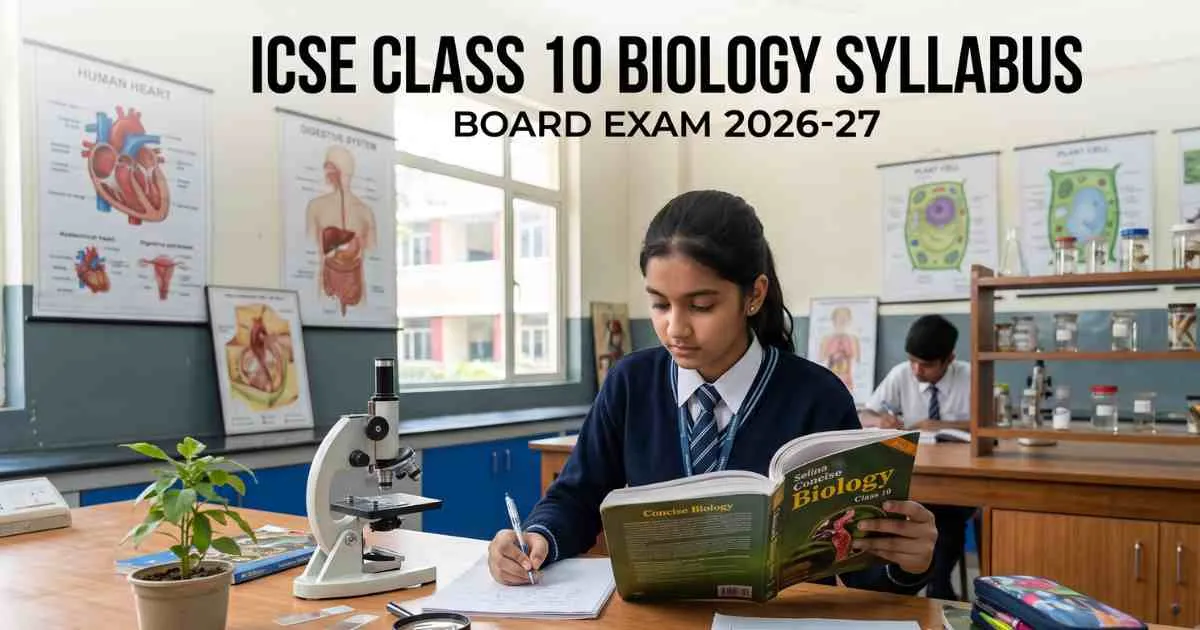
ICSE Class 10 Biology Syllabus: The Council for Indian School Certificate Examinations (CISCE) has released the ICSE Class 10 Biology Syllabus for the 2026-27 academic session for students appearing in the 2027 board examination. The syllabus covers important topics such as cell division, genetics, plant physiology, human anatomy and physiology, human evolution, population and pollution. It also includes practical work carrying 20 marks, while the theory paper carries 80 marks. Students can check the complete chapter wise syllabus, exam pattern and download the official Biology syllabus PDF below.
ICSE Class 10th Biology Syllabus 2026-27: Exam Pattern and Marking
The ICSE Class 10 Biology assessment for the 2027 board examination comprises a theory paper and an internal assessment of practical work. As per the official CISCE syllabus, the theory examination carries 80 marks and is conducted for two hours, while practical work accounts for the remaining 20 marks. Students can refer to the table below for the examination pattern and marks distribution.
| Exam Component | Maximum Marks | Duration |
| Theory Paper (Biology) | 80 | 2 Hours |
| Internal Assessment (Practical Work) | 20 | As per school schedule |
| Total | 100 | — |
Also Read:
ICSE Class 10 English Syllabus for Board Exam 2026-27, Download PDF Here
ICSE Class 10 History & Civics Syllabus for Board Exam 2026-27, Download PDF Here
ICSE Class 10 Syllabus 2026-27: Download Subject-Wise PDFs for CISCE Board Exam
ICSE Class 10th Biology Syllabus 2026-27
| Unit | Chapter | Important Topics |
| 1. Basic Biology | Cell Cycle and Cell Division | Cell cycle, including Interphase (G1, S and G2) and mitotic phase; stages of mitosis; basic understanding of meiosis as reduction division; homologous chromosomes; crossing over; significance and differences between mitosis and meiosis. |
| Structure of Chromosome | Basic structure of a chromosome; chromatin, chromatid, gene, DNA structure and centromere. | |
| Genetics | Mendel’s three laws of inheritance; monohybrid cross (phenotype and genotype); dihybrid cross (phenotype only); genes, alleles, heterozygous and homozygous conditions, dominant and recessive traits, mutation, variation, phenotype and genotype; sex determination in humans; X-linked inheritance of haemophilia and colour blindness. | |
| 2. Plant Physiology | Absorption by Roots | Imbibition, diffusion, osmosis, osmotic pressure, root pressure, turgidity, flaccidity, plasmolysis and deplasmolysis; absorption of water and minerals; active and passive transport; movement of water into xylem; ascent of sap; root hair structure; cohesive and adhesive forces; transpiration pull; experiments demonstrating water conduction through xylem. |
| Transpiration | Process and importance of transpiration; Ganong’s potometer and its limitations; factors affecting the rate of transpiration; stomatal transpiration and potassium ion exchange theory; adaptations that reduce transpiration; guttation and bleeding; experiments involving loss of water from plants and cobalt chloride paper. | |
| Photosynthesis | Process and significance of photosynthesis; chloroplast structure; light and dark reactions; photolysis of water; formation of ATP and NADPH; release of oxygen; formation of glucose; balanced chemical equation; stomatal movement; adaptations for photosynthesis; experiments to show the necessity of light, carbon dioxide and chlorophyll; starch testing, destarching and the carbon cycle. | |
| Chemical Coordination in Plants | Plant growth regulators—auxins, gibberellins, cytokinins, abscisic acid and ethylene; their effects on plant growth; tropic movements, including phototropism, geotropism, hydrotropism, thigmotropism and chemotropism. | |
| 3. Human Anatomy and Physiology | Circulatory System | Blood and lymph; composition and functions of red blood cells, white blood cells and platelets; tissue fluid and lymph; blood coagulation; structure and working of the heart; major blood vessels; systole and diastole; double circulation; pulse and blood pressure; arteries, veins and capillaries; spleen and tonsils; ABO blood groups, Rh factor and the hepatic portal system. |
| Excretory System | Excretory organs; parts and functions of the urinary system; external and internal structure of the kidney; associated blood vessels; nephron structure; ultrafiltration, selective reabsorption and tubular secretion; formation of urine. | |
| Nervous System and Sense Organs | Structure of a neuron; central, peripheral and autonomic nervous systems; brain and spinal cord; parts and functions of the brain; grey and white matter; voluntary and involuntary actions; reflex action and reflex arc; natural and acquired reflexes; eye and ear structure and functions; stereoscopic vision, accommodation and adaptation; eye defects and corrective measures; hearing and balance. | |
| Endocrine System | Endocrine and exocrine glands; location and shape of the adrenal, pancreas, thyroid and pituitary glands; hormones, including insulin, glucagon, thyroxin, cortical hormones, adrenaline, growth hormone, tropic hormones, ADH and oxytocin; effects of hypo- and hypersecretion; feedback mechanism with reference to TSH. | |
| Reproductive System | Male and female reproductive organs; male accessory glands; secondary sexual characteristics; structure and functions of sperm and egg; fertilisation, implantation, placenta, gestation and parturition; functions of the placenta and foetal membranes; amniotic fluid; menstrual cycle; roles of testosterone, oestrogen and progesterone; identical and fraternal twins. | |
| 4. Population | Population Explosion and Control | Population explosion in India and the world; reasons for population growth; demography, population density, birth rate, death rate and growth rate; effects such as unemployment, overexploitation of natural resources, low per capita income, rising prices, pollution and unequal distribution of wealth; surgical population-control methods, including tubectomy and vasectomy. |
| 5. Human Evolution | Evolution and Theories of Evolution | Introduction to human evolution; human ancestors—Australopithecus, Homo habilis, Homo erectus, Neanderthals, Cro-Magnon and modern humans; bipedalism, cranial capacity, canine teeth, forehead and brow ridges, chin development, body hair, height and posture; Lamarck’s theory of inheritance of acquired characteristics, including use and disuse of organs; Darwin’s theory of natural selection and survival of the fittest, with the peppered moth as an example. |
| 6. Pollution | Types and Sources of Pollution | Air pollution from vehicles, industries, burning garbage and brick kilns; water pollution from detergents, sewage, industrial waste and oil spills; thermal pollution; soil pollution from industrial, commercial and domestic waste and chemical fertilisers; biomedical waste; radiation pollution; noise pollution. |
| Biodegradable and Non-biodegradable Waste | Meaning and examples of biodegradable waste, such as paper and vegetable peels, and non-biodegradable waste, such as plastics, glass and Styrofoam; pesticides such as DDT. | |
| Effects and Control of Pollution | Effects on climate, the environment, human health and other organisms; greenhouse effect, global warming, acid rain and ozone layer depletion; control measures such as unleaded petrol/CNG, switching off engines at traffic signals, social forestry, sewage treatment plants, restrictions on polythene and plastics, organic farming and vehicular emission standards; a brief mention of Swachh Bharat Abhiyan. |
ICSE Class 10th Biology Syllabus 2026-27 PDF
ICSE Class 10th Biology Practical Syllabus 2026-27
The ICSE Class 10 Biology syllabus for 2026-27 includes practical work for internal assessment. Students should prepare the following experiments and identification exercises listed in the official CISCE syllabus.
| Practical Area | Experiments and Activities |
| Plant Life | Observation of permanent slides showing stages of mitosis. |
| Diffusion, osmosis and absorption | Diffusion using potassium permanganate in water; osmosis using the thistle funnel experiment and potato osmoscope; absorption using a small herbaceous plant. |
| Transpiration | Demonstration using a bell jar; unequal transpiration in a dorsiventral leaf using cobalt chloride paper; uptake of water and rate of transpiration using Ganong’s potometer. |
| Photosynthesis | Experiments showing the need for light, carbon dioxide and chlorophyll; demonstration of oxygen release using Hydrilla or Elodea. |
| Animal Life | Identification of the urinary system, heart, internal structure of the kidney and external structure of the brain using models and charts. |
| Blood and sense organs | Identification of blood cells under a microscope; identification of the internal structures of the eye and ear using models and charts. |
| Endocrine glands | Identification and location of the adrenal, pancreas, thyroid and pituitary glands using models or charts. |
ICSE Class 10 Biology Internal Assessment 2026–27: Grading Criteria
As per the ICSE Class 10 Biology syllabus for the 2027 examination, practical work is assessed on five criteria: preparation, procedure/testing, observation, inference/results and presentation.
| Grade | Marks | Preparation | Procedure / Testing | Observation | Inference / Results | Presentation |
| Grade I | 4 | Follows instructions with understanding, modifies them if needed and uses apparatus and materials safely. | Analyses the problem systematically, identifies variables and plans a logical investigation. | Records observations systematically without being given a format and recognises the accuracy of instruments. | Processes data independently, identifies sources of error and suggests modifications when needed. | Accurate and good presentation with appropriate techniques. |
| Grade II | 3 | Follows step-by-step instructions and understands safety while using apparatus and materials. | Specifies the sequence of operations, explains changes in procedure and controls one variable while dealing with another. | Makes relevant observations and records them without assistance using a suitable format. | Processes data appropriately and draws conclusions consistent with the results. | Adequate presentation using appropriate techniques. |
| Grade III | 2 | Follows instructions one step at a time and demonstrates safety awareness and familiarity with apparatus. | Develops a simple experimental strategy and uses trial and error to proceed. | Needs detailed instructions and a format to record observations. | Processes data with a detailed format and draws qualitative conclusions as required. | Reasonable presentation, though some parts may be disorganised or untidy. |
| Grade IV | 1 | Follows some instructions to perform a single practical operation but is casual about safety. | Struggles with the experiment but follows an obvious experimental strategy. | Requires a format to record observations and may make recording errors. | Makes errors in processing data even with a detailed format and reaches conclusions with help. | Poor and disorganised presentation, though the sequence is acceptable. |
| Grade V | 0 | Cannot follow instructions or perform practical work without full assistance and is unaware of safety requirements. | Cannot proceed with the experiment without repeated help. | Records are faulty or irrelevant even when a format is provided. | Cannot process results or draw conclusions, even with considerable help. | Unacceptable, disorganised and untidy presentation, with rough work missing. |
ICSE Class 10 Biology Internal Assessment: Marks Distribution
The ICSE Class 10 Biology internal assessment carries a total of 20 marks. The subject teacher (internal examiner) awards 10 marks, while the external examiner awards the remaining 10 marks. These marks contribute to the students overall Biology Score.
| Examiner | Marks |
| Subject Teacher (Internal Examiner) | 10 |
| External Examiner | 10 |
| Total | 20 |
Also Read:
ICSE Class 10 Computer Applications Syllabus for Board Exam 2026-27: Download Free PDF Here
ICSE Class 10 Performing Arts Syllabus 2026-27: Download Syllabus PDF Here

Faham is an education specialist and has over three years of experience in the education and edtech industry, specializing in digital and educational content creation. He holds an MBA in Marketing and Human Resources from Swami Vivekanand University. Throughout his career, Faham has developed expertise in creating engaging and informative content across diverse educational domains.
In addition to his edtech experience, he worked for two years as a Public Speaking and Creative Writing Expert, helping learners enhance their communication and writing skills. He has also been associated with Testbook and Adda Education as a Content Writer, where he created high-quality content for K–12 education, Management Entrance Examinations, UPSC, Law, and State Defence examinations. His strong understanding of educational content and exam preparation enables him to simplify complex topics and deliver valuable learning resources to students.


![[यहां देखें] GDS 1st Merit List 2026 LIVE: इंडिया पोस्ट जीडीएस पहली मेरिट लिस्ट आज, ये रहा Circle Wise Result PDF लिंक](https://img.jagranjosh.com/images/2026/October/9102026/India-post-merit-list.jpg)
.jpg)