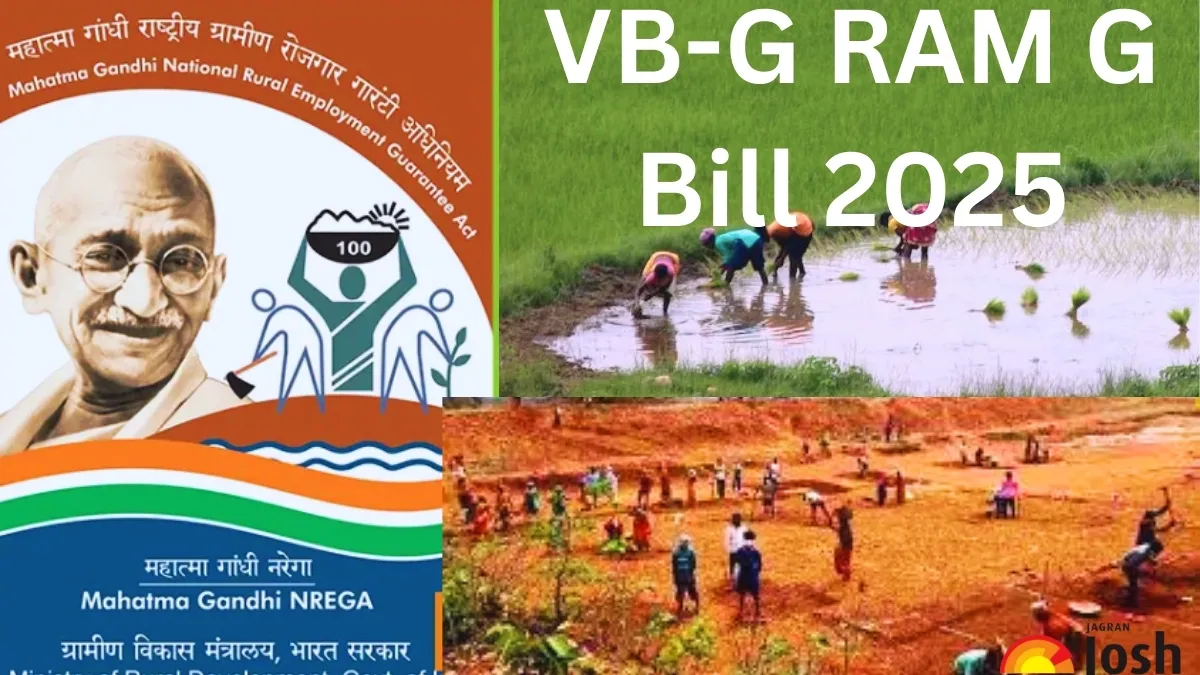
The central government introduced the Viksit Bharat - Guarantee for Rozgar and Ajeevika Mission (Gramin): VB G RAM G Bill, 2025 in Lok Sabha. It seeks to establish a rural development framework aligned with the national vision of Viksit Bharat @2047 by providing a statutory guarantee of 125 days of wage employment in every financial year to every rural household, which amends the 100-day wage employment guarantee provided by the MGNREG Act, 2005, and adult members who volunteer to undertake unskilled manual work and to promote empowerment, growth, convergence and saturation for a prosperous and resilient rural Bharat.
Key Highlights of the VB-G RAM G Bill, 2025:
-
The bill guarantees 125 days of wage employment to rural households and focuses on empowerment, growth, convergence and saturation.
-
‘Viksit Gram Panchayat Plans’ to be prepared by the Gram Panchayats on a saturation basis with convergence of schemes, using PM Gati Shakti
-
Integrated 'Viksit Bharat National Rural Infrastructure Stack' envisioned for rural public works
-
Special focus on water security works, core rural infrastructure, livelihood-related infrastructure, and special works to mitigate extreme weather events
-
Provisions to facilitate availability of farm labour during peak agricultural seasons
-
Robust transparency and accountability mechanisms, such as weekly public disclosure systems and strengthened social audits
-
A comprehensive governance ecosystem built on digital public infrastructure for efficient and high-integrity implementation.
What is the MGNREG Act, 2005, and what are its key provisions?
The Government of India passed the Mahatma Gandhi National Rural Employment Guarantee Act, 2005, in September, 2005. The mandate of the MGNREGA is to provide at least 100 days of guaranteed wage employment in a financial year to every rural household whose adult members volunteer to do unskilled manual work. The objective of the Act is to enhance the livelihood security of the people in the rural areas by generating wage employment through works that develop the infrastructure base of that area.
The core features of the MGNREGA are:
-
Providing not less than 100 days of unskilled manual work as guaranteed employment in a financial year to every household in rural areas.
-
Strengthening the livelihood resource base of the poor
-
Proactively ensuring social inclusion
-
Strengthening Panchayati Raj Institutions
-
Centrally Sponsored Scheme (the full cost of the wages covered by the central government)
-
The Ministry of Rural Development is the nodal implementing agency.
-
It provides an additional 50 days of employment in drought- or calamity-affected areas, fostering rural development through public works.
-
A minimum of one-third (⅓) of the beneficiaries under MGNREGA must be women.
-
Payments are made directly to workers' bank accounts or Aadhaar-linked accounts, and compensation for delayed payment is at a rate of 0.05% of unpaid per day.
-
Beneficiaries injured during work are eligible for compensation.
-
In forested areas, tribal households without private property other than land rights under the Forest Rights Act (FRA), 2006, are eligible for additional employment benefits.
-
State governments may extend workdays beyond the guaranteed period using state funds.
What are the changes proposed by the VB-G RAM G Bill?
125 days of wage employment:
The VB-G RAM G guaranteed 125 days of wage employment per rural household each financial year, up from MGNREGA, which was 100 days per financial year, to avoid the complexity of the days based on special circumstances. It makes 125 days the standard statutory entitlement.
Changes in Centre-State Funding Structure:
A major change introduced in the bill is a fund-sharing mechanism between the centre and state in the MGNREGA; the centre paid 100% of the cost of the unskilled worker. Every state government is required to prepare a scheme for giving effect to the guarantee proposed under this bill within 6 months of the commencement of the Act. It will operate as a Centrally Sponsored Scheme (CSS) like
- 90:10 (centre & state) for North-Eastern and Himalayan States/UT
- 60:40 (centre & state) for all other states and UTs with legislature
- 100% Centre funding for UTs without legislature
Normative Allocation:
The bill provides for normative allocation to states based on objective parameters. States will ensure transparent and need-based intrastate distribution of funds across districts and gram panchayats, based on local developmental needs, thereby strengthening equity, transparency and accountability.
Provisions to pause during peak agricultural seasons:
No work shall be undertaken during peak agricultural season; the state government must notify in advance a period aggregating to 60 days per financial sowing and harvesting season, and the notification may vary by districts, blocks, gram panchayats and agro-climatic zones according to local cropping patterns. All planning and implementing authorities are legally bound to ensure works occur only outside these periods.
Viksit Gram Panchayat Plans and National Infrastructure Stack:
The Bill provides for institutionalising convergence of all relevant schemes through a unified planning process anchored in Viksit Gram Panchayat Plans, aggregated into the Viksit Bharat National Rural Infrastructure Stack, which will be aligned with the national priorities. It will be integrated with the PM Gati Shakti National Master Plan to ensure spatial optimisation and interdepartmental convergence.
- The visit Gram Panchayat plans will be considered upward: Gram Panchayat-Block-District-State
- National Rural Infrastructure Stack will cover four thematic areas such as Water security, Core rural infrastructure, livelihood-related infrastructure and Extreme weather mitigation works.
Comprehensive governance ecosystem:
The Bill mandates a comprehensive governance ecosystem built on digital public infrastructure, including biometric authentication, spatial-technology-enabled planning and monitoring, mobile-based reporting with real-time dashboards, AI-enabled analytics and strengthened social audit mechanisms, ensuring transparent, efficient and high-integrity implementation.
Why are changes required in the existing MGNREG Act?
Over the past two decades, rural India has undergone transformative changes, marked by saturation-orientated delivery of major government schemes;
-
expanded rural connectivity, housing, drinking water, sanitation and electrification
-
deeper financial inclusion with improved digital access,
-
diversification of the rural workforce
-
rising aspirations for better incomes, productive infrastructure and greater climate resilience.
Comparison Between MGNREGA and VB-G RAM G Bill (2025)
| Feature | MGNREGA (2005) | New VB–G RAM G Bill (2025) |
| Guaranteed Work | 100 days per household. | 125 days per household |
| Funding (Wages) | 100% Central Government | 60:40 split (Centre:State) for most; 90:10 for Northeast/Hill states. |
| Wage Payouts | Within 15 days | Weekly basis (encouraged for faster liquidity). |
| Peak Season Work | Available year-round (often causes farm labour shortages) | 60-day pause during peak sowing/harvesting to help farmers |
| Planning Unit | Labour Budget (Demand-driven) | Viksit Gram Panchayat Plans (integrated with PM Gati-Shakti) |
| Budgeting Model | Open-ended (Unlimited based on demand) | Normative Allocation (budget-capped based on objective parameters) |
| Monitoring Tech | Basic geo-tagging / NMMS app. | AI-based fraud detection and GPS mobile-based monitoring |
| Asset Type | General (dams, roads, pits). | Thematic Infrastructure (water security, climate resilience, and markets) |
| Audit Frequency | Periodic Social Audits. | Mandatory twice-yearly social audits per panchayat |
As national development advances, rural development programmes require periodical revision to remain aligned with emerging needs and further aspirations. In the vastly changed circumstances of today, a transformational approach to rural development is essential to achieve the objectives of Viksit Bharat @2047.




-1765902792765.jpg)

Comments
All Comments (0)
Join the conversation