Bihar Board Class 12th Chemistry Model Paper 2025: Download Sample Paper PDF
Bihar Board Sample Paper 2025: The Bihar School Examination Board (BSEB) has released the 2024-25 model papers for Class 12 students. Get the Chemistry model paper PDF for free.
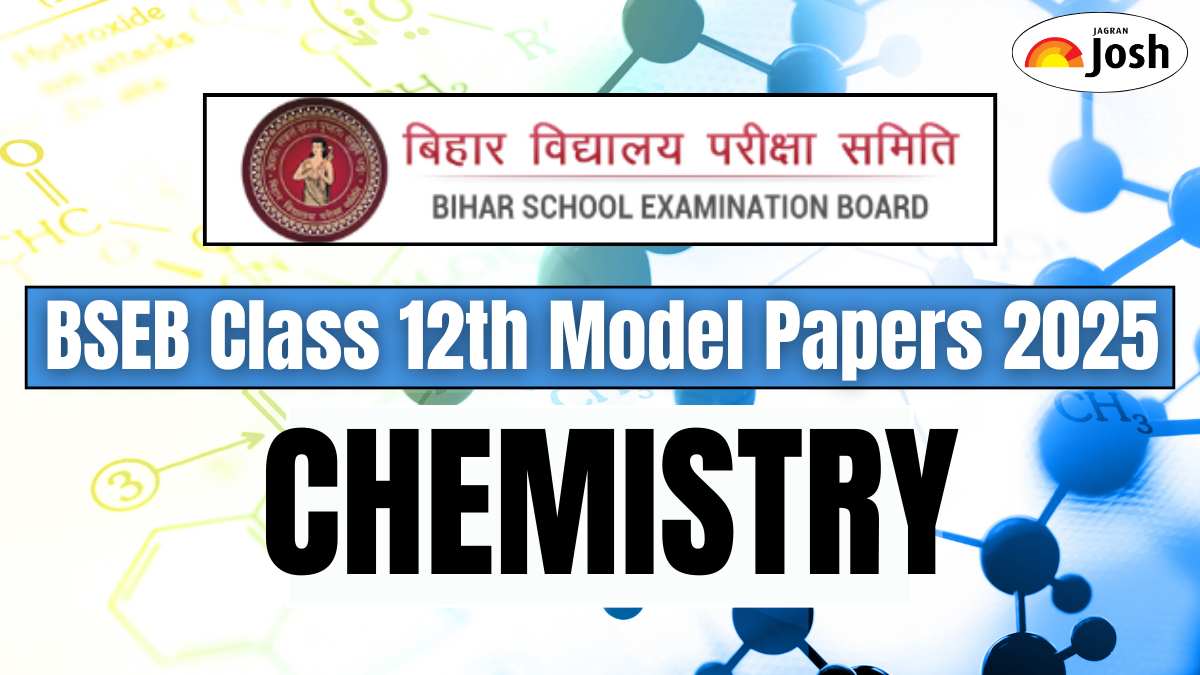
Bihar Board Model Papers 2025 PDF: The Bihar School Examination Board (BSEB) is a prominent state education board responsible for conducting the class 10 and class 12 exams. To assist students in preparing for their exams, the board has released model papers that reflect the latest exam pattern and format. These papers can be easily downloaded from this article. This article provides a model paper for Bihar Board Class 12 Chemistry. Additionally, it includes important exam dates to help you plan your studies effectively.
Check| BSEB Class 12 Chemistry Syllabus 2024-25
Bihar Board 12th Chemistry Model Papers 2024-25
Here is the Bihar Board Chemistry model paper. These model papers are provided for the inter students who will sit for board exams this year. Click on the link to see and download the Chemistry sample papers.
Section - A
1. The number of main crystal system is
(A) 4 (B) 7
(C) 14 (D) 8
2. The co-ordination number of an atom in body centred cubic geometry is
(A) 4 (B) 6
(C) 8 (D) 9
3. The number of Bravais lattices in a cubic crystal is
(A) 3 (B) 1
(C) 4 (D) 14
4. The number of tetrahedral voids in a face centred cubic unit cell having identical atom is
(A) 8 (B) 4
(C) 6 (D) 12
5. Which of the following has maximum depression in Freezing point?
(A) 𝐾2𝑆𝑂4 (B) 𝑁𝑎𝐶𝑙
(C) Urea (D) Glucose
6. Which of the following is an example of colligative properties of a solution?
(A) Density (B) Mass
(C) Elevation in boiling point (D) Temperature
7. If 18𝑔 of glucose (C6H12O6) is present in 1000𝑔 of a solvent, then the molality of solution is
(A) 1 (B) 2
(C) 0.1 (D) 0.5
8. One Faraday is equal to
(A) 9,650 coulomb (B) 10,000 coulomb
(C) 49,640 coulomb (D) 96,500 coulomb
9. The number of ions produced by 1 molecule of K4(Fe(CN)6) in aqueous solution is
(A) 2 (B) 5
(C) 11 (D) 10
10. If equivalent conductance of 0.1 N 𝐶𝐻3𝐶𝑂𝑂𝐻 at 25°𝑐 in 80 and at infinite dilution is 400 ohm-1 𝑐𝑚2 equivalent -1, then its degree of dissociation is
(A) 1 (B) 0.2
(C) 0.1 (D) 0.5
11. In order of standard reduction potentials of 𝐶𝑢, 𝑍𝑛, 𝐴𝑔 and 𝐹𝑒 is
(A) 𝐶𝑢, 𝐴𝑔, 𝐹𝑒, 𝑍𝑛 (B) 𝐴𝑔, 𝐶𝑢, 𝐹𝑒, 𝑍𝑛
(C) 𝐹𝑒, 𝐴𝑔, 𝐶𝑢, 𝑍𝑛 (D) 𝑍𝑛, 𝐶𝑢, 𝐴𝑔, 𝐹𝑒
12. Which of the following is a secondary cell?
(A) Leclanche cell (B) Lead storage battery
(C) Concentration cell (D) All of these
13. The standard reduction potential values of elements 𝐴, 𝐵 and 𝐶 are +0.68 𝑉, −2.50 𝑉 and 0.50 𝑉 respectively. The order of their reducing power is
(A) 𝐴 > 𝐵 > 𝐶 (B) 𝐴 > 𝐶 > 𝐵
(C) 𝐶 > 𝐵 > 𝐴 (D) 𝐵 > 𝐶 > 𝐴
14. The unit of rate of reaction and rate constant is same for the reaction of which order?
(A) Zero (B) First
(C) Second (D) Third
↓
↓
↓
To download this complete set of Chemistry questions with and get more diverse options, click on the link below:
Bihar Board 12th Chemistry Model Paper Download PDF
Bihar Board Class 12 Exam Dates 2025
The Bihar School Examination Board (BSEB) has announced the Class 12 Exam Dates for 2025. The exams are set to begin on February 1, 2025 and will end on February 15, 2025. Students can check the official schedule on the BSEB website or at Jagran Josh and start their preparations accordingly.
Bihar Board Class 12 Exam Preparation Tips
Here are some basic exam preparation tips to help you perform your best:
1. Create a Study Schedule : Break down your syllabus and create a realistic study schedule. Allocate more time for difficult subjects. Don't just focus on one subject; ensure all subjects are covered. Set daily and weekly goals for a sense of accomplishment.
2. Understand the Syllabus: Familiarize yourself with the syllabus and exam pattern. Prioritize chapters with higher weightage or that you find challenging.
3. Stay Organize Make Note: Write short notes or summaries for quick revision later. Keep all your textbooks, notes, and reference material in one place for easy access.
4. Practice Previous Years’ Papers: Practice with past exam papers to understand the pattern, time management, and types of questions. Take mock exams to test your readiness and boost your confidence.
5. Active Learning: eaching concepts to someone else helps reinforce your own understanding. For important formulas, definitions, or vocabulary, flashcards are a quick revision tool.
IMPORTANT TOPICS SUBJECT-WISE | ||
Physics | Chemistry | Mathematics |
Biology | ||

Anisha Mishra is journalist with over 3 years of experience in covering the Indian education sector. She has worked extensively in the K12 domain, with focus on the state board as well as central board examinations, policy structure of seconday and higher secondary education as well as the entrance examinations like JEE, NEET, CLAT, etc. Her extensive experience in the domain has helped her provide students with concise accurate information in all aspectes of school life and education. Her key interest lies in decoding the changes in the curriculum, NEP implementation and changing education ecosystem in the country. Besides working, she enjoys traveling, exploring new places and cultures, and painting.